Category Archives: soap

Aloe

IMG_2356

If you’re going to have any house plant, and you should, (check out the link below to learn why) you should at least have aloe.

http://www.mnn.com/health/healthy-spaces/photos/15-houseplants-for-improving-indoor-air-quality/a-breath-of-fresh-air

Aloe is easy to grow, while some articles that I have read say that it should be placed by a sunny window, I find that it does quite well in the corner of my dining room where it does not get direct sunlight. It does not require a lot of attention. I usually give it  drink of water every 10 – 14 days and this is quite sufficient. I have discovered that it also enjoys coffee, so every 3rd or 4th watering I dilute some of the coffee that is leftover from that morning and use it to water the aloe.  The plants really seem to brighten up after having their morning coffee. I do have to be careful, when using coffee to water the plants, not to get any on the aloe leaves because the coffee will damage the leaves. I only pour the coffee on the soil.

I think everyone should have at least one aloe plant in their home, not only are they helpful for the indoor environment, but they act as first aid in the case of burns. Whether it be a sunburn or accidently touching something hot, simply snip an aloe leaf, peel back the outer part and apply the sticky, oozing gel directly to the burn for quick relief. We do not deal with other skin conditions such as eczema or psoriasis but if we did I would certainly try aloe before seeking help from pharmaceuticals.

The most common way I use aloe nowadays is as an ingredient in my soap. My aloe soap is probably my favorite of all the different soaps I make. I don’t know that any of the healing properties of aloe remain after it is processed into soap, but it has a luxurious lather and just feels so good on the skin.

I do have aloe soap available for sale. Anyone interested in purchasing some should contact me by email @ ruth20012001@yahoo.com and put soap in the subject line.
Soap Of The Week – Pumpkin

Lately it seems that I have traded (Don’t Eat It!) soap making for (I can’t wait to eat it!) sap/syrup cooking, so I didn’t make this, or any soap in the past week, but the Pumpkin Spice Soap that I made back in December is ready.

This is not a new recipe. In fact I think adding pumpkin to soap was one of my first experiments in soap making, probably 7 or 8 years ago. “You’re out of control! 🙂 ” was my husband’s response the first time I made this. He has laughingly repeated this phrase several times since – coconut soap, coffee soap, peanut butter soap. Nowadays, however, he is more likely to instigate a new recipe, than he is to be shocked but my creations.

I have made changes to the recipe over the years, but I am very pleased with the ingredients that I am now using.  The fats/oils that I use are olive oil, coconut oil and tallow. This combination makes a hard bar that lathers nicely and rinses off well.

The other ingredients I add to this soap are pumpkin (our home grown), cinnamon, nutmeg, and sugar. While pumpkin, cinnamon and nutmeg are all said to be beneficial in skincare, I really can’t say whether they retain their beneficial properties though the soap making process. They do however add color and a light, spicy fragrance to the soap. When sugar is added to a soap recipe it is said to intensify the lather.

When each batch of soap has been cured for at least six weeks my husband and I test the soap before anyone else gets to use it. Our test is simple – grab a bar and hop in the shower. “It’s a nice soap,” my husband said after showering with this batch of pumpkin spice. After my critical evaluation I think the word that best describes this soap is fun. In case you’re thinking, “this woman needs to get a life,” please remember that soap making is a big part of my life. I say “fun” because I enjoyed the light cinnamon/nutmeg scent of this soap, and the nutmeg which has a bit of a coarse texture felt like small sand particles embedded in the soap –  adding a bit of scrubbing power, but mostly it was fun to see the large bubbles magically appear as the soap was rubbed across wet skin. It does develop into a rich lather that feels really nice. This is a soap I am pleased to sell.

If you are interested in purchasing this or any “Don’t Eat It!” soap or skin care products found in my store email me at ruth20012001@yahoo.com and put soap in the subject line.


The Week’s Soap- Hops

My original plan for this week was to make the soap I call “Hint of Mint” which is made with mint leaves infused into the water as the liquid, and mint leaves imbedded in the bars as well. This all changed when I announced to my husband “I’m going to make soap tomorrow”. As I mentioned this to him he was in the midst of moving a hops vine that had been hanging and drying in our backroom for several months. “You could make hops soap” he said.

I began pulling the dried flowers or seed cones off the vine, I crushed some up on a plate, I smelled them and I said “why not?”. I decided to infuse the hops into the liquid that I would use to make the soap, so I heated some water and put the crushed hops flowers in it. I let them infuse overnight.

I then went to the internet to do a little research. I really didn’t know anything about hops except that they are used to make beer.  I found many articles such as this one, http://www.stylecraze.com/articles/surprising-benefits-of-hops-for-skin-hair-and-health/#gref that tell of the potential health benefits of hops. I found that hops are being used therapeutically in the forms of tea, tinctures and essential oils. They are also added to skin and hair care products. I felt good about this experiment.

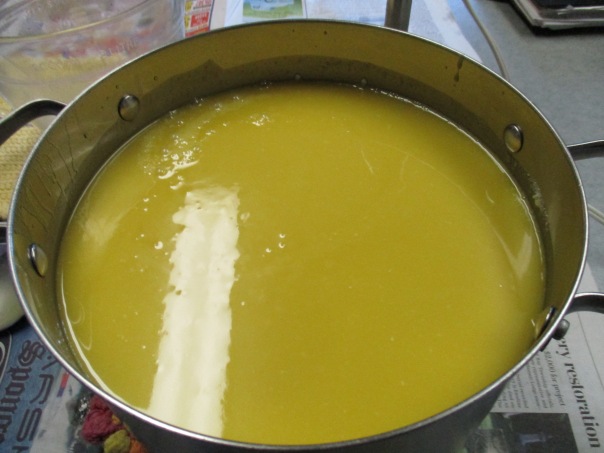
Before making the soap the next morning I strained the hops flowers from the liquid and set them aside in case I decided to put some in the soap. The hops infused water was bright yellow and smelled like hops. While I was pretty certain the scent would fade away, I thought this liquid would give the soap a yellowish color.

I occasionally have people tell me that they are allergic to specific ingredients in soap, and I like to be able to offer alternatives, so for this soap I decided to leave out the olive oil. I decided to use coconut oil, sunflower oil and tallow. With that in mind I went to this soap calculator, one of my favorite online tools http://soapcalc.net/calc/SoapCalcWP.asp  to formulate my recipe. To use the soap calculator I enter the amount of each oil or fat that I want to use and the calculator will tell me the correct amount of liquid and lye that I need to use. It will also give me an idea of how my soap will turn out, using a numeric scale to rate the degrees of hardness, cleansing, conditioning, bubbliness, and creaminess the soap will have. I adjust the amounts of each oil/fat until I am satisfied that the soap will have sufficient amounts of each of these properties. I really do love this soap calculator; it has allowed me to successfully formulate all of my own soap recipes. It is a free online tool and I would recommend it for anyone who wants to create their own soap recipes.

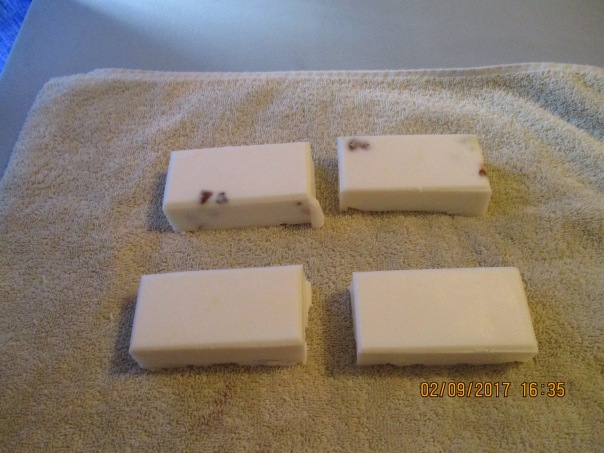
It was no surprise that when I added the lye to the liquid the smell of hops was no longer present. I was, however, surprised when I added the lye liquid to the oils that the yellow color also disappeared. The soap turned white. I decided to add some of the hops petals to one tray (half the batch). I didn’t want to over do it, a lesson I learned from making soap with clover blossoms in it (too many blossoms make a big mess in the shower). I thought maybe I could just have some on the top layer of each bar. Since the soap gets poured into the bottom of the mold I put a layer of petals down before putting in the soap. Even though I tried carefully spooning the soap onto the petals they still floated up into the soap. Oh well you can’t win ’em all.

After two days in the mold the soap came out easily.

img_2234
Hops Soap

These are a hard bars of soap evidenced by the way the edges cracked when I cut them into bars. In about six weeks we will test this soap and discover what else we like or don’t like about it. I keep you posted.


Soap Of The Week

In a recent post I mentioned that I was planning on making one batch of soap per week. After receiving a call from a customer last week I knew what kind of soap I would be making this week.

The phone call started with the customer asking me how many bars of soap I make when I make a batch. I explained that each tray holds 16 bars and I usually make two trays at a time. She said, “next time you make my soap I want a whole tray.” She explained that her “other half”, as she calls him, ran out of his commercially made soap, so she had him try her soap. He liked it. “I’ve been trying to get him to use homemade soap,” she said, but he would only use a specific brand.

The soap I make for her is one of the simplest soaps I make. She called me last summer and told me her soap maker was no longer going to be making soap for her. She explained that she had horrible reactions when using commercial and homemade soaps and her previous soap maker had made a special recipe for her. She wasn’t sure what ingredient she was reacting to, nor was she sure what the ingredients her previous soap maker was using. She only knew it contained lard. Could I make her a soap, she asked. Since I do like experimenting, and I do like problem solving, this would be fun.

I had her describe the soap she was currently using. When she said it was very soft and “snot like” when wet, and it did not lather, I decided it was not necessarily a recipe I needed or wanted to duplicate. Since I know the two most common oils used in both commercial and handcrafted soap are coconut oil and palm oil, I figured she was probably reacting to one of these. I do not use palm oil in my soaps, so I asked her to try one of mine. After several days of use she said she did break out in a rash.

Even though it is a soap making rule of thumb to combine three or more oils or fats to make a nice bar of soap, it’s a rule that I have been breaking since early on in my soap making practice. I have made, and continue to make, very nice soaps using recipes with one, two or three oils/fats. I suspected it was coconut oil that my customer was reacting to, but decided to play it safe by using just the one oil/fat that I knew she could use. I made a soap with just one fat and three total ingredients – lard, water and lye – a recipe I had not made before.

The soap was ready six weeks later and after my husband and I each tried it, I delivered it to my customer. My personal impression was – a hard bar of soap, some creamy lather, felt good on the skin (no snot), and rinsed off nicely. Custom made, yet simple, this soap has now become “her soap” or maybe I should say “their soap”. This is the recipe I made this week, and although I haven’t named it yet I will be adding it to my store when this batch is ready (about 6 weeks).


Spinning, Crocheting, Soap and Strawberry Wine

Just a quick update – I am attempting to use the spinning wheel for short periods nearly every day, but I can’t say that it has “clicked” yet. I can’t seem to get the bobbin to take up the twisted fibers, though yesterday it did for a very, very, brief period. I’ve read this is a common problem for new spinners. I know my fiber is getting over twisted. I have watched many videos and they all make it look pretty easy. They advise to treadle slower and tighten the tension, but they don’t show repeated trial and errors until they get it right. While a video like that might be reassuring to the new, struggling spinner (me) I don’t suppose I (or anyone) would want to sit through it. So I’ll just keep trying, and like I said before I let you know when it “clicks”.

I have continued to do a lot of crocheting, and knowing that I can create things out of yarn keeps me motivated to learn to make (spin) yarn.

img_2207

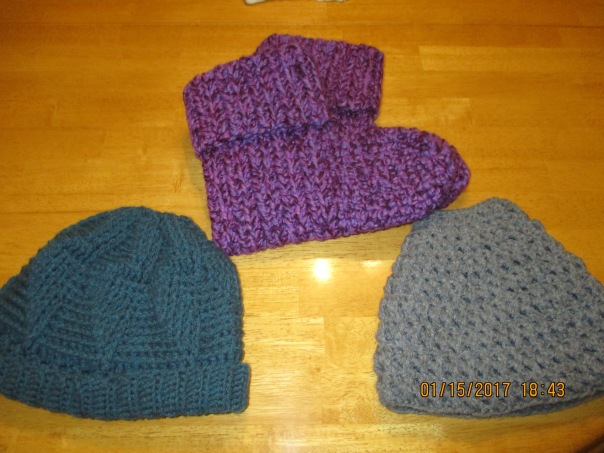
I didn’t make the purple slippers for any particular reason, but an extra pair of slippers is always a good thing on hand. It’s a pretty simple pattern that I don’t even have to read anymore. So I can whip these up pretty quickly. I found a free pattern on-line for the hat on the left. When it was finished, and I tried it on, I discovered it was a little small for me. Upon hearing this my husband tried it on. He really liked it and adopted it for his own. I’m currently making another one using the same pattern but with a larger hook. While talking to my sister recently she told me that “ponytail” or “messy bun” hats were becoming very popular. After looking at some patterns I decided to make one. Rather than print out a pattern, I decided to use a stitch that I like and see if I could make one up. The results are the grey hat on the right. It fits me pretty good. Yes – this will definitely work when wearing my hair in a ponytail.

I’ve also been catching up on making soap. One of the nice things about making soap is that this can be done during the time of year when other activities (specifically outdoor activities) can’t be done. After the holidays my supplies were getting low, so my plan is to make one batch per week until I get caught up. I currently have Pumpkin Spice (ready in 3 weeks), Aloe (ready in about 4 weeks) and Coconut Soap (ready in about 5 weeks) curing.

IMG_0377
Coconut Soap Ready to Pour in the Mold


Since we still have a lot of strawberries in the freezer from this years crop I decided that I could use 3 quarts to experiment with making a batch of wine. I first read some recipes online. Since I didn’t follow any of them precisely I won’t source them, and since I don’t yet know how my wine will turn out I’m not going to give you my recipe either. I defrosted the strawberries then mashed them. I added sugar, then boiling water. After this had cooled I added my yeast. I stirred it daily and I could smell and taste that it was becoming alcohol. Yesterday, after about a week in the crock, I strained the mash and put the wine in a bottle with an airlock for the process to continue.  It will probably be a few weeks before that is complete. After that it should probably age for several months, but if we really like it that probably won’t happen.