Since this is my 100th post I wanted to do something special. I thought about doing a raffle or product give away – giving away a soap and balm gift package to a randomly selected person who commented on the post. After a little research I found out that it’s not quite as easy as it sounds. Apparently each state has its own rules regarding that type of thing as does the federal government. Other countries have different laws as well. In order to legally do a product giveaway I would have to hire an attorney.
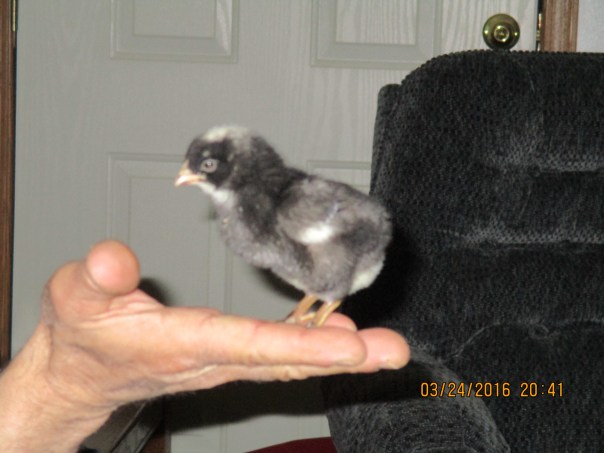
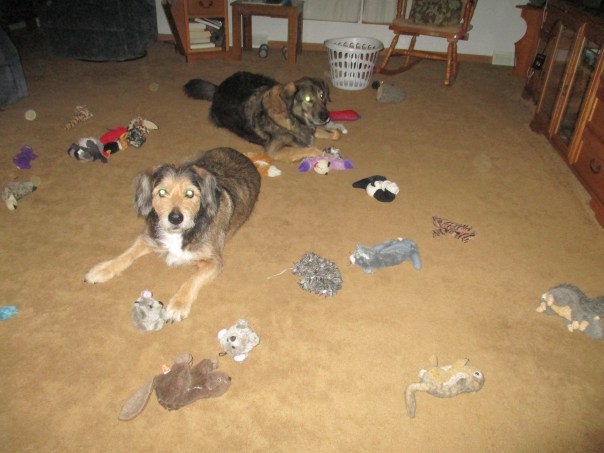
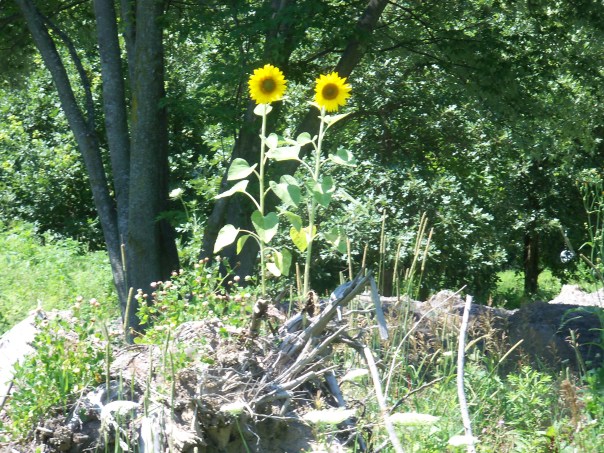
Sorry folks. That’s not gonna happen. Instead I decided to share some random pictures and hope that they make you smile 🙂
Barred Rock Pullet
Curious CreaturesPlay Time for The Boys
Even though I can’t offer a product give away, I do promise that if you contact me about purchasing any of my products https://donteatitsoap.com/store/ , I will always give you a fair price.
This was not what I planned on writing about for part II (that post will now become part three) but since it is taking a while to write that post I thought I would quickly tell you what we did Tuesday.
A few weeks ago I decided to order 4 Basswood trees also known as American Linden trees. http://forestry.ohiodnr.gov/basswood I have been shopping local garden centers for these trees for the past two summers but have yet to find them. We were not really sure about ordering bare root trees through the mail, because we haven’t had very good results doing this in the past. I was able to find a nursery in Michigan that had them for sale, http://www.coldstreamfarm.net/american-basswood-tilia-americana.html but a 6 hour round trip to purchase a few trees did not seem very practical. Since I really wanted Basswood, ordering them seemed our best option.
I love things that serve multiple purposes and Basswood trees seemed a good choice for several reasons. Basswoods are sometimes called bee trees as the blossoms are said to attract bees and butterflies. The nectar is said to make a high quality honey. The flowers of the Basswood (American Linden) can be used to make a tea which is used for medicinal purposes. I have also read that their leaves are edible. Basswood grow into great shade trees and their fruit is eaten by wildlife.
Tuesday morning the trees arrived via UPS. The weather was favorable for planting trees so we packed up and headed for the farm.
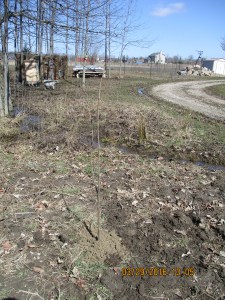
The trees looked very healthy and had good root systems.
This one is somewhat camouflaged in the photo.
After each tree was planted we put a fence around it to protect it from deer. Before next winter we will also need to protect the trunks from being eaten by mice or rabbits.
I am looking forward to seeing these trees leaf-out over the next few weeks. Planting trees does not offer the quick gratification that you may get from planting annuals or perennials, and I am not certain how old these trees have to be before they flower and bear fruit, but we intend to be around and keeping bees for many years, so we look forward to seeing that as well.
If you are thinking about planting trees and providing food for the bees, fruit trees are another good option. I would recommend doing a little research before you select a tree, because some fruit trees need a second variety, as a pollinator, in order to produce fruit. Then you and the bees can both benefit from the tree(s).
Recently someone sent me an email which contained this picture. Her comment was, “I thought this was interesting”. Since she thought it was interesting I thought other readers might think so as well.
This is the time of year when people start itching to get outside and beautify their yards, so it’s the perfect time to write about it. While I think the photo (above) is good, I’d like to offer some other thoughts, ideas and links for reference.
It you have access to pretty much any media source you have probably heard in recent years about the honey bees being in danger. There have been countless stories of mysterious bee die-offs and colony collapse disorder. When we tell people that we are bee keepers, we often get comments about the bees disappearing and people seem to have varying degrees of knowledge on the topic. Disturbing as it is, I won’t go into my thoughts on the many causes of this, but instead focus on what individuals can do to, as the above photo says, “Help Save The Bees”. I have found this website to be a good resource https://savebees.org/ if you want to know more about the topic.
I think it is important to note that it is not only the honey bees that are in danger. The honey bee is the one we most often think of and are probably most concerned with because we humans have become managers of the honey bee. We put them in homes (hives), where we want them, and feed or medicate them when we feel it is necessary. We then utilize their services for pollenating our crops and we rob them of their products (honey, wax, pollen, propolis) for our consumption. Other bee types, each with their own attributes, are disappearing as well. Even though we don’t get honey or other products from them these other bees, wasps, and hornets they still play important roles in nature, doing things like pollinating plants and helping control insect populations by feeding on insects and caterpillars.
I do think that rather than sit on our hands and wait years for the government to come up with a plan and then spend millions of dollars on it, that most of us have the power to do some little things that can make a difference.
In addition to the message in the above picture, I’ll offer the following suggestions:
#1. Do Nothing – I’m not trying to confuse you when I say that the first action that should be considered, and is quite appropriate in many situations, is to do nothing. What I mean is let nature take its course. We often see bees, hornets and wasps as dangerous and feel the need to exterminate them from our space, so when we find a nest we are quick to seek ways to get rid of it. Sometimes, they do indeed, build nests in buildings, or equipment, or other places where they just can’t stay, so it is necessary to get rid of them. Other times it may be possible to allow them to stay.
Last year, for example, we discovered a bald faced hornets nest in the tree in front of our house. The nest was about 12 feet up and hung over the street. It was also near my parking place in the driveway. My first thought was that it was dangerous for whoever cut the grass, it was also potentially dangerous for people riding bikes or walking under that tree, I wondered if they would become disturbed by my entering and exiting my vehicle, and heaven forbid some kids should decide to play ball in the street and hit that nest. My husband and I talked about it and decided that if these hornets became aggressive we would then remove the nest. These hornets visited our deck daily but I only saw one or two at a time. They would fly around but never attempted to sting. I did observe them eating other insects. They never seemed disturbed by the grass being cut or our being in the area of their nest. We were able to peacefully coexist and I feel good about our decision to let them stay. If at all possible give bees, wasps and hornets their (or a piece of your) space.
#2 Do Nothing – Another way to do nothing, or let nature take its course, is to let wild flowers grow and blossom, thus providing food for the bees. Unfortunately we have come to think of many of the blossoms that the bees feed on as unsightly weeds. In our area bees forage on the dandelions and clover in our lawns and in addition they forage on things like golden rod, asters, thistle blossoms and many other (weeds) that grow in fields and along ditches. So instead of cutting , pulling or using herbicides to eradicate these weeds, we can decide to “do nothing”. Enjoy seeing the dandelions blossom in your yard or the thistle and golden rod take over a field or the side of the ditch and know they are a beautiful source of food for the bees.
I also want to share my thoughts about planting for the bees but have decided to do the in a separate post, so stay tuned for Part II.
We have decided to postpone my Friday evening presentation at Essential Health in Memphis. I will post an update when this presentation is rescheduled.
We have been using a lot of maple syrup lately. It’s delicious on our French toast or waffles that we have been having for breakfast several times a week, but have you shopped for maple syrup lately? I’m talking about real maple syrup not, the corn syrup that is flavored up to taste like maple syrup. It’s expensive. So much so that we have recently opted for the fake stuff in effort to keep our grocery bill down. Real maple syrup has truly become a delicacy. A quick check at the Walmart website showed me prices ranging from 54 cents up to 94 cents per ounce. 54 cents might not seem like much but you don’t buy just one ounce. 12 ounces at 54 cents is $6.48, a quart which is 32 ounces at 54 cents would be $17.28, and a gallon which equals 128 ounces at 54 cents per ounce comes to $69.12. Keep in mind those are the low end prices; at 94 cents an ounce a gallon would cost over $120.
So considering this, and that fact that we have had the equipment needed for tapping the trees and collecting the sap, stored in our shed for the past few years, tapping some maple trees was a no-brainer.
We have been watching the weather forecast for about the last two weeks, since sap flow is dependent on the weather. Basically sap flows from trees that are still dormant when temperatures rise above freezing during the day but fall back below freezing at night. For a thorough explanation click here http://maple.dnr.cornell.edu/produc/sapflow.htm Since todays temperature was forecasted to be in the high 40’s or low 50’s and daytime temperatures for the next week to be mostly above freezing, it seemed like a good day to get the trees tapped.
After breakfast, we started out by tapping some sugar maples.
Tapping A Sugar Maple
We used manual drill, and when I did the tapping of one of the trees I was surprised at how easy it was to drill the hole. A few things to note about drilling are that it should be done at a slight upward angle and drilled no more than 2 inches into the tree. I’m not sure if you can see in the picture that the drill bit had a piece of tape on it to mark the 2 inch mark. Recommended height is a height that is comfortable, so reaching up or bending down is not necessary. Also the ideal spot is one that has not been previously tapped and has no visible scars.
Spile In Place
After drilling the hole the spile is tapped into the hole. Again I was somewhat surprised at how easy it was. It only took a few gentle taps with a light hammer and the spile was securely in place.
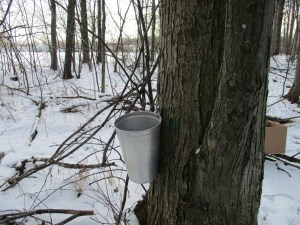
Sap Bucket Hanging From Spile
The next step was to hang the sap bucket. The bucket has a small hole in it, and the spile has a hook below the spout that is designed to hold the bucket. When the bucket is hung from the hook the spout then reaches over the top edge of the bucket. When the sap flows from the tree it runs down the spout and into the bucket.
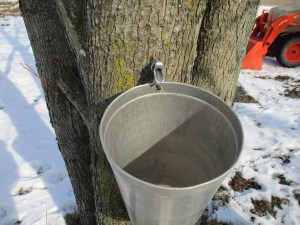
Sap Bucket With Lid
The final step in the tapping process is to install the lid. Fortunately we had figured out how to assemble these a few days prior to doing the tapping, as it was a bit of a puzzle. The back edge of the lid is folded over but cut out in the center. There is a very thin metal rod that gets inserted through the first half of the fold. It then goes through two holes that were drilled into the top of the spile, then lastly through the second half of the fold on the lid. At this point the lid is secured to the spile, and it only rests on the lip of the bucket. The lid sits on an angle and has quite a bit of overhang, so it does serve to keep rain, potential snowfall, and anything else falling from above, out of the bucket. It does not sit tight on the bucket, so there is still a chance that things such as bugs or anything coming at it from the proper angle might get in. Those things can be filtered out later. This design allows for the bucket to be removed from the spile, for empting, without having the lid in the way. A very clever design.
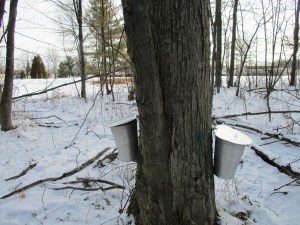
Some Trees Can Have More Than One Tap
http://maple.dnr.cornell.edu/FAQ.htm gives this information to determine how many taps a tree can support. “How many taps should you have on a maple tree? A healthy tree 10-17 inches in diameter (31-53 inch circumference) should have no more than one tap. A tree 18-24 inches in diameter (57-75 inch circumference) should have no more than two taps. A tree larger than 25 inches in diameter (79-inch circumference) should have no more than three taps.”
Tapping A Sugar Maple
We put half of our 18 buckets on sugar maples, but we also wanted to tap our silver maples at the farm. While silver maples indeed produce sap, it is said that they are not idea because the sugar content is lower than that of the sugar maple, thus requiring more sap to make the syrup. They also bud out earlier, therefore they have a shorter sap flow season.
Silver Maple
The first thing we noticed when tapping the silver maples was that the sap began to flow immediately when the tree was drilled. Because it is clear it doesn’t show up in this picture, but there is sap coming out.
Tapped Silver Maple
Unlike sugar maples that have a single large trunk growing straight up, the silver maple tends to have many trunks growing from near ground level. They grow outward on an angle. Because of this the buckets do not hang very straight. They will need to be emptied more often to prevent the sap from spilling over the side.
Upon seeing the sap run from the tree my husband tasted it. This was no surprise to me since he has a long history of tasting sap. As a kid he worked for a neighborhood maple syrup operation, and ever since I’ve know him, whenever he sees sap coming out of cut wood, even if it’s burning in the fire place, he dips his finger in the sap and tastes it. When he tasted the sap from the silver maple he responded with “it’s sweet, it has good sugar content.” I then tasted then sap and learned that my palate is not as refined as his. To me it tasted like water with just the slightest hint of sweetness. This makes sense to me because the sugar content of the sap from and sugar maple is reported only to be between 2 and 3% and the sugar content of the silver maple sap is between 1.5 and 1.75%.
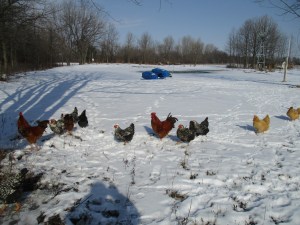
Curious Creatures
As with most things we do at the farm the chickens had to investigate. (and who doesn’t love a good chicken picture)
Tapping the trees is only the beginning, and I might add the easy part, of making syrup. With that statement I must correct the comments made on my earlier post. https://donteatitsoap.com/2016/02/17/can-you-guess-what-we-are-doing/ Erin’s comment was, “Dad says gathering maple syrup” and I replied “Dad is correct”. What I should have said is that dad has the gist of what we are doing, but technically (and I’m sure Dad knows this) you don’t simply gather maple syrup from a tree. The sap buckets will be checked at least twice a day, and the sap that is collected in the buckets will only become syrup after a long boiling process. It will take 40-50 gallons of sap to boil down into one gallon of syrup. So as we continue to collect sap and make syrup I will post updates on our progress. I hope you will check back to see how it goes.











 Don't Eat It! Soap and Skin Care