Category Archives: garlic

Time Flies

It is said that as you get older time seems to go faster. It is also said that time flies when you’re having fun. I’m not sure which it is, and I suspect it is a combination of the two, but time sure does seem to be going quickly. Here it is well into June already and it  seems I have missed a lot of the things I should have written about. I thought I’d make this a catch up post.

Planting and weeding were two of our priorities in the last week of May and first week of June. My husband and I worked mostly together to do a thorough weeding of the entire garlic field. We spread it out over 5 or 6 days working 2 to 4 hours each day and it looked really good when it was finished. We are now just pulling big weeds as needed in the garlic. I have also spent time pulling weeds in the Prayer Garden, and devoted almost a full day to weeding the strawberry patch and asparagus. We have pretty much waged war on weeds and for now we seem to be winning the battle.

My husband has also spent a lot of time getting the garden planted. He started with the fifty tomato plants that he has grown from heirloom seed, as well as some green peppers, cabbage, and cucumbers.  We had our annual date to the local green house. The green house is one of the few places I enjoy shopping and usually I spend way too much money buying plants. This year there were only a few thing that we needed because my husband had started much of what we needed from seed. He picked out a couple of egg plants and some leeks and I bought a couple of rosemary plants but they were all out of culinary sage that I wanted. I did get a couple of Russian sage plants. Although they are not edible they should look nice in the prayer garden and the blossoms are said to attract butterflies. Maybe the bees will like them as well.

IMG_2695

We had another swarm of bees. We watched the entire event. Above is the beginning when the group was starting to leave the hive.

IMG_2692

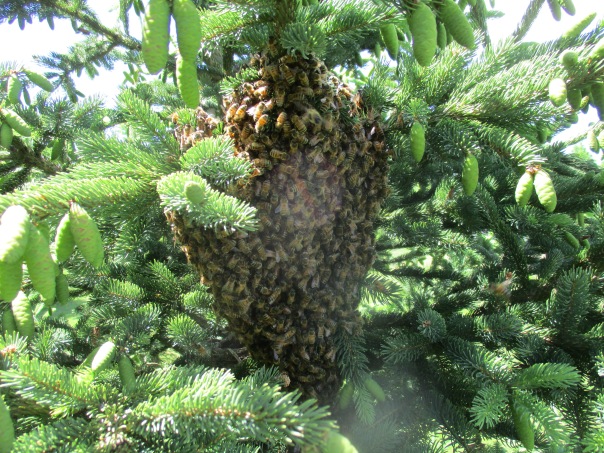
It’s hard to make out in the above photo but all the little yellow spots against the green areas and all of the black spots against the blue sky are bees. They settled in a picturesque location nearby.
IMG_2700

The flexibility of the  pine branches made it easy for my husband to slip a bucket up over the swarm. He then shook the branch while holding the bucket around the swarm. Nearly all of the bees fell into the bucket. He covered it with a lid and carried it to the empty hive.

IMG_2704

He dumped the bees into the hive and put the inner cover on. He placed a piece of wood over the hole in the top of the inner cover to keep the bees inside. He went back to the pine tree and repeated the process to collect the bees that were left behind.

We watched the hive and saw bees gathering at the small slot in the side of the inner cover. This was a good indication that the queen was inside and the workers were going in to be with the queen.

It’s now about a week later and this hive along with our other 5 are all doing well.

IMG_2687

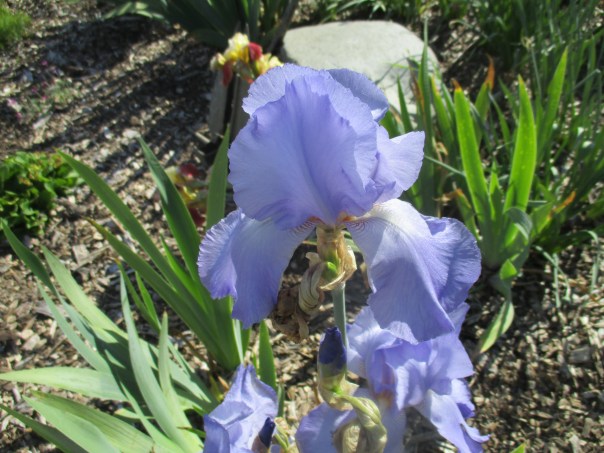
The Irises are in full bloom in the Prayer Garden. When I was planting rosemary and sage the other day a lovely fragrance caught my attention. Since the Irises were the nearest blossoms I walked to them and took a sniff. Wow! Spicy-sweet. I then took a long deep breathe to fill myself with this wonderful scent. These have only been in place for a couple of years and have really just taken off this year. I always thought that Irises were planted for their showy flowers, and that is why I planted them. I never realized that they were aromatic as well.
IMG_2723

I guess this just goes to show that we should take time to stop and smell the Irises. I’ll consider this a lesson learned.

Harvesting and watering are now our primary activities. Our asparagus crop was significantly affected by the wet weather this year and we harvested less than 50% of what we had last year. The strawberries are ripening and I have picked about 7 quarts so far. I am freezing them for now and will make jam with many of them when I have more time. I have also picked and dried oregano, spearmint and chocolate mint.

We are now having to water daily as we have gone from overly wet weather to overly dry. I think our last good rain was before Memorial Day, and the lack of rain plus the summerlike temperatures, equals very thirsty plants. This post explains our watering system on the farm. Since the farm is off grid watering takes a little more time and effort than just turning on a faucet. https://donteatitsoap.com/2016/06/05/our-off-grid-irrigation-system/?iframe=true&theme_preview=true

While there are many other things going on here, there is much work to be done and precious little time to write about it, so until next time 🙂


A Year In Growing Garlic (Part VII)

IMG_2617

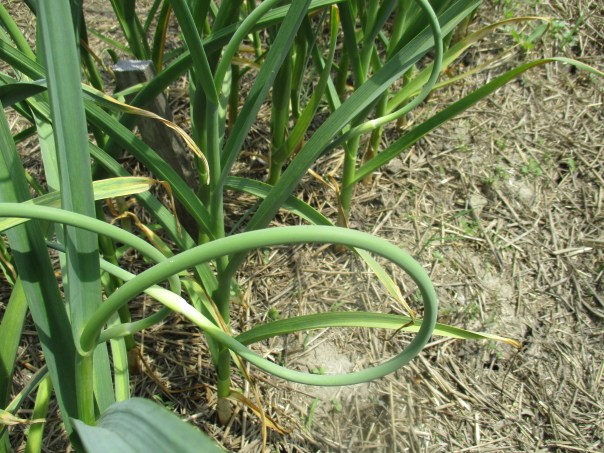
If you planted garlic last fall, as we did, by now you should be seeing vigorous green top growth. How vigorous can depend on many things. Variety of garlic you planted, clove size that was planted and soil conditions are all major factors. If You are not seeing vigorous green growth you will probably need to add some nitrogen fertilizer to give it a boost. It is recommended that nitrogen only be given up until the time that the bulbs start forming. This article explains that bulbs start forming around the time the ground temperature reaches around 60 degrees. http://greyduckgarlic.com/Southern_Garlic_Grower_Guide.html  Another article I read said that bulbs start forming around Memorial day. That article I’m assuming was referring to growing garlic in a cooler, northern climate like ours.

This time of year it is also important to make sure that garlic is getting enough water. This year our problem has been too much water, since we have had “April showers” in January, February, March, April and the first part of May. Although our garlic has shown signs of being stressed with some yellowing of the leaves, due to too much water, we are optimistic that we will have a decent crop.

It is recommended that garlic receive 1 inch of water a week during dry periods up until about two weeks before harvest. At this time we have no intention of watering the garlic anytime soon.

Keeping garlic weeded is the other chore that needs to be done from now until harvest. “Weed early, weed often” seems to be a garlic growers mantra as I seen it written in more then one article that I’ve read about growing garlic. Last week my husband and I spent several hours on two separate days weeding the garlic. Weeding garlic is something that needs to be done by hand, especially if it is planted with several rows close together, like our is.  At this point the weeds were still small and with the ground being wet the weeds came out easily. I believe this is the reason for the “weed early” advice. As bulb formation begins making sure the garlic weed free is even more important, as garlic that is crowded by weeds or roots of weeds will produce smaller bulbs. I do expect that we will be on our hands and knees weeding the garlic a couple more times before harvest. 🙂


A Year In Growing Garlic (Part V)

If you are new to reading my blog you may have missed these earlier posts, so check them out and catch up on our year in growing garlic.

https://donteatitsoap.com/2016/09/30/a-year-in-growing-garlic-part-i/

https://donteatitsoap.com/2016/10/13/a-year-in-growing-garlic-part-ii/

https://donteatitsoap.com/2016/10/18/a-year-in-growing-garlic-part-iii/

https://donteatitsoap.com/2017/01/28/a-year-in-growing-garlic-part-iv/

In my Part IV post that I wrote in January I expressed our great concerns about how well the garlic would grow in the wet conditions that we were having this past winter. The wet conditions continued pretty much throughout the winter, with only short freezing periods, and now into the spring. At this point we have learned that garlic is much more resilient that we believed it to be.

IMG_2407

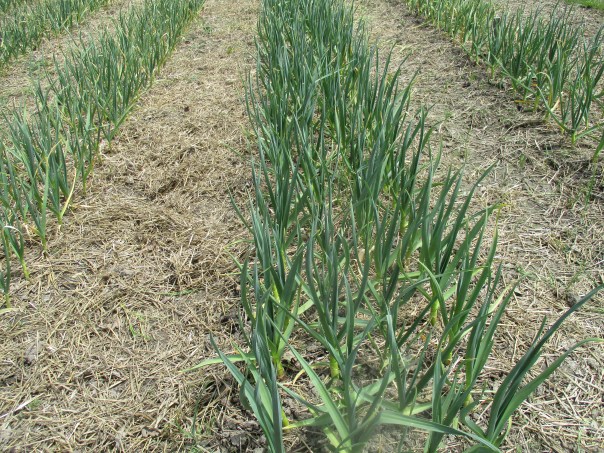
The garlic is coming up beautifully and we are so thankful. Since it has all grown up through the straw, we will leave the straw in place to help with weed control. If the garlic had not grown through the straw we would be raking the straw away in hopes of revealing the garlic spouts.

As the ground dries and temperatures warm I expect to see vigorous green growth on the garlic. We will keep them weeded and watered as necessary and probably side dress it with nitrogen fertilizer in the spring to encourage the green growth. It is recommended that fertilizer not be given after May because at this point the bulb will be developing.


For Garlic Lovers

I am a bit afraid that things are getting somewhat confusing on my blog since I’ve recently written about soap and sap, but I still feel the need to add this post about a soup that I made recently. To be clear this is definitely a recipe to eat but I would not recommend bathing with it 🙂 .

The soup which I might call cream of potato with mushroom and garlic was loosely based on this recipe  http://allrecipes.com/recipe/13131/cream-of-garlic-soup/ . I’m really not sure how much you have to change a recipe before it can become your own, but I am fairly sure that the original recipe would be good as well. I didn’t precisely measure most of the ingredients so I’ll just share with you the changes that I made to this recipe.

I started with three medium size bulbs of garlic, I peeled each clove and minced it in the garlic press, this was at least 3/4 of a cup maybe more. I heated the olive oil in a pan and then added the minced garlic to the hot olive oil and turned off the heat. I had also peeled, cubed and boiled three good size potatoes. Instead of white wine (in the original recipe) I increased the amount of chicken broth to about 3 1/2 cups. I added the garlic/olive oil to the chicken broth. I drained and mashed the potatoes. I then began using a mixer to beat the potatoes and slowly adding the broth. If you decide to use the mixer like I did, instead of a blender that is recommended in the original recipe, it is important to add the broth slowly because at some point the mixture might become so thin that it begins to splatter. Take it from me, you really don’t want to find yourself washing it off the counter, walls,  your shirt and anywhere else it happens to land. When the mixture did get too thin to use the mixer I found that I was able to stir in the rest of the broth. I put this mixture on the stove over medium heat, stirred in about 3 cups of half and half and added about one teaspoon of salt.

While that was cooking I washed, sliced and sautéed about 12 ounces of fresh mushrooms. I then added them to the soup. I let this cook over low heat for about an hour, stirring every now and then to make sure it was not scorching.

As my title says this soup is for garlic lovers. It does have a very strong garlic flavor. Yumm!  I am not sure that I would like it as much without the mushrooms and it might even be better with cheese melted on top.

As garlic farmers we are interested in all things garlic, so I invite you to share how you like to use garlic. Do you use it medicinally? Do you have a favorite recipe? Please feel free to comment on this page.


A Year In Growing Garlic (Part III)

On Thursday as we continued to prepare for planting we made a couple of “executive” (meaning my husband and I agreed) decisions. The first one is that we will not plant Spanish Roja garlic this year. We decided this because this variety does not store well and thus does not meet the standards that we have set. It seems to start going bad within three months of harvest even when properly stored, while the other varieties will remain fresh for 5 or more months when properly stored.  The second decision we made is that the chickens would stay inside the chicken yard while we were planting.


While the chickens have a large penned area, most days we leave the gate open and they are free to roam our farm. We know all too well that when our chickens spot freshly tilled soil or straw piles it is a free-for-all, they scratch and peck and then nestle their whole bodies into the soil or straw without a care for what they may be destroying. So for the next few days, until we are done planting, and mulching with straw, and the straw hopefully gets rained on and matted down so it is less appealing to the chickens, we will keep the chickens in their pen, and save ourselves a lot of grief.

WARNING: If a garlic farmer ever asks you if you want to “get down and dirty”, participate in “grounding or earthing” https://draxe.com/earthing/ ,  or “play in the dirt”, they may be trying to recruit you to plant garlic :).

img_1945

Friday October 14th was, as I like to say when we are about to start a big project, “Game On”.

The job started with my husband tilling up the garlic bed in the morning. The soil was very loose, with no big clumps like we have dealt with in past years and very few rocks. What a blessing this was.

img_1946

He also set out the stakes and twine, that we would use to mark the rows, as well as our lattice planting grids.

img_1948 In past years we have used one 8×2 foot piece of lattice to make our four rows. We plant in the rows that had four spaces across this gives us 64 cloves in the ground and then we pick up the lattice and place it in the next (8×2 foot) space in the row. This year we purchased 2 more 8×2 foot pieces of lattice. We placed them end to end in the row and were able to plant 192 cloves before getting up to move the lattice. We found that each row would accommodate eight, 8 foot, lengths of lattice, so our 64 feet long rows contain 512 garlic plants.

img_1951

We each started out with a bucket full of garlic cloves, our planting stick which we use to make the hole that the clove is planted in, and a foam kneeling pad. Although the foam kneeling pads were comfortable, we abandoned them early on as the  soil was soft enough that the kneeling pads were not necessary. I suspect they also would have negated any positive effects we attained from grounding.

img_1969

Using our planting sticks we poke a hole about 4 inches deep in the soil and then place a clove in the hole. The clove must be planted root side down/ pointy side up and this is the reason we are on our hand and knees in the dirt planting each clove with TLC. My husband eventually realized that the soil was loose enough, this year, that he could simply push the clove deep enough into the soil without using the stick to make a hole first.

img_1960

After each of the lattice sections were planted, while my husband moved them to the next section in the row, I cover each planted clove with soil. Since the soil was loose and not clumpy this was done by simple running the back of a garden rake over the area.

It took us an average of 45 minutes to plant one 64 foot row or 512 cloves of garlic. On Friday we planted Red Toch and S&H Silver and ended with 3 full rows and partial row planted. On Saturday we planted Music and Chesnok Red and at this point we have 7 1/2 rows or 3840 cloves planted. With the 20 lbs. of Chesnok Red that are arrived today, and will hopefully be planted tomorrow, we should end up with somewhere in the area of 5000 garlic planted this year.


img_1977

Once the planting was done on Saturday we mulched all of the rows with a thick layer of straw.  It took one bale of straw per row. Over the winter the mulch will insulate the ground and protect the cloves from extreme temperatures. The rain we got on Sunday weighed down the straw so it will not blow away. My husband also ran several rows of twine around the whole area close to the ground. This will keep the dogs out of the area and hopefully the chickens as well.

My husband and I agree that garlic planting this year has seemed easier than in any of the previous years. Continually amending the soil and some tweaks to our process are really paying off.