I’m planning on being at the Memphis Farmers Market tomorrow morning from 9 a.m.-1 p.m. I will be selling soaps and balms. Stop by and see me if you are in the area. 🙂
Category Archives: Uncategorized
Beware
This title should really be “Bee Where?” We were anticipating a delivery of packaged bees on Friday. We had placed the order back in January – three packages of bees to be delivered the first week of May. My husband received a call from the apiary during the first week of May telling him that the bees would be delayed a week because of weather. The bees were to be shipped on May 11.
I received an email from the USPS on May 11 stating that the bees had been shipped from Tennessee. They were sent second day priority mail. They had left that post office at 4:30 pm on May 11, and our expected delivery date was May 13th.
Friday, May 13th came and even though he hadn’t received a phone call, my husband stopped by the post office in the morning since he was already in town. The bees had not arrived yet but they were expecting another truck around 11:00 A.M. When we hadn’t heard from them by about noon, he called the post office and was told that the bees were not on that truck. The online tracking had not been updated since the bees left the Tennessee post office at 4:30 P.M. on Wednesday. Frustrated, we resigned ourselves to the fact that even though the weather was not forecast to be favorable for it, we would be hiving bees on Saturday.
Saturday morning when we got up, I checked the USPS website and the tracking had still not been updated. My husband kept his phone nearby awaiting the frantic phone call from the post office eager to get those things out of there. By 9:30 when the call did not come he called them again. Still no bees, but they again were expecting a truck in an hour or so. Again around noon he made the call to the post office. No bees, was their answer, and was he sure they were shipped. According to their website, which still had not been updated, they were.
At this point we were not only frustrated, but also left with a lot of questions. Where are the bees? Will they ever arrive? Will they be alive and healthy when/if they do arrive? What happens if they are not?
Sunday, May 15, 2016 I checked the USPS tracking site and received this message “The package is delayed and will not be delivered by the expected delivery date. An updated delivery date will be provided when available. Your item departed our USPS facility in GRAND RAPIDS, MI 49588 on May 15, 2016 at 3:17 am. The item is currently in transit to the destination” Checking the website several times later on Sunday gave me the same results.
This morning, Monday, May 16 the USPS tracking finally reported that the bees were at our local post office. My husband also received a phone call telling him that the bees were there. He went to the post office and upon his return one look at his face told me that things were not good. I felt like crying when I saw that all of the bees were dead.


The feeder cans still had plenty of sugar water in them so we know the bees did not starve to death. Without knowing where the bees were for the past five days leaves us only guessing that, since we have had overnight temperatures in the 30’s, the bees perhaps froze to death.
It’s hard to define the emotions we felt today- sadness about the death of so many bees, disappointment that we will not be starting the new hives as planned and anger that perhaps feels like hopelessness because we don’t know who to be angry with. We can’t blame the entire USPS and I sure we will never have an explanation as to why this happened, but somewhere along the way their system failed. We trusted them to deliver our bees in just two days. It ended up taking more than twice that long and it cost the bees their lives.
I am certainly not writing this to bash the USPS, if fact I have always been satisfied with their service, and the two previous times the we received bees through the mail we did receive them alive, healthy, and in just two days.

It’s been a pretty quiet and somber day around here today, and we are now waiting for a return call from our supplier to see if they will ship more bees or our money will be refunded.
I am glad I did not publish at this point, because it turns out there is more to the story. Even though it was difficult to get motivated to do anything else, because of this whole ordeal, my husband decided to go to the farm and get some tractor work done play on the tractor for a while. Shortly before I expected him home my phone rang. When I answered, my husband informed me that we had just received a gift from God. One of our hives had swarmed, and the swarm had landed in a spot where he could capture it.
I grabbed some honey, that we had saved for feeding the new bees, and my camera, and headed to the farm. He filled the feeder so he could place it on top of the hive as soon as he got the bees inside, and I snapped a couple of photos.


My husband captured the swarm by brushing them, with his gloved hands, off the branch and into a five gallon bucket. He then dumped the bucket into a hive that we had ready for the new bees. He made a second trip up the ladder to get more bees that had gathered on the branch.
So our day ended on a positive note, with a message from God saying, “Hey, don’t worry. I got this.” I believe the moral of this story is, that people will fail you, but God will not.
Vaccines-Informative Workshop
Vaccines are a very controversial subject nowadays and education about the topic is the best way for people to make informed decisions. This educational workshop on the topic is being held in Clarkston, Michigan. I have been invited to be a vendor at this workshop and will have Don’t Eat It! natural soaps and skin care products available for purchase.

Since I was unfamiliar with the presenter I did a google search and found her website which I have linked at the bottom of this page. Clicking on the tabs at the top of her page leads to many health related articles.
Chickens, Chickens and More Chickens
I thought I would do a quick chicken update since when I talk to family or friends I often get asked how the chickens are doing.

The Barred Rock chicks, otherwise known as “The Six Pack”, made the move to the farm last week.
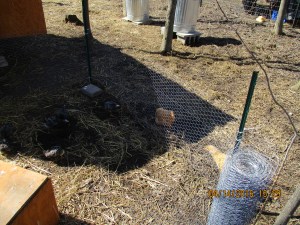
They started off in a small penned in area. They loved being on the ground where they could scratch and peck. Some of the older chicks were curious.
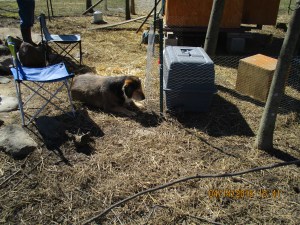
Scout loved being able to watch them. They were only in the penned in area for the first two days. On day three they ran out of the coop in the morning before we could round them up and get them in the pen. They are now free to forage the farm as they please, but they do stick pretty close to the coop.

Meanwhile the young Buff Orpingtons, A.K.A. “The Gang of Eight”, are doing well. They tend to stick together.

They are getting bigger.
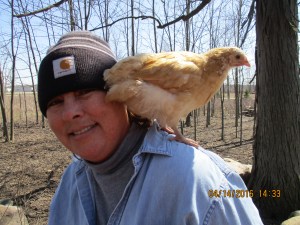
And they are very friendly. While sitting in a lawn chair near the coop we often end up with one or two or three of them sitting on our lap or perched on our shoulder. They are a lot of fun.
Sadly we lost one of our old Buffs to a hawk a couple weeks ago. She was from the first batch of chicks we bought. We had her since 2013. Her name was Super Chick. She got her name when she was young because she would stand in front of the gate when it was closed and fly up to the top. The way she flew up reminded me of Superman. She continued to live up to her name as she got older. When we would leave the gate closed to keep the chickens penned in we would always arrive back at the farm to find Super Chick out of the pen. She usually didn’t stick with the flock, but wandered on her own a lot. When our younger rooster, Autumn, grew up he took a liking to her and he seemed to follow her everywhere. Autumn seems lost without her.
Loosing an occasional chicken to a predator is one of the risks involved in allowing chickens to free range. However, the rewards of having happy, healthy chickens, reduced feed costs and fabulous eggs, have far outweighed the occasional loss of a hen.
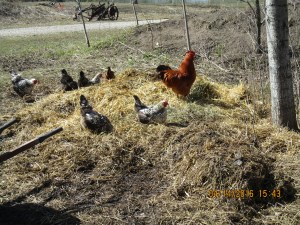
The rest of the flock are enjoying spring time. The photo above is Autumn with a group of our Silver Laced Wyandotte’s.

There is lots of scratching and pecking to do this time of year.

This is Honey. She too is from our first batch of chicks. Honey won a special place in our hearts early on, as she would jump up on my husbands lap, peck at us if she wanted our attention, or squat down in front of us if she wanted to be picked up. Honey is also one of our two hens that have brooded chicks.
Our chickens are allowed to free range during the daylight hours and spend their nights roosting in the coop. As the daylight hours increase so does the amount of time the chickens spend outside. In the dead of winter the coop is opened up around 8 A.M. and closed around 5 P.M., but today they were ready to exit the coop by 7 A.M. and we probably won’t be able to close up the coop until 8:30 P.M. or so. The chickens naturally return to the coop at night, but some of the young ones are still requiring a little coaching.
This time of year we too are ready to retire to our “coop” when darkness falls, but as the weather warms I am certain we will spend many evening sitting around a campfire long after the chickens have gone to bed.
To Save The Bees (Part III) Provide Food

Since we decided to become beekeepers I have read many recommendations about what to plant for the bees including the above picture. I feel very strongly that it is important for the health of the bees that they have a variety of foods (plants) to forage. Although it is not our only consideration when deciding what to plant, planting for the bees is something that we have been doing since we bought the farm and decided to become beekeepers.
Other things we take into consideration are:
1. Is the plant annual or perennial? Except for food and herbs we usually don’t plant annuals.
2. To know if a perennial will survive it is important to know the hardiness zone that you live in. Some plants that are perennial will not survive the colder temperatures of our winter and some will not even grow long enough to blossom.
3. It is also good to know the growing conditions that the plant requires – type of soil, wet or dry, and sun or shade are all important considerations when deciding where to plant something.
4. I love things that have multiple purposes. So I consider other uses for the plant – are they edible, medicinal, a good cover crop that will nourish the soil, or simply planted for their beauty ?
5. I also have to consider what critters will eat these plants before either the we or the bees can benefit from them. I have found some plants that the deer and rabbits simply don’t bother with, yet there are many others that have to be fenced in order to protect them.
6. When planting for the bees, another thing to consider is the bloom time of the plant. It is good to have plants that blossom at different times of the year. Early spring is probably the time when the bees are most in need. As they emerge from their hives in the spring, their winter food stores are running low if not depleted, they need to be able to find food in order to survive.
What we have planted:
Lavender was a plant of choice before we ever knew we were going to become bee keepers. I originally planted lavender at the house because I loved the plant, loved the fragrance, loved the dried flowers that could be made into sachets, sleep pillows, tea, or infused into oil. I also add them to my chamomile/lavender soap. It was on the plants at the house that I first observed honey bees foraging and realized what a good bee plant it was. When we bought the farm, planting lavender was a no-brainer and it is now a large part of our prayer garden. Another thing that I appreciate about lavender is that deer and rabbits leave it alone.

Thyme is also grown in our prayer garden. It is a low creeping plant that makes a nice ground cover. It has both culinary and medicinal uses. http://www.delallo.com/articles/thyme Last spring, when the thyme was flowering, I noticed that the honey bees were all over it. I was happy to see this because thyme essential oil is recommended as a natural treatment for varroa mites. While I haven’t seen it written anywhere, my theory is that by feeding on thyme, perhaps, the bees can extract the thymol that is reported to be effective for controlling the varroa mites, thus not requiring human intervention. Thyme is another plant that is not bothered by deer or rabbits. This year I will divide the roots and spread thyme throughout the prayer garden.
Sage and Salvia are of the same family. This link provides a growing guide for the different types. http://www.bhg.com/gardening/flowers/perennials/guide-to-salvias/ When planting sage/salvia it is important to note the hardiness zone for the variety you are planting. I have grown several varieties of sage. They grow well during the summer, and I have been able to harvest their leaves, but since they are not hardy in our (zone 5) growing area they have never blossomed and have not survived our winters. Since they do not flower they are not useful to the bees. On the other hand I do have a salvia plant (I’m not sure what variety it is) that has beautiful purple spiked flowers in the spring and summer. I have had it for three years and the honey bees love it. Salvia and sage seem to be plants that the deer and rabbits leave alone.
Basil – I have grown basil for many years. I use it fresh during the summer and dry it to have on hand year round. I pick the leaves off before it begins to flower and continue to pick them until I want it to flower and go to seed. Late last summer, when I let the basil plants flower, I noticed the honey bees were heavily foraging them.
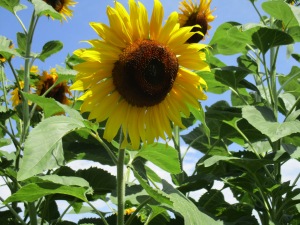
Sunflower is one of the annuals that we grow. I can not speak for all varieties of sunflowers but our bees visit the Grey Stripe Mammoth variety often.

After planting sunflowers once, don’t be surprised if they come up voluntarily in surprising places as these did. They always made me smile 🙂
Coneflowers – Also know as Echinacea, is a plant I grow for its medicinal purposes, that the bees also like. http://www.gardenexperiments.com/echinacea-species-flowering-plants-for-bees-butterflies-and-birds/
Asters grow wild in our field. They blossom in the late summer and fall and last year we witnessed the bees feeding heavily on them.
Clover is the one thing that we plant most often, that is great bee food. We sometimes use clover as a cover crop to nourish the soil for future crops, but most often we use it combined with grass seed when we landscape areas. Call me crazy, and you might if you’ve been paying a lawn care company to keep your lawn weed free, but I feel that white clover compliments the grass. It grows at a similar rate, it fixes nitrogen that helps the grass grow, and it is soft to walk on. I also like that if I mow the white clover when it is blossoming, it will blossom again.
Buckwheat – Another plant that we have used as a cover crop that the bees seem to enjoy. Buckwheat makes a dark honey with a strong flavor. It also makes a good cover crop as it grows fast and is said to choke out competing weeds.
Last summer my husband and I were in the garden center department of one of the local home improvement stores. I was looking for more of the salvia plant that I have, but was unable to find any. We noticed honey bees visiting several different flowering plants. You should probably know that for me going to a garden center and not buying plants is almost like going to the Dairy Queen and not buying ice cream. I absolutely hate shopping and the only exception is going to a green house or garden center. I could spend way too many hours and way too much money in these places. That being said we ended up buying some of the plants that we saw honey bees visiting.
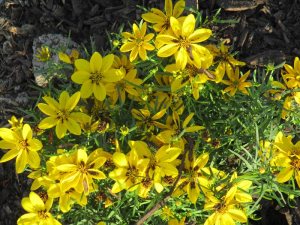
They included a Coreopsis also known as Tickseed.
A Mallow
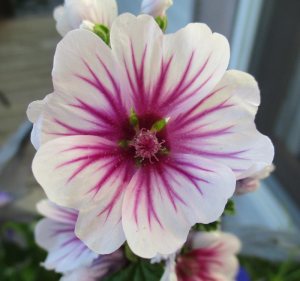
and a Balloon Flower that I don’t have a picture of. After planting these in our prayer garden I didn’t notice any bees on them. I suspect that there were so many other things blossoming in the area that the bees did not pay any attention to these flowers. Thus, the lesson I take from this is that my focus should be 0n sticking to what we already have. I will add more lavender, (I started some by seed) I will divide the thyme and let it spread, and perhaps I will divide my salvia in order to have more plants. I will cherish the clover, the asters and the golden rod that grow wild in our field, and I will not curse the thistle (much).
 Don't Eat It! Soap and Skin Care