Category Archives: Bees

To Save The Bees (Part III) Provide Food

untitled

Since we decided to become beekeepers I have read many recommendations about what to plant for the bees including the above picture. I feel very strongly that it is important for the health of the bees that they have a variety of foods (plants) to forage. Although it is not our only consideration when deciding what to plant, planting for the bees is something that we have been doing since we bought the farm and decided to become beekeepers.

Other things we take into consideration are:

1. Is the plant annual or perennial? Except for food and herbs we usually don’t plant annuals.

2. To know if a perennial  will survive it is important to know the hardiness zone that you live in.  Some plants that are perennial will not survive the colder temperatures of our winter and some will not even grow long enough to blossom.

3. It is also good to know the growing conditions that the plant requires – type of soil, wet or dry, and sun or shade are all important considerations when deciding where to plant something.

4. I love things that have multiple purposes. So I consider other uses for the plant – are they edible, medicinal, a good cover crop that will nourish the soil, or simply planted for their beauty ?

5. I also have to consider what critters will eat these plants before either the we or the bees can benefit from them. I have found some plants that the deer and rabbits simply don’t bother with, yet there are many others that have to be fenced in order to protect them.

6. When planting for the bees, another thing to consider is the bloom time of the plant. It is good to have plants that blossom at different times of the year. Early spring is probably the time when the bees are most in need. As they emerge from their hives in the spring, their winter food stores are running low if not depleted, they need to be able to find food in order to survive.

What we have planted:

Lavender  was a plant of choice before we ever knew we were going to become bee keepers. I originally planted lavender at the house  because I loved the plant, loved the fragrance, loved the dried flowers that could be made into sachets, sleep pillows, tea, or infused into oil. I also add them to my chamomile/lavender soap. It was on the plants at the house that I first observed honey bees foraging and realized what a good bee plant it was. When we bought the farm, planting lavender was a no-brainer and it is now a large part of our prayer garden. Another thing that I appreciate about lavender is that deer and rabbits leave it alone.

IMG_0084
Our Prayer Garden

Thyme is also grown in our prayer garden. It is a low creeping plant that makes a nice ground cover. It has both culinary and medicinal uses. http://www.delallo.com/articles/thyme  Last spring, when the thyme was flowering, I noticed that the honey bees were all over it. I was happy to see this because thyme essential oil is recommended as a natural treatment for varroa mites. While I haven’t seen it written anywhere, my theory is that by feeding on thyme, perhaps, the bees can extract the thymol that is reported to be effective for controlling the varroa mites, thus not requiring human intervention.  Thyme is another plant that is not bothered by deer or rabbits. This year I will divide the roots and spread thyme throughout the  prayer garden.

Sage and Salvia are of the same family. This link provides a growing guide for the different types. http://www.bhg.com/gardening/flowers/perennials/guide-to-salvias/    When planting sage/salvia it is important to note the hardiness zone for the variety you are planting. I have grown several varieties of sage. They grow well during the summer, and I have been able to harvest their leaves, but since they are not hardy in our (zone 5) growing area they have never blossomed and have not survived our winters. Since they do not flower they are not useful to the bees. On the other hand I do have a salvia plant (I’m not sure what variety it is) that has beautiful purple spiked flowers in the spring and summer. I have had it for three years and the honey bees love it. Salvia and sage seem to be plants that the deer and rabbits leave alone.

Basil – I have grown basil for many years. I use it fresh during the summer and dry it to have on hand year round. I pick the leaves off before it begins to flower and continue to pick them  until I want it to flower and go to seed. Late last summer, when I let the basil plants flower, I noticed the honey bees were heavily foraging them.
IMG_0161

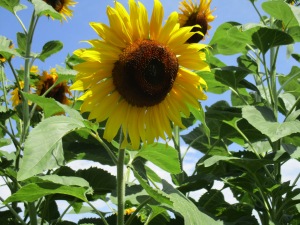
Sunflower  is one of the annuals that we grow. I can not speak for all varieties of sunflowers but our bees visit the Grey Stripe Mammoth variety often.

102_0895

After planting sunflowers once, don’t be surprised if they come up voluntarily in surprising places as these did. They always made me smile 🙂

Coneflowers – Also know as Echinacea, is a plant I grow for its medicinal purposes, that the bees also like. http://www.gardenexperiments.com/echinacea-species-flowering-plants-for-bees-butterflies-and-birds/

Asters grow wild in our field. They blossom in the late summer and fall and last year we witnessed the bees feeding heavily on them.

Clover is the one thing that we plant most often, that is great bee food. We sometimes use clover as a cover crop to nourish the soil for future crops, but most often we use it combined with grass seed when we landscape areas.  Call me crazy, and you might if you’ve been paying a lawn care company to keep your lawn weed free, but I feel that white clover compliments the grass. It grows at a similar rate, it fixes nitrogen that helps the grass grow, and it is soft to walk on. I also like that if I mow the white clover when it is blossoming, it will blossom again.

Buckwheat – Another plant that we have used as a cover crop that the bees seem to enjoy. Buckwheat makes a dark honey with a strong flavor. It also makes a good cover crop as it grows fast and is said to choke out competing weeds.

Last summer my husband and I were in the garden center department of one of the local home improvement stores. I was looking for more of the salvia plant that I have, but was unable to find any. We noticed honey bees visiting several different flowering plants. You should probably know that for me going to a garden center and not buying plants is almost like going to the Dairy Queen and not buying ice cream. I absolutely hate shopping and the only exception is going to a green house or garden center. I could spend way too many hours and way too much money in these places. That being said we ended up buying some of the plants that we saw honey bees visiting.

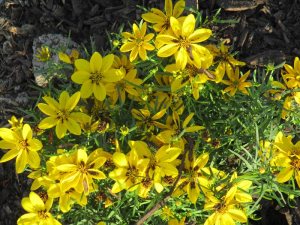
They included a Coreopsis also known as Tickseed.
IMG_0046
Tickseed


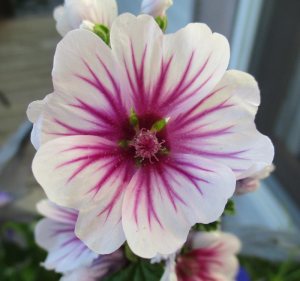
A Mallow

IMG_0001
Mallow

and a Balloon Flower that I don’t have a picture of. After planting these in our prayer garden I didn’t notice any bees on them. I suspect that there were so many other things blossoming in the area that the bees did not pay any attention to these flowers. Thus, the lesson I take from this is that my focus should be 0n sticking to what we already have. I will add more lavender, (I started some by seed) I will divide the thyme and let it spread, and perhaps I will divide my salvia in order to have more plants. I will cherish the clover, the asters and the golden rod that grow wild in our field, and I will not curse the thistle (much).

To Save The Bees (Part II) Planting

This was not what I planned on writing about for part II (that post will now become part three) but since it is taking a while to write that post I thought I would quickly tell you what we did Tuesday.

A few weeks ago I decided to order 4 Basswood trees also known as American Linden trees. http://forestry.ohiodnr.gov/basswood I have been shopping local garden centers for these trees for the past two summers but have yet to find them. We were not really sure about ordering bare root trees through the mail, because we haven’t had very good results doing this in the past.  I was able to find a nursery in Michigan that had them for sale, http://www.coldstreamfarm.net/american-basswood-tilia-americana.html  but a 6 hour round trip to purchase a few trees did not seem very practical. Since I really wanted Basswood, ordering them seemed our best option.

I love things that serve multiple purposes and Basswood trees seemed a good choice for several reasons. Basswoods are sometimes called bee trees as the blossoms are said to attract bees and butterflies. The nectar is said to make a high quality honey. The flowers of the Basswood (American Linden) can be used to make a tea which is used for medicinal purposes. I have also read that their leaves are edible. Basswood grow into great shade trees and their fruit is eaten by wildlife.

Tuesday morning the trees arrived via UPS. The weather was favorable for planting trees so  we packed up and headed for the farm.

IMG_1062

The trees looked very healthy and had good root systems.

IMG_1060

This one is somewhat camouflaged in the photo.

IMG_1061

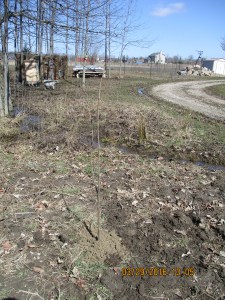
After each tree was planted we put a fence around it to protect it from deer. Before next winter we will also need to protect the trunks from being eaten by mice or rabbits.

IMG_1066

I am looking forward to seeing these trees leaf-out over the next few weeks. Planting trees does not offer the quick gratification that you may get from planting annuals or perennials, and I am not certain how old these trees have to be before they flower and bear fruit, but we intend to be around and keeping bees for many years, so we look forward to seeing that as well.

If you are thinking about planting trees and providing food for the bees, fruit trees are another good option. I would recommend doing a little research before you select a tree, because some fruit trees need a second variety, as a pollinator, in order to produce fruit. Then you and the bees can both benefit from the tree(s).

To Save The Bees (Part I) Do Nothing

untitled

Recently someone sent me an email which contained this picture. Her comment was, “I thought this was interesting”. Since she thought it was interesting I thought other readers might think so as well.

This is the time of year when people start itching to get outside and beautify their yards, so it’s the perfect time to write about it.  While I think the photo (above) is good, I’d like to offer some other thoughts, ideas and links for reference.

It you have access to pretty much any media source you have probably heard in recent years about the honey bees being in danger. There have been countless stories of mysterious bee die-offs and colony collapse disorder. When we tell people that we are bee keepers, we often get comments about the bees disappearing and people seem to have varying degrees of knowledge on the topic. Disturbing as it is, I won’t go into my thoughts on the many causes of this, but instead focus on what individuals can do to, as the above photo says, “Help Save The Bees”. I have found this website to be a good resource https://savebees.org/ if you want to know more about the topic.

I think it is important to note that it is not only the honey bees that are in danger. The honey bee is the one we most often think of and are probably most concerned with because we humans have become managers of the honey bee. We put them in homes (hives), where we want them, and feed or medicate them when we feel it is necessary. We then utilize their services for pollenating our crops and we rob them of their products (honey, wax, pollen, propolis) for our consumption. Other bee types, each with their own attributes, are disappearing as well. Even though we don’t get honey or other products from them these other bees, wasps, and hornets they still play important roles in nature,  doing things like pollinating plants and helping control insect populations by feeding on insects and caterpillars.

I do think that rather than sit on our hands and wait years for the government to come up with a plan and then spend millions of dollars on it, that most of us have the power to do some little things that can make a difference.

In addition to the message in the above picture, I’ll offer the following suggestions:

#1. Do Nothing – I’m not trying to confuse you when I say that the first action that should be considered, and is quite appropriate in many situations, is to do nothing. What I mean is let nature take its course. We often see bees, hornets and wasps as dangerous and feel the need to exterminate them from our space, so when we find a nest we are quick to seek ways to get rid of it. Sometimes, they do indeed, build nests in buildings, or equipment, or other places where they just can’t stay, so it is necessary to get rid of them. Other times it may be possible to allow them to stay.

Last year, for example, we discovered a bald faced hornets nest in the tree in front of our house. The nest was about 12 feet up and hung over the street. It was also near my parking place in the driveway. My first thought was that it was dangerous for whoever cut the grass, it was also potentially dangerous for people riding bikes or walking under that tree, I wondered if they would become disturbed by my entering and exiting my vehicle, and heaven forbid some kids should decide to play ball in the street and hit that nest. My husband and I talked about it and decided that if these hornets became aggressive we would then remove the nest. These hornets visited our deck daily but I only saw one or two at a time. They would fly around but never attempted to sting. I did observe them eating other insects. They never seemed disturbed by the grass being cut or our being in the area of their nest. We were able to peacefully coexist and I feel good about our decision to let them stay. If at all possible give bees, wasps and hornets their (or a piece of your) space.

#2 Do Nothing – Another way to do nothing, or let nature take its course, is to let wild flowers grow and blossom, thus providing food for the bees. Unfortunately we have come to think of many of the blossoms that the bees feed on as unsightly weeds. In our area bees forage on the dandelions and clover in our lawns and in addition they forage on things like golden rod, asters, thistle blossoms and many other (weeds) that  grow in fields and along ditches. So instead of cutting , pulling or using herbicides to eradicate these weeds, we can decide to “do nothing”. Enjoy seeing the dandelions blossom in your yard or the thistle and golden rod take over a field or the side of the ditch and know they are a beautiful source of food for the bees.

I also want to share my thoughts about planting for the bees but have decided to do the in a separate post, so stay tuned for Part II.


Life Is Happening Faster Than I Can Write

I don’t know about other writers but it takes me a while, anywhere from couple hours to a couple days, to write a blog post. I’ll write some, then go back and read and edit and stop to do other things or just collect my thoughts, then I’ll write some more and reread and edit and you get the picture. It seems to happen quite often that I’ll be working on one post when something else comes up, and I decide to write about that instead. At this point I have no fewer then a dozen drafts saved, potential posts that are started but just haven’t got completed and published yet. I suspect that some will get finished in the future, some may be deleted, and some of the thoughts may be incorporated in other post.

With several things on my mind this morning, I just realized that life is happening faster than I can write. (This is probably why I’ve never been able to keep a journal for very long.) Todays post we be about various things.

In Like A Lion

It’s hard to believe that today is March 1st already. See what I mean about life happening fast. Today is actually March 2nd. Still hard to believe. Whichever day it is, March did arrive and in our area it came in like a lion. I wouldn’t describe it as a raging or even roaring lion but the lion was not sleeping last night either, it was perhaps was just resting or playfully romping. We got a decent amount of snow, but as seems to be the case lately, not as much as the weather forecasters predicted. Probably the most accurate weather forecast that I heard yesterday was given by the radio DJ that said “were gonna get a lot of snow”. Since it was snowing pretty hard at that time it was a safe bet that he was right. Looking at flat surfaces outside it looks like we got about four inches, but since it was a light fluffy snow and the wind was blowing, some areas on the ground may have eight inches while others only have a couple. The “lion” may have caused adverse travel conditions, and shut down schools and senior centers, but I am not aware of any power outages or actual storm damage in our area. The “lion” did give us the opportunity to play in the snow a little today. 🙂 My big hope now is that when “March goes out like a lamb” it is not an unruly lamb.

Maple Syrup Update

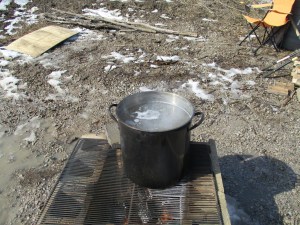
One thing I didn’t realize about sap flow, and I don’t know how typical this is, was how it will stop and start again. Since the temperatures have been so unstable we have had the sap flow for a day or two, then stop for several days, then flow for a day or two, then stop again. We had a whole week between the first sap boiling and the next time we had sap to boil, but this past Sunday, with temperatures topping out near 60 degrees, was a great day to be at the farm boiling sap. While my husband was there all day, I joined him there for a few hours and took some pictures of the process that I did not get during the last syrup making.

IMG_0803
Cooking Sap At The Farm
IMG_0813
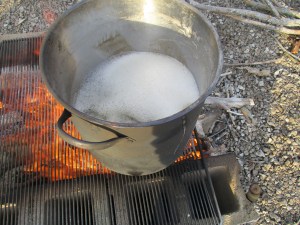
Cooking Sap

You can see in the above pictures that the sap has boiled down some.

The next series of pictures shows how the sap will foam up and boil over if the fire underneath is extremely hot.

IMG_0819IMG_0825IMG_0830

Stirring the pot and reducing the flame brought it back down.

The next picture shows that were getting close to the point where we will finish it off on the stove in the house. It has cooked way down and is turning brown. It also tastes sweet.

IMG_0837
Cooking Sap

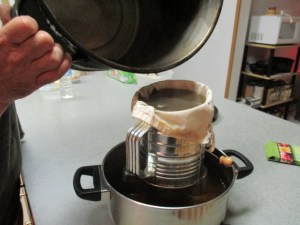
When we brought the sap home the first step was to filter it. To do this we used a jelly bag set inside a flour sifter. It may not be a professional method, but it works. We did set the filter up on two small glasses to give the sap room to drain into the pan.

IMG_0842
Filtering Sap

We then followed the same process that we did previously, boiling the sap until it became thick and reached 219 degrees Fahrenheit on the thermometer. Instead of bottling it immediately like we did last time. We let the temperature drop to 200 degrees and filtered it again.

Last time we did not filter it after boiling, and we ended up with sand in the bottom of the jar. I did a little research and found out that the sand is formed during the boiling process, so in order to have clear syrup it must be filtered after the boiling is complete. This time we do not have any sand in it.

IMG_0850
Maple Syrup

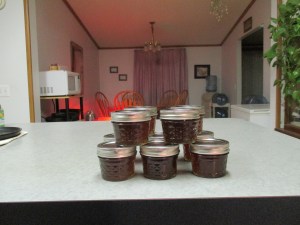
My husband estimated cooking about 50 quarts of sap and our yield turned out to be these (10) 4 ounce jars of syrup, equal to 1 and 1/4 quarts, so our ratio of sap to syrup was 40:1. And the flavor is oh so good!

Sharing The Kitchen

With Sunday being such a nice day the sap continue to flow and my husband spent yesterday, again, cooking sap at the farm, while I spent the day at home peeling garlic to dehydrate. Once I got the approximately 3 lbs. of garlic peeled. I realized that Dom would be bringing syrup home to cook this evening. Knowing that once I put the garlic in the dehydrator the smell of garlic would permeate the house, I decided that I would wait. I don’t know if it would happen, but I didn’t want the syrup to pick up the smell and perhaps the flavor of garlic. Garlic flavored syrup just does not sound appetizing. I put the peeled garlic in a zip lock bag freezer bag and put it in the fridge for the night.

We cooked up some of the sap last night and the rest will remain in cold storage until we are ready to cook it. Today the garlic is in the dehydrator. It should be finished by tomorrow morning.

Chick Update

The chicks are doing well.

Getting their pin feathers.

IMG_0757

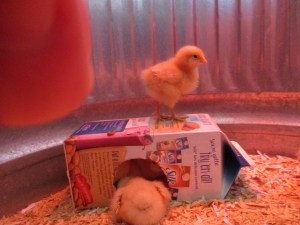
Enjoying their playhouse.

IMG_0767

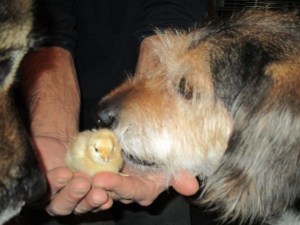
And making new friends.

IMG_0770


Others Enjoyed Sunday’s Weather As Well

IMG_0794

The bees were out on Sunday.

IMG_0791

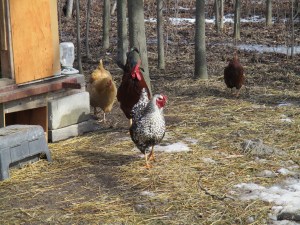
The Chickens enjoyed the weather as well.

IMG_0792

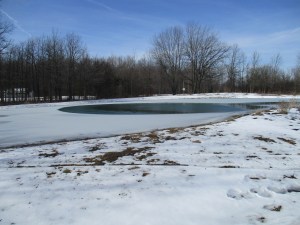
I don’t know if the pond ever completely froze over this year.

IMG_0793

Widely because the windmill has done it’s job.

You can’t tell from this picture but the windmill was spinning.

That’s All Folks

At least that’s enough for today. Until Next Time 🙂