Category Archives: Bees

Five Hives

As of Monday, May 23 rd., we have five hives of honey bees.

We were working at the farm in the morning, my husband planting tomatoes while I was weeding the prayer garden and marshmallow garden https://donteatitsoap.com/2015/08/05/marshmallow-root/ . We took about an hour for lunch and decided to get right back at it. As my husband walked toward the field where he was going to start planting pepper plants I heard him say, “We have a swarm”.

IMG_2650

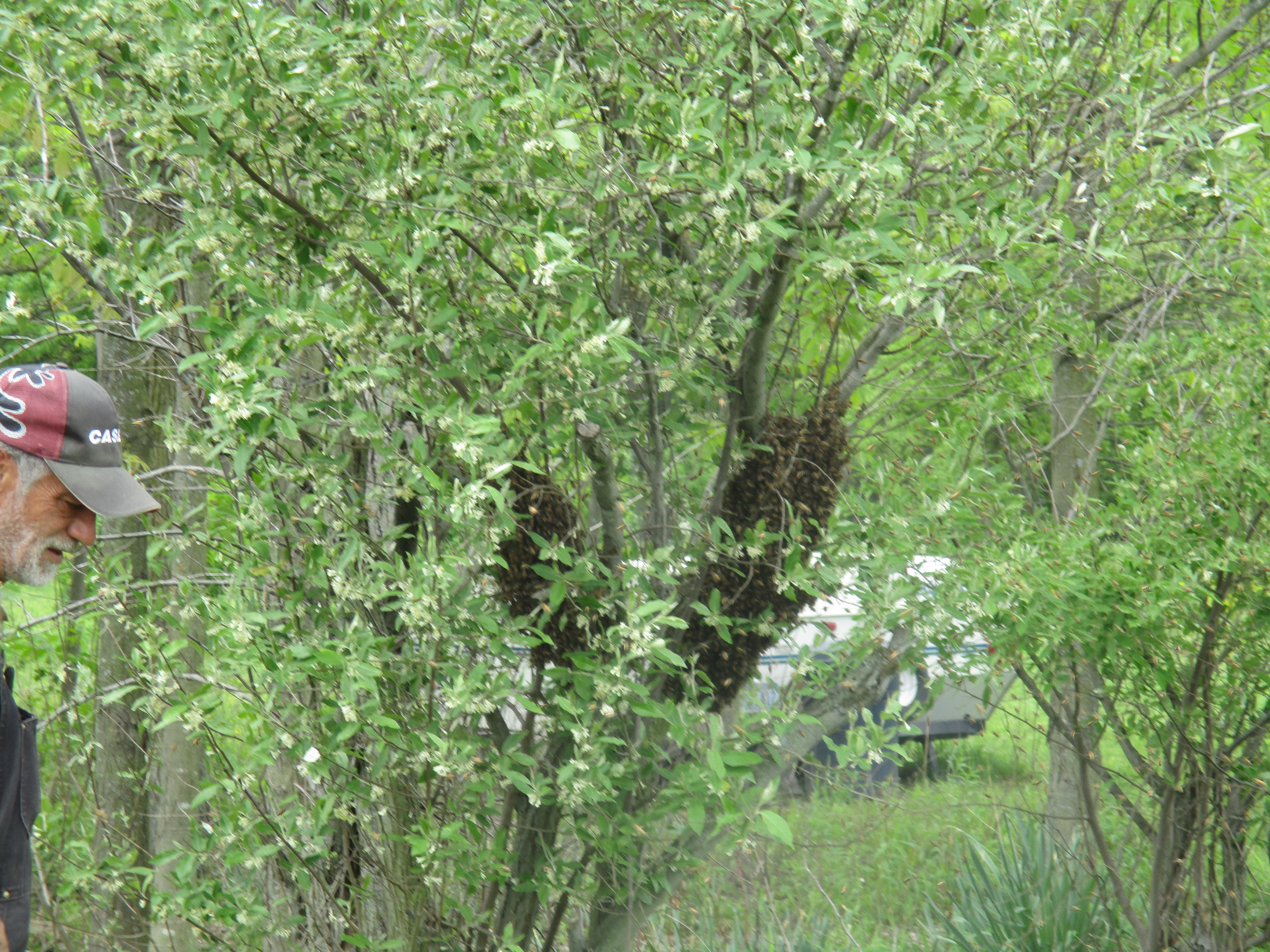
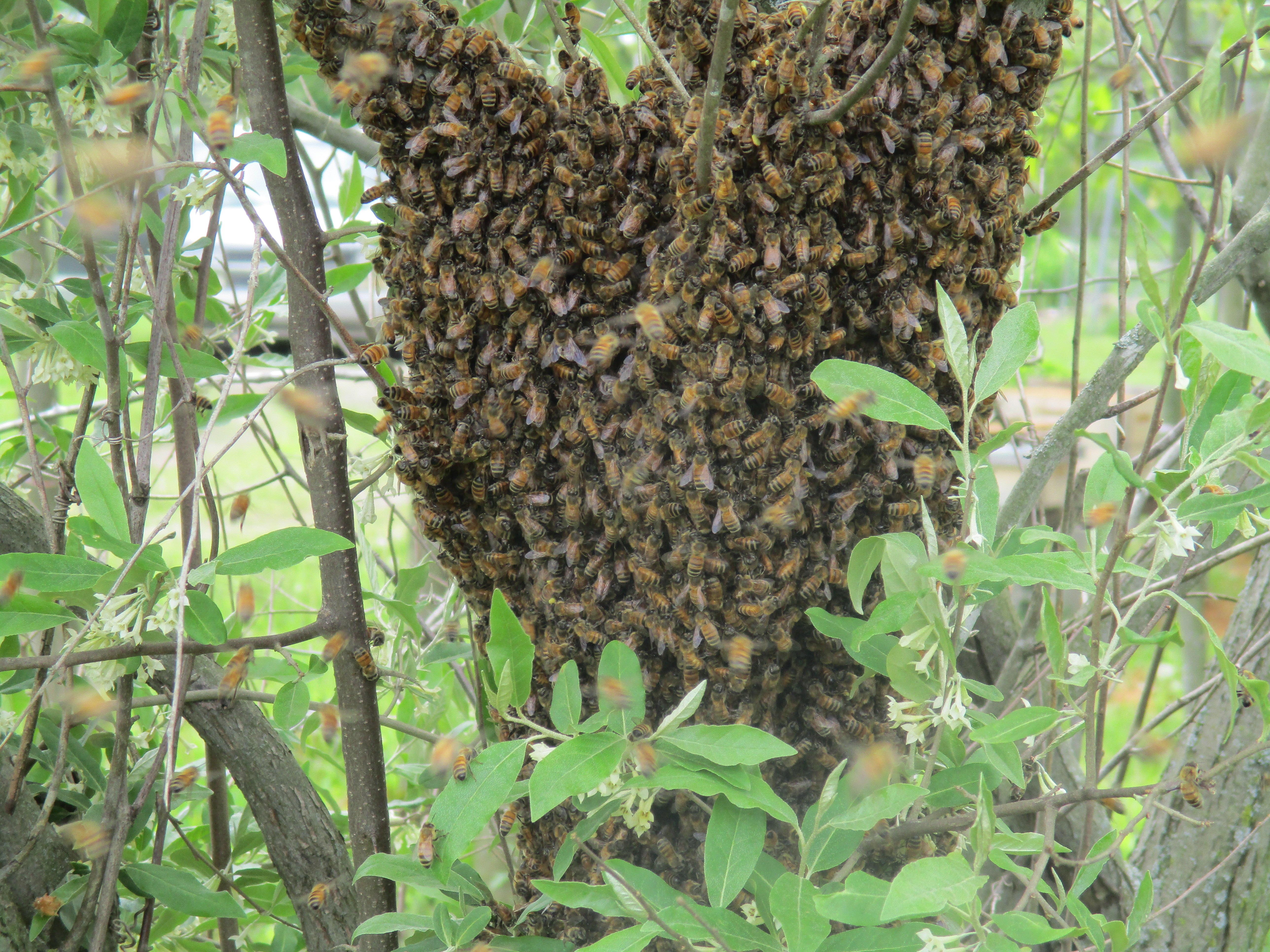
I grabbed my camera and walked in his direction. I saw the bees still getting themselves organized in an Autumn Olive tree. The way they were landing it looked like two separate swarms but by the time they had finished they had all come together as one large swarm.

IMG_2654

One of the nice things about the location of our apiary is that it is surrounded by trees so when it is time for a swarm of bees to move to a new location their first stop is usually in one of the nearby trees. The Autumn Olive which is in bloom right now is very fragrant and I don’t blame them for choosing this tree.

Swarming is how honey bees colonies reproduce. When the hive begins to become over crowded the bees produce a new queen. They do this by building special brood cells which are known as queen cells. The queen larvae is then fed exclusively on royal jelly. The old queen leaves the hive with the swarm of worker bees in search of a new location to call home. The new queen hatches, mates with the drones, and begins laying eggs in the hive.

One thing I want to point out is that if you come across a swarm of bees on a tree or other structure there is no need to panic. It is not necessary to have someone remove them, as these bees are in transition and will be gone soon. There is no danger if you simply avoid the area. That’s not to say that if you know a beekeeper you shouldn’t call them to see if they want to come get it, as they might appreciate the opportunity to start a new hive.

As the bees settled in my husband began preparing to capture them. Just like with hiving bees it is important to make sure that everything is in place before getting started. He already had a empty hive ready in anticipation of capturing a swarm. He opened it up and removed some frames from an area where he would dump the bees. He left the covers sitting nearby.

He got out a five gallon bucket with a lid and examined the tree. I reminded him this tree has thorns. He decided he would need to cut a lower branch off so he could get to the swarm. He put on his bee suit, but since he wouldn’t need my help I didn’t suit up. I would just watch and take photos.

IMG_2666

The battery of my camera went dead after this photo.

After he removed the branch he was able to put the bucket directly under the branch that held the swarm. He then shook the branch very hard and a large portion of the swarm dropped into the bucket. His objective at this point was to get the queen. He quickly covered the bucket and took it to the hive that he had ready.  He emptied the bucket into the hive and I imagine he said a silent prayer that the queen was amongst them. He placed the cover over the hive and went back for more of the bees who were gathering back on the limb. He again shook the branch so that another large amount of bees fell into the bucket, and he took them to the hive as well. After repeating this a third time he had captured most of the bees. When he placed the cover on the hive many of the bees which were flying around the outside began clustering on the hive. This was a good sign that the queen was inside.

It is now three days later and this hive seems to be functioning as well as the others. Worker bees are leaving the hive and coming back with bright yellow pollen. That is just what we like to see. 🙂

Home Sweet Home (Hiving Honey Bees)

We are convinced that bee keeping is part art, part science and part luck. We have read many books and websites and there are so many ways of doing things and reasons behind doing things that it is really up to each bee keeper to decide what works best for them.  Experienced bee keepers may read this and identify 5 or 10 things that they think we did “wrong”. New bee keepers should not use this as their “bee hiving bible”, but study different methods and decide for themselves what will work best. With that being said this is our story of hiving our bees this year.

IMG_2596

Saturday morning we had perfect weather for putting our new bees in their hives. The sun was shinning, the temperature was in the low 60’s and the wind was clam. It was in February, after we realized the loss of two out of our four hives, that we decided to order two packages of bees.  Since we had such a tragic experience last year when our bees were delivered by U.S. Mail https://donteatitsoap.com/2016/05/17/beware/ we knew we would never do that again. Fortunately last August at the Saint Clair County Farm Museum’s Harvest Days we met Scott and Jen from Osage Farms  http://www.osagebees.com/ . They are building an impressive business which includes managing their own bees and bee products along with selling beekeeping products and packaged bees. They don’t raise and package the bees. Their supplier is out of Georgia and Scott personally makes the trip from Michigan to bring back a truckload of bees. We decided to order our bees from them.

We knew the bees would be arriving sometime on Saturday and when we got the news from Jen on Saturday morning that we could pick them up anytime after 9:00 a.m. we headed out the door. Their location in Avoca, Michigan is less than a 20 mile drive and we were back home and getting our bee suits and bee kit ready before 10:00 a.m.

Our bee kit contains the tools that we use when working in the bee hives – hive tools, bee brushes, a couple of small nails that are used for poking a hole in the queen candy to help the workers release the queen from her cage. It also has things like a mirror, flashlight and guitar strings that are handy at times but were not used for hiving the bees. I also made up a spray bottle of light sugar syrup.

When we got to the farm my husband organized all of the hive pieces that we were going to need. He had already in place a bottom board, a deep hive body with 10 frames, a medium hive body with two frames removed from the center, and a medium hive body with all frames removed, for each of the two new hives. Next to each new hive he had set out an inner cover and an outer cover.

IMG_2602

Having everything organized is extremely important when hiving bees because you don’t want to be searching for missing pieces once you get that package of bees open.

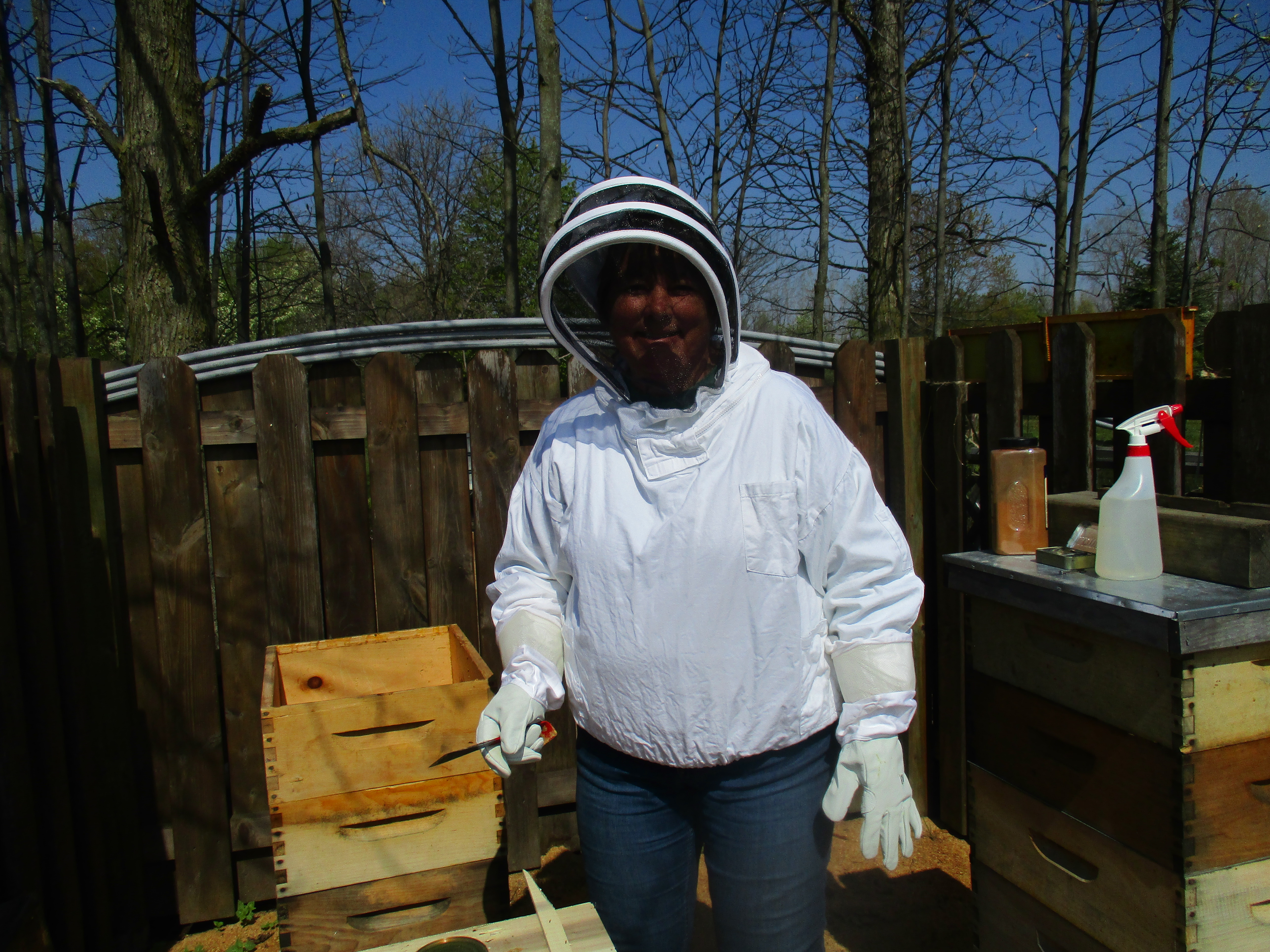
Once we had everything in place we put on our bee suits. We don’t have full suits, just the hooded jackets and gloves. We wear blue jeans and pull our sock up over our pant legs so bees do not have an entryway.

Wearing a bee suit can be an encumbrance, the added layer of clothing can be hot and bulky, the screen can make it difficult to see clearly, and the gloves can interfere with manual dexterity.

My husband tends to only wear his suit when it is really necessary and he decided early in the hiving process that it was not necessary. Honey bees are generally not aggressive and only use their stinger as a defense mechanism. At this point they had no food to defend, so unless he accidently put his had on one it is not likely he would get stung. He stopped me before I opened the package and said “This is just in the way,” while taking off his hooded jacket. The picture of him below is much later in the process since I could stop to take his picture while we were busy with the bees and there is no way I would have been able to press that little camera button with those bulky gloves on.

IMG_2609

Usually my husband opens the package, dumps the bees, and deals with the queen cage while I stand by to quickly put on covers or hand him things he might need. This year he  walked me through the process as I did more of the work.

Before we began opening the packages I sprayed them with the sugar water. I used a mixture of 1 part sugar to two parts water. Spraying the bees is said to calm them. I’m not sure if it does.

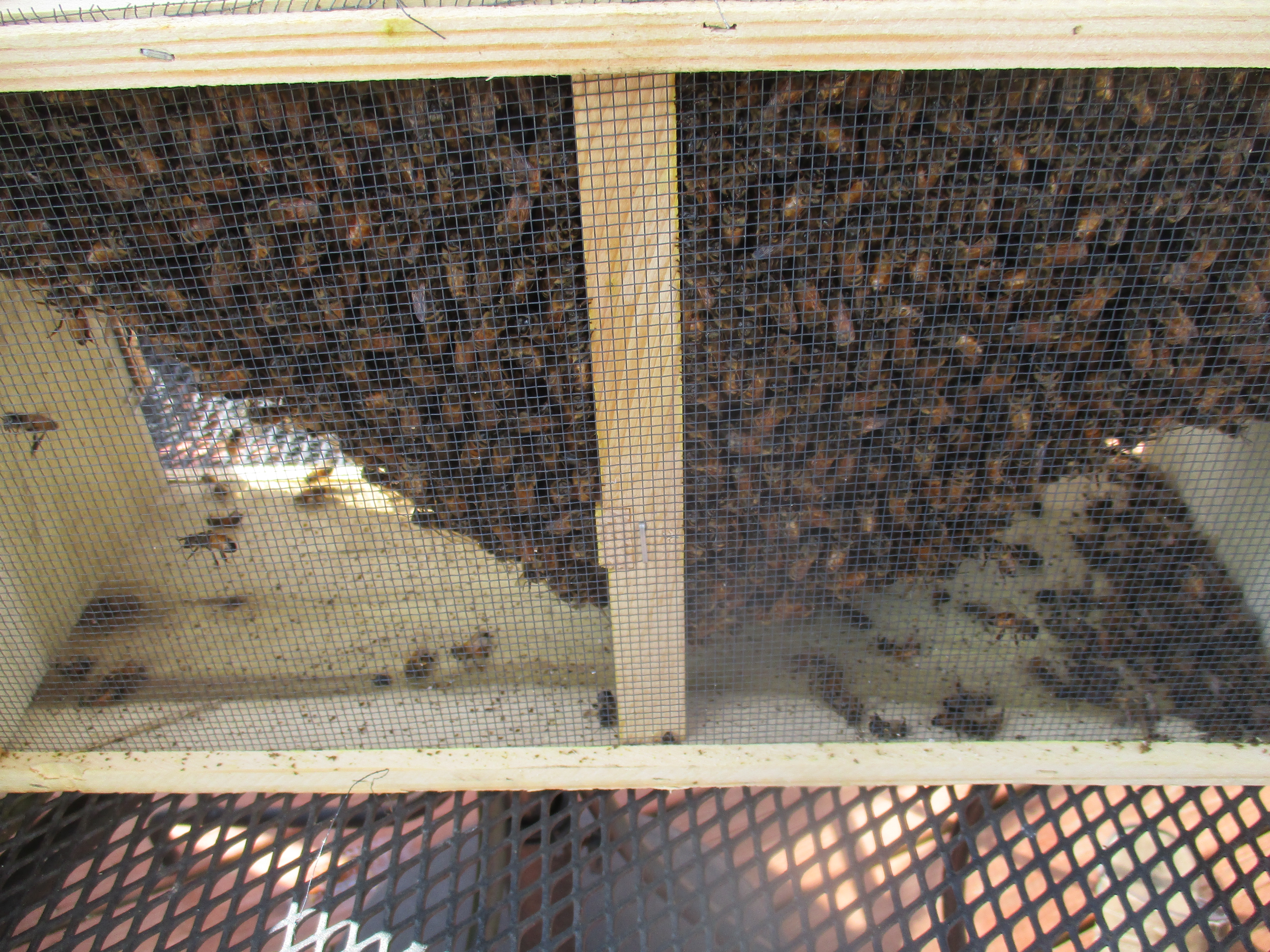
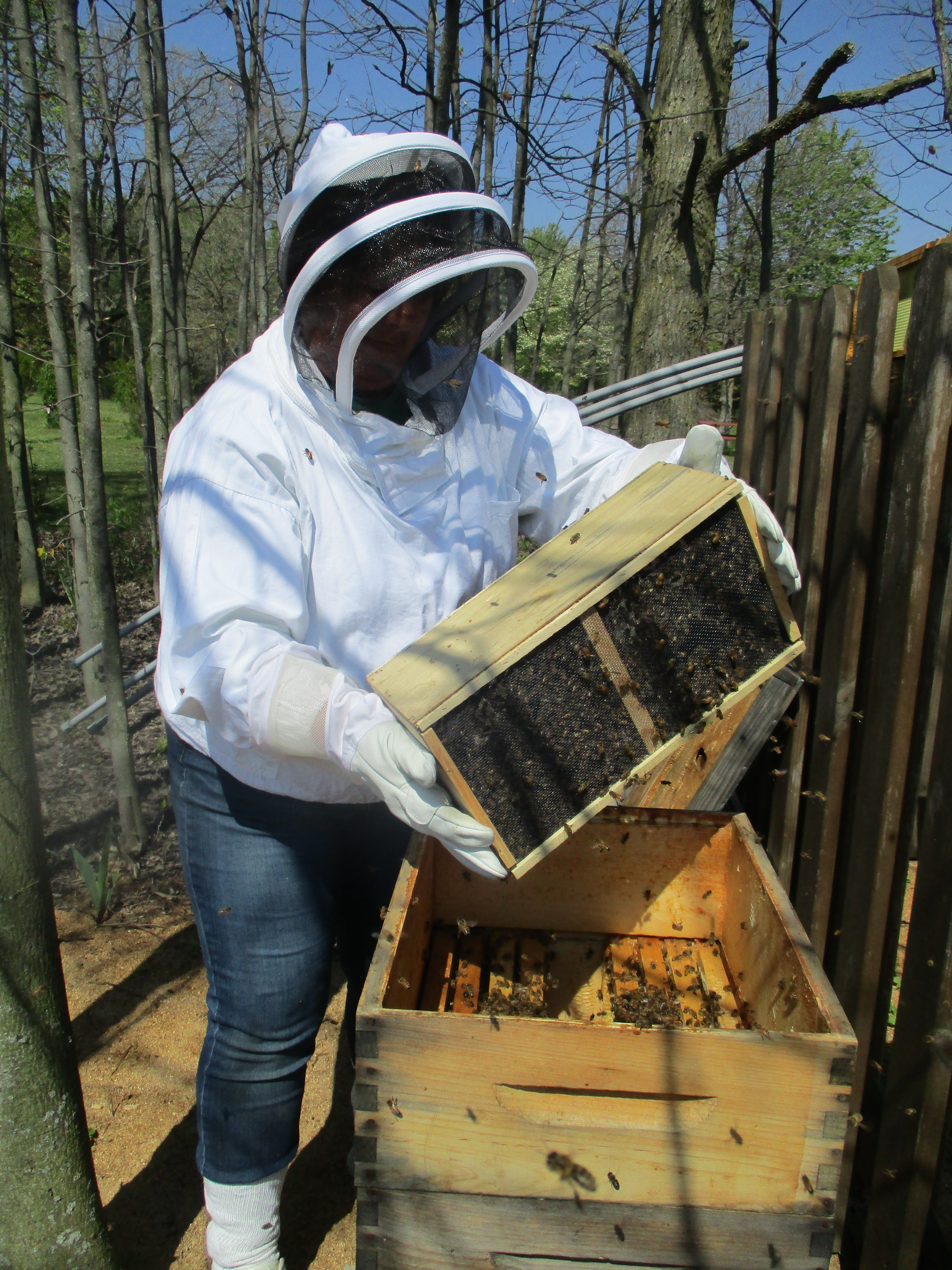
I started by using the hive tool to pry off the wooden cover that was stapled to the top of the package. When that was removed it exposed the top of the feeder can. I then used the tool to pry up the edge of the feeder can and loosen the plastic tag that held the queen cage in place. Once the feeder can was removed my husband took the queen cage out of the package and I quickly placed the wooden cover back over the hole in the package to keep the bees inside. We inspected the queen cage to make sure the queen was alive. Each queen cage had a queen and three or four attendants with her. It had queen candy on one end and a small cork to plug the hole that would expose the queen candy. My husband removed the cork then took a small nail to gently puncture a starter hole in the queen candy. He then used a slightly larger nail to make the hole bigger all the time being careful not to hit the bees with the nail. This will make it easier for the workers to release the queen from her cage.

My husband then set the queen cage in the hive, in the space where the two frames had been left out of the medium hive body. It was sitting on top of the frames in the bottom hive body.

IMG_2606

Once we had the queen cage in place it was time to shake the rest of the bees into the hive. I let him do the first one but I decided I would do the second one. Even though I have watched my husband do this quite a few times, I didn’t realize how tough you have to be with them. After giving the package several good shakes into the hive with a cluster of bees dropping into the hive each time, and shaking them first to one end then to the other then out the center, and hitting the ends of the package to get them clustered and out, there were still a lot of bees clinging to the screened side of the packages. My husband then took the package from me and gave it a couple good slams on the wooded work table, then shook most of the rest of the bees into the hive.

All this time there were thousands of bees flying around us but I honestly didn’t pay them much attention. My focus was on the task at hand and  thinking about what we needed to do next.

After most of the bees were out of the package he put the package on the ground near the hive entrance so the rest of the bees could find their new home when they exited the package. We brushed a few bees off the lip of the hive box as we slid the inner cover in place, then we put on the outer cover.

As far as feeding these new bees we decided not to use a feeder on the hive. We stopped feeding our bees sugar water several years ago and began making sure they have enough honey to keep them going. We are able to use honey that was in the hives we lost over the winter. Rather than putting it inside the hives my husband has it set up on the bench directly outside the hives. (see photo with my husband in it above).

By afternoon the bee activity had settled down quite a bit and there were bees coming and go from  both of the new hives.

It was a good day. 🙂


Sights of Spring

This is the day the Lord has made…

I didn’t make it out to the farm until yesterday afternoon. As I walked past the prayer garden I and looked for the killdeer eggs this is what I saw.

IMG_2557

“They weren’t hatched this morning” my husband said.

IMG_2558

Both parents were near by screeching and doing the broken wing act to try to get us out of the area. I expect the babies will be running all around the area soon. I am happy that I can weed that side of the prayer garden now.

My husband’s main task for the day was cleaning frames from the bee hives. He first lets the bees do their part. He sets out the frames that still have honey and wax and lets the bees take what they want. Once they stop visiting a frame he finishes cleaning it before putting it back in a hive.

IMG_2580

As I walked around the farm I observed bees foraging amongst the apple blossoms. I made many attempts at photographing them. They were too busy to pose for a picture, so this was the best I got.

IMG_2573The bees were also collecting a lot of dandelion pollen. This lady stopped for a few seconds, so I was able to get a clear shot before she moved on.

IMG_2575

Last week we observed something that neither my husband, who has spent much of his life around ponds, creeks, rivers and lakes, or I have ever witnessed before. The toads had all made their way to this shallow grassy area of our pond and were mating there.

IMG_2520

There were too many to count and as we stood there watching more toads were arriving for the party.

IMG_2584

Yesterday as I walked by that area of the pond I noticed tiny black tadpoles apparently just hatching.

IMG_2587

We also spotted minnows swimming in the beach area.

For the past two years only one of our young lilac bushes has blossomed. When I mentioned this to my son-in-law last summer he suggested that I spread wood ash around them. Last fall I did spread wood ash around all of the lilac bushes and some of our apple trees as well.

IMG_2569

This year 10 of our 15 lilac bushes have blossoms.

Our apple trees also have more blossoms than they ever have before.

IMG_2577

Several years ago around just before Mother’s day my husband and I planted some trilliums in a wooded area of our farm. These were one of my mom’s favorite wild flowers, and we planted them as a tribute to mom who passed away the same year we bought our farm.

IMG_2560

Mom’s trilliums are beginning to bloom, appropriately, in time for Mother’s day.

Visitors are another common sight at the farm during the warm weather seasons, and it was good to have our first visitors of spring.

IMG_2590

Two of our daughters, Kara and Lindell, stopped by for a visit yesterday afternoon. They were dancing as they came up the driveway since my husband had a classic rock station playing on the radio.

Let us rejoice and be glad in it. Psalm 118:24


The Sap Is Flowing and The Hens Are Laying

Over the weekend, as we looked ahead at the 10 day weather forecast and saw that 8 out of 10 days were predicted to have high temperatures above freezing, we decided it was time to tap maple trees. Here is the link to my past from last year about tapping maple trees. https://donteatitsoap.com/2016/02/20/tapping-maple-trees/?iframe=true&theme_preview=true

So yesterday, (Monday, February 13) we set a total of 18 taps (and buckets) in 8 maple trees at our farm. It seems early to be tapping the trees, but the sap began flowing as soon as the taps were in place. I guess, like many things farming related, weather conditions mean more than the date on the calendar. We also set up a fire pit where the sap will be boiled down.

img_2237

Today, after lunch, we went to the farm to collect the sap. When all 18 buckets were emptied we had collected 10 gallons of sap. Our plan is to collect the sap for the next couple of days before we begin boiling it down. Our intention is to leave the taps in place, and continue to collect sap and make syrup, as long as the sap runs clear. When the sap turns cloudy maple syrup season is finished.

img_2242

Throughout the month of December the chickens’ egg production gradually slowed, and through the month of January we only collected one or two eggs per day. Last week we began getting 5 or 6 eggs daily and now we are up to 8 or 9. As the days grow longer, and the chickens enjoy more sunny days, egg production will continue to increase. This makes feeding the hens all winter worth while.

img_2239

The bees were out today when the afternoon temperature climbed to around 50 degrees. I don’t think there was anything for them to forage, but at least they could take a cleansing flight. Later this week when temps get back into the 50’s we will check their food supplies and feed them if necessary. We do have honey and wax reserved for them so we do not have to feed them sugar water. We did lose one hive earlier this winter. We could not determine the reason for the loss, as the hive was not full of dead bees. At this point it seems as if the three remaining hives are okay, and we plan to start two new hives in May. We will also capture swarms to if the opportunity arises.

Regardless of the date on the calendar, or the groundhog’s prediction, all signs on the farm are pointing to an early spring.

I Brake For Bees


I told my husband that I need a t-shirt that says “I brake for bees” but probably more appropriate would be a bumper sticker pasted on the back of our riding lawn tractor.

This may be something only another beekeeper can understand, and even among beekeepers I might be in the minority. It wasn’t something that I thought about before I realized I was doing it, but as I mow the lawn at the farm I often see honey bees foraging on the dandelion or clover blossoms. My natural reaction is to yield them the right of way. Of course having wrote the check to purchase packages of bees, along with reaping the rewards of their labors, I have a great understanding of their value. Now it may or may not be the case that they will move out of the way of the mower just like the chickens and dogs move out of the way of vehicles at the last minute, but I am just not certain.

Few other creatures get this kind of consideration but among them are frogs, toads and snakes.

This past summer, my husband, who is totally on the same page with me as he has been known to get off the mower and move a toad to a safe place before continuing to mow, and I decided to restrict our mowing to the later evening hours after the bees were mostly back to the hive. It may be crazy, but I consider this a small sacrifice to help keep our hives healthy and strong.

img_1650