Category Archives: Chickens

Old Dog New Chicks

A few days ago, as we prepared to get chicks, my husband brought in the stock tank that we use as a brooder. When Scout saw this he began looking around for the chicks. We had to tell him “not yet, Scout”. We weren’t planning on getting the chicks until the following day. Scout has been down this road before, in fact 4 out of the past five years we have brought home baby chicks and raised them.

The first year I had great concerns about Scout being around the chicks. When we adopted him from the shelter in 2011 we were told he was about 3 years old and part terrier. Nobody knows what kind of terrier but that was not important to us. Over the next several years we found that he definitely had the terrier instinct to hunt and kill small animals and he was quite proficient at it. He could quickly and cleanly dispatch a raccoon, possum, ground hog, cat or baby turkey by just snapping it’s neck. He was about eight years old when we first started raising chickens.

I pretty much left it to my husband to train Scout with the chicks. Dom would hold a chick and let Scout sniff it and nudge it with his nose and he would tell Scout that those were his (Scout’s) babies. “You have to be nice to your babies,” we would say. Scout would become very excited, and want to look into the brooder, whenever he would hear the chicks make a noise, and anytime my husband or I were doing anything with the chicks (feeding, watering, holding or cleaning the brooder) Scout wanted to be involved.

That spring Scout learned that he was not allowed to chase and kill the chickens, unfortunately it was at the expense of one of our hens, but for a dog of his age and breed to learn not to chase chickens, or any other small critter, is a huge success.
IMG_0706
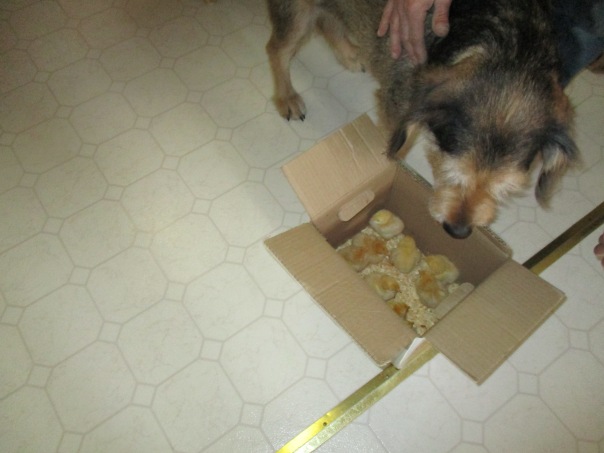
Scout Welcoming Our New Chicks

Nowadays I have no concerns about Scout chasing the chickens. Our free range chickens wander, peck and scratch throughout the farm and we have total confidence that neither Scout nor our other dog, Trooper, will cause them any harm.


One of Scout’s nicknames is “Chicken Daddy”, and he loves it when we tell him he is a good  Chicken Daddy. At age 13 (in people years) Scout has slowed down a lot. He does not pay as much attention to the chicks, but he was still very eager to see/sniff them when we brought them home.

The other thing he really enjoys is helping close up the chicken coop at night. When we go into the coop to count chickens and make sure everyone made it back home, Scout will step inside and sniff a couple of chickens to say “good night to his babies”.

IMG_0715

He really is a good chicken daddy.

The Sap Is Flowing and The Hens Are Laying

Over the weekend, as we looked ahead at the 10 day weather forecast and saw that 8 out of 10 days were predicted to have high temperatures above freezing, we decided it was time to tap maple trees. Here is the link to my past from last year about tapping maple trees. https://donteatitsoap.com/2016/02/20/tapping-maple-trees/?iframe=true&theme_preview=true

So yesterday, (Monday, February 13) we set a total of 18 taps (and buckets) in 8 maple trees at our farm. It seems early to be tapping the trees, but the sap began flowing as soon as the taps were in place. I guess, like many things farming related, weather conditions mean more than the date on the calendar. We also set up a fire pit where the sap will be boiled down.

img_2237

Today, after lunch, we went to the farm to collect the sap. When all 18 buckets were emptied we had collected 10 gallons of sap. Our plan is to collect the sap for the next couple of days before we begin boiling it down. Our intention is to leave the taps in place, and continue to collect sap and make syrup, as long as the sap runs clear. When the sap turns cloudy maple syrup season is finished.

img_2242

Throughout the month of December the chickens’ egg production gradually slowed, and through the month of January we only collected one or two eggs per day. Last week we began getting 5 or 6 eggs daily and now we are up to 8 or 9. As the days grow longer, and the chickens enjoy more sunny days, egg production will continue to increase. This makes feeding the hens all winter worth while.

img_2239

The bees were out today when the afternoon temperature climbed to around 50 degrees. I don’t think there was anything for them to forage, but at least they could take a cleansing flight. Later this week when temps get back into the 50’s we will check their food supplies and feed them if necessary. We do have honey and wax reserved for them so we do not have to feed them sugar water. We did lose one hive earlier this winter. We could not determine the reason for the loss, as the hive was not full of dead bees. At this point it seems as if the three remaining hives are okay, and we plan to start two new hives in May. We will also capture swarms to if the opportunity arises.

Regardless of the date on the calendar, or the groundhog’s prediction, all signs on the farm are pointing to an early spring.

Chicken Fun

We often find our chickens providing us with great entertainment. Sometimes in the evening, before they are all inside, we will even sit down near the coop and watch, what we call, chicken TV.

IMG_1407

This is Honey. She is one of our oldest hens and has always loved my husband. This particular evening she was curious about what he had in his hand.

IMG_1411

She then decided she wanted to sit on his lap. When she pays attention to me she is usually pecking at my ring, my buttons, or my jeans.  Honey has and will always have a special place in our hearts.

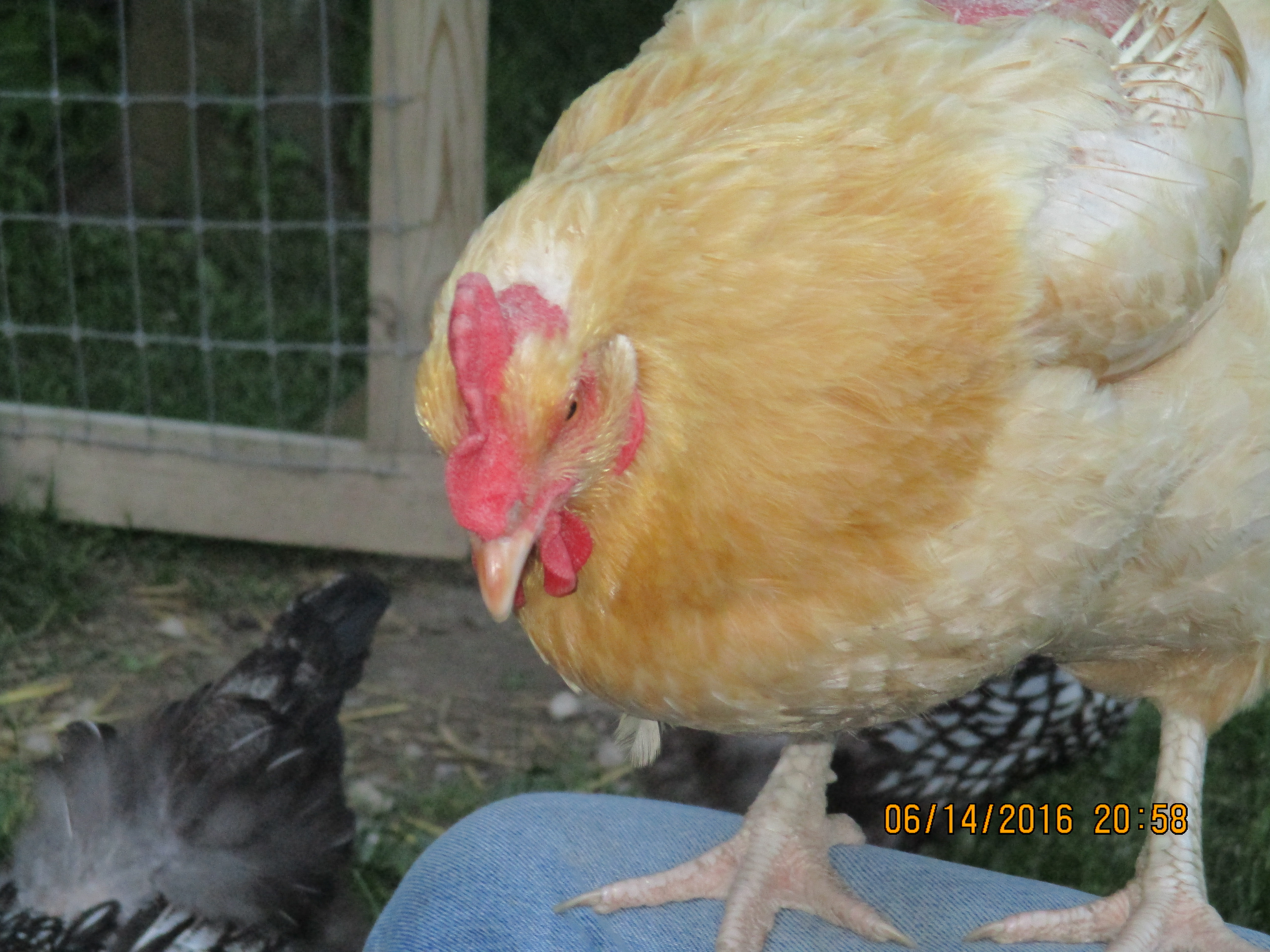
This young buff decided my lap was a good place to sit. The Buff Orpingtons are definitely the most friendly breed we have.

IMG_1367

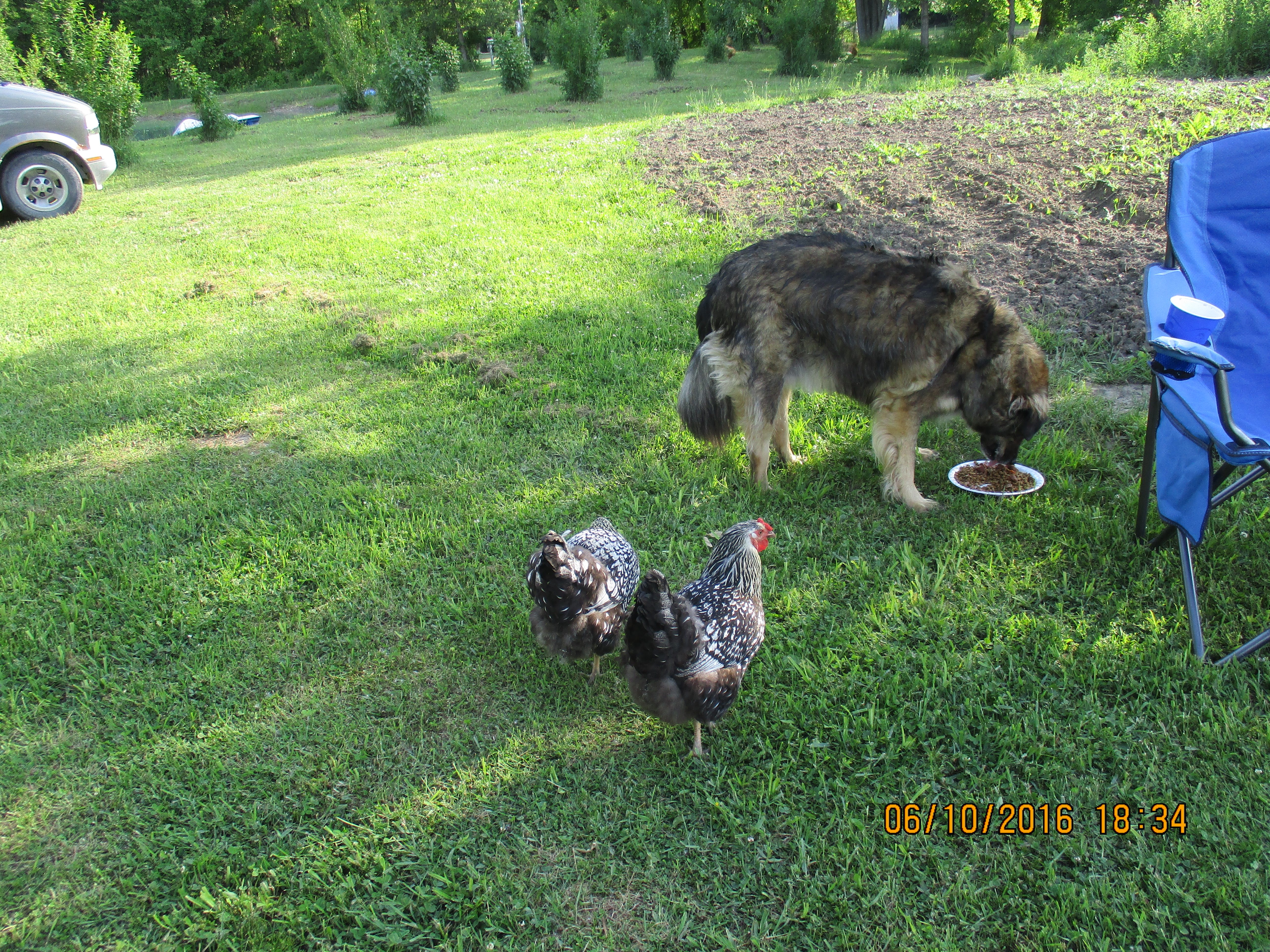
We have a group of Silver Wyandotte’s that like to visit the campsite around dinner time. They like to check out what is on the grill, and despite my warnings that someday that could be them, they keep showing up and begging for food.

IMG_1369They are also interested in what the dogs are eating. If they get too close Trooper will pounce at them to scare them away. He doesn’t hurt them though and they just keep coming back. They have learned that they will often end up with some kind of “treats”.

IMG_1496

Anytime we do landscaping the chickens are sure to show up especially if it involves fresh topsoil. They love to peck and scratch and most of all dust themselves in the newly placed dirt.

Yesterday evening  as my husband and I were filling in this trench at least a dozen hens showed up to add the finishing touches. My husband would shovel the soil into the trench, pack it down, put another layer on top and rake it so it was even with the ground on either side. The chickens would then peck, scratch, and then nestle their little bodies down into the loose soil leaving nest shapes holes in the soil.

While we may not have the prettiest landscaping we do have happy chickens 🙂

Chickens, Chickens and More Chickens

I thought I would do a quick chicken update since when I talk to family or friends I often get asked how the chickens are doing.

IMG_1084

The Barred Rock chicks, otherwise known as “The Six Pack”, made the move to the farm last week.

IMG_1111

They started off in a small penned in area. They loved being on the ground where they could scratch and peck. Some of the older chicks were curious.

IMG_1115

Scout loved being able to watch them. They were only in the penned in area for the first two days. On day three they ran out of the coop in the morning before we could round them up and get them in the pen. They are now free to forage the farm as they please, but they do stick pretty close to the coop.

IMG_1057

Meanwhile the young Buff Orpingtons, A.K.A. “The Gang of Eight”, are doing well. They tend to stick together.

IMG_1119

They are getting bigger.

IMG_1082

And they are very friendly. While sitting in a lawn chair near the coop we often end up with one or two or three of them sitting on our lap or perched on our shoulder. They are a lot of fun.

Sadly we lost one of our old Buffs to a hawk a couple weeks ago. She was from the first batch of chicks we bought. We had her since 2013. Her name was Super Chick. She got her name when she was young because she would stand in front of the gate when it was closed and fly up to the top. The way she flew up reminded me of Superman. She continued to live up to her name as she got older.  When we would leave the gate closed to keep the chickens penned in we would always arrive back at the farm to find Super Chick out of the pen. She usually didn’t stick with the flock, but wandered on her own a lot. When our younger rooster, Autumn, grew up he took a liking to her and he seemed to follow her everywhere. Autumn seems lost without her.

Loosing an occasional chicken to a predator is one of the risks involved in allowing chickens to free range.  However, the rewards of having happy, healthy chickens, reduced feed costs and fabulous eggs, have far outweighed the occasional loss of a hen.

IMG_1121

The rest of the flock are enjoying spring time. The photo above is Autumn with a group of our Silver Laced Wyandotte’s.

IMG_0987

There is lots of scratching and pecking to do this time of year.

IMG_1105

This is Honey. She too is from our first batch of chicks. Honey won a special place in our hearts early on, as she would jump up on my husbands lap, peck at us if she wanted our attention, or squat down in front of us if she wanted to be picked up. Honey is also one of our two hens that have brooded chicks.

Our chickens are allowed to free range during the daylight hours and spend their nights roosting in the coop. As the daylight hours increase so does the amount of time the chickens spend outside. In the dead of winter the coop is opened up around 8 A.M. and closed around 5 P.M., but today they were ready to exit the coop by 7 A.M. and we probably won’t be able to close up the coop until 8:30 P.M. or so.  The chickens naturally return to the coop at night, but some of the young ones are still requiring a little coaching.

This time of year we too are ready to retire to our “coop” when darkness falls, but as the weather warms I am certain we will spend many evening sitting around a campfire long after the chickens have gone to bed.


Coloring Eggs and Chicken Update

Last year we were curious about coloring brown eggs, so we decided to try it. This year, since I decided to make deviled eggs for today, I thought I would color them first and share my results, in case anyone else is curious.

IMG_1046

IMG_1047

I used regular food coloring, something I vaguely remember doing as a child, before Paas came out with the egg coloring kits.

The eggs I colored were varying degrees of brown. I follow the directions on the food coloring package – 1 tps. of white vinegar, 20 drops of food coloring and 1/2 cup of boiling water. Since I didn’t have 20 drops of red food coloring I mixed 15 drops of red and 5 drops of blue, which gave me the maroon color. The two on the top left are blue, the two on the top right are green, the two on the bottom left are maroon and the two on the bottom right are yellow. The eggs that were darker brown going into the dye came out in darker shades than the ones that were lighter going in. The answer is:  while brown eggs don’t make pretty, pastel Easter eggs, they indeed can be dyed.

I’ll also add a quick chicken update.

This past Monday as our  Buff Orpington chicks turned 4 weeks old, and are now feathered out,  we moved them to the farm. They seemed to be getting bored in the hutch on the deck and needed room to roam.

IMG_0991

They rode in this crate to the farm.

IMG_0987

The Chicken yard was busy when we got there, but when the big birds realized that we did not bring them treats, most of them went off to find their own goodies.

My husband had added new roost space inside the coop, enough to accommodate 30 chickens. Before bringing out the young ones today  he also penned in an area around the small chicken door to keep the young ones close to the coop.

IMG_0996

The big birds will use the big (people) door for now.

IMG_1003

Some of the big birds were curious.

IMG_1019

Some even came and visited. The big hens gave the little ones an occasional, intimidating, peck, but it was mostly if they got too close to the food (treats).  We had to move the big hens out of the penned area because they could not find the way out on their own. At night my husband put “the group of 8”, as he is fondly calling the young buffs, into the coop where they huddled together in one of the nest boxes. “The Group of 8” spent their fist couple of days mostly inside the coop, and my husband found it necessary to open up the penned in area because the big birds would get in and be trapped there.

Yesterday “The Group of 8” spent the day out on their own. They mostly stayed together and sometimes with the rest of the flock. There has been no signs of aggression from the big birds, but I wouldn’t think there would be from a group who will share their living quarters (food and all) with 20 or more starlings during the winter. “The Group of 8” is now in training for their nighttime routine which includes returning to the coop at night and using the ramp to get inside. I’m sure they will catch on quickly.

After Monday’s move, we decided to make it a full house (coop). Since we only had 24 birds we went to the farm store for 6 more. Again they did not have the breed we were looking for (Buff Orpington) so we decided this time on Barred Rocks.

IMG_1041

IMG_1045

Upon adding this “six pack” we comment that our flock is becoming very diverse.

And with that I wish you all a Beautiful and Blessed Easter. Until next time 🙂