Category Archives: Uncategorized

Bath Day For The Boys

One 90 lb. Scout + one 120 lb. Trooper on bath day = one big job. What makes it somewhat easier is the fact that they are well behaved when they get their bath. Yesterday when I    announced to the Boys that they were going to get a bath they both came into the bathroom and looked at the tub. I still needed to get things set up for them, so I told Scout he had to wait a few minutes. He laid down to wait.

IMG_2546
Scout waiting for his bath.

We used to give them both their bath’s in our garden tub. My husband hooked a shower hose to the tub faucet and this works well.

100_0377
Bath time for Scout and Trooper

We usually bathe them one at a time, but one time my husband actually had them both in the tub together.

Trooper still gets his bath in the tub, but Scout’s advanced age prevents him from jumping into the tub like he used to. Nowadays I remove our glass shower doors so that Scout can just step into the shower. I kneel on the floor beside the shower and wash him up. He loves the attention and he loves it when we tell him he is a “clean puppy”.

A few years back, after I began using my homemade soap for washing my own hair, I decided to try using it on the boys. Buying dog shampoo can be expensive, the highly perfumed fragrance of these often has adverse effects on my sinuses, and getting these shampoos completely rinsed out of the boys coats was a nightmare. Using the soap, on the other hand, there are no added fragrance. It provides a lather that penetrates even Trooper’s extremely thick coat and under coat yet it rinses out nicely. Yesterday I used Aloe Soap but I sometimes use my Hair Care Soap that I use on my own hair.

IMG_2548
Scout and Trooper – the afterbath

After their bath my husband had them lay on the blanket to dry and he gave them a nail trim.

Last night as I petting each one and saying good night I noticed how exceptionally soft Troopers coat was and even Scout’s wirey hair had a softer feel. Indeed, Don’t Eat It! Handcrafted Soaps are good for the whole family, including the dog.


Two New Soap Recipes

I am really excited about the two new soap recipes I made this week. The soap I made on Monday was inspired by the dandelions that are popping up everywhere screaming “spring is here.” I decided that those yellow beauties might just make a nice soap.

Usually before I try something new with a soap recipe I do an internet search to see if others have done similar. Artisan soap makers are a creative bunch and it seems there is not much they haven’t tried and wrote about. I did indeed find several sites with dandelion soap recipes, stories, and for sale. I do not use other peoples recipes but I like to get an idea of how others have used particular ingredients, what the results were and if there is anything major that might go wrong.

By this time I have learned that when adding botanicals to cold process soaps you will very rarely capture any fragrance and I have no way of testing to see if any potential therapeutic benefits from them survive the process. The most I could hope for is to capture some of the cheery yellow color. Hoping to double up on any benefits I infused both the water and the oils with dandelion flowers. I decided to add honey as well.

This recipe is now out of the molds and has a deep yellow color. It still has to cure for about six weeks and doubtless the color will change as the soap cures. I’ll let you know how it turns out.

Todays soap experiment is maple. When I did my internet search for maple soap I found that maple syrup is often used as an ingredient in handcrafted soap. My plan was a little different. When my husband was collecting sap to make syrup this spring I asked him to save me a couple of quarts so I could make a batch of soap with it. “Are you sure you know what you are doing?” he asked. I explained that I plan to use the sap in place of the water in my soap recipe. He graciously obliged my request and I have kept the sap in the freezer waiting to be turned into soap.

One morning when we were having our homemade syrup on our pancakes and I looked at the sugar sand that had collected at the bottom of the jar and wondered about using it in soap. Will the sand particles remain sand or will they dissolve during the processing. I remembered reading that it is mostly composed of calcium salts and malic acid. It is not harmful to eat and upon further research I learned that those ingredients can be beneficial for skin care. Again I can’t make any claims about my soap providing these therapeutic benefits because it is questionable whether they survive the soap making process. The sand in that jar was gone before I had a chance to tell my husband that I wanted to save some for making soap. We had a few more jars with sand at the bottom, so I opened one this morning, poured most of the syrup into an empty jar and put it in the refrigerator for future breakfast. The sand and a small portion of the syrup that was left in the bottom of the jar were added to my soap.

The maple soap, if it turns out well, will definitely be a seasonal soap and I expect the sweet dandelion soap will be as well. Although they won’t be ready for 6+ weeks you can contact me by email ( ruth20012001@yahoo.com) if you are interested in purchasing either of these soaps. 🙂

Meat The Chicks

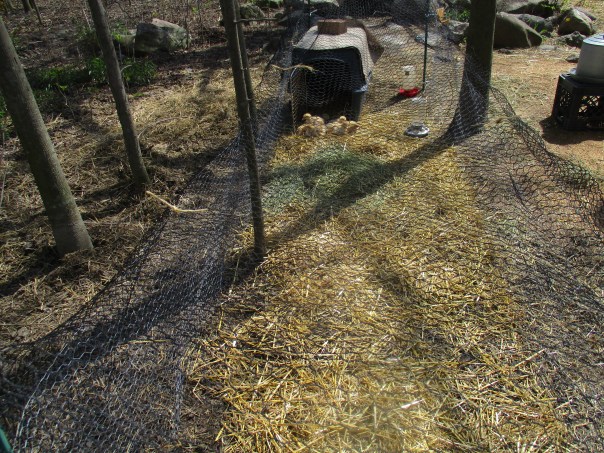
or maybe I should say “The Meat Chicks”. The plan for these chicks is to raise them only until they are large enough to butcher. Regardless of the title we have begun introducing the chicks to the farm and the rest of the flock.

IMG_2525

We set up a 12′ x 3′ run, made out of 2 foot chicken wire, near the chicken coop. We left the dog crate inside the run so the chicks could get out of the sun or wind if they need to. We covered the run with netting so the chicks can’t fly out and the other chickens or overhead predators can’t get in. We thought the chicks would go into the crate as darkness comes, this would make it easy to bring them back to the brooder for the overnight hours. We quickly learned there is a flaw in this plan. Even though the chicks spent time in and out of the crate during the day, as darkness approached all of the chicks were outside of the crate. The first night I chuckled as my husband told me that he had to crawl around the pen to catch them all and put them back in the crate. The second night I actually lost our bet when we arrived at their pen to find them all huddled next to the crate. My creative husband, who was willing to try anything so he would not have to crawl around on his hands and knees again chasing chicks, took out his flashlight, turned it on, and put it in the crate. Immediately all 10 chicks went into the crate on their own. That’s when we realized that unlike our older chickens that always return to their coop when darkness comes,    these chicks have never know darkness. The warmth that they require at their young age has always been provided by a heat lamp during the overnight hours.  They were seeking light or maybe afraid of the dark.

“I didn’t know if that would work,” 🙂 my husband said as he carried the crate to the van, but we are thankful that it did as we plan to continue this for a week or so until we feel they are ready to move to the farm permanently.

Dressing Things Up

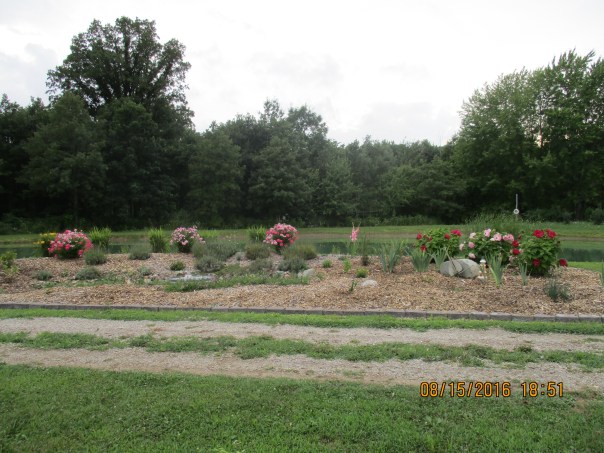
In 2013 when our prayer garden started to take shape it was only about 1/3 of it’s current size. To dress it up that spring I remember buying 8 bags of mulch. It was not enough. I ended up making a second trip for 4 more bags.

IMG_1651

The following year, after we had expanded the prayer garden to nearly it’s current size, buying bags of mulch was just not feasible. My husband took his pickup truck to the local landscape supply and brought me a truckload of mulch. When I had emptied the truck and spread all that mulch in the prayer garden, it wasn’t enough.  He made a second trip and brought back another truckload of mulch so I could finish the job right.

The next year the prayer garden had expanded slightly to it’s current size and since it is a main focal point on the farm dressing it up is important to us. It took three pickup loads of mulch that year to do the job. This was getting to be expensive.

Last year we decided to take a different approach. I had read that often times tree trimming companies will deliver free mulch if they are in the area and need a place to dump it. There is actually a website where you can sign up to have mulch delivered. https://freemulch.abouttrees.com/#!/home  Rather than take our chances with this website, hoping that maybe one of the companies in our area participate, we decided to take a more direct approach. Last May when I saw a crew trimming trees in our community I immediately told my husband. He found where they were working and stopped to talk to them. He asked what they do with the mulch. He was told they usually take it back to their facility and sell it. He told them if they wanted a location near buy to dump a load we would love to have some. He left them with the address to our farm and his phone number. We didn’t really hold much hope that we would be getting mulch from them, but later that day when we arrived at the farm we were pleasantly surprised.

IMG_1197

This mulch was a little crude. It had larger pieces and some whole sticks that apparently passed through the shredder unscathed, but the price was right. I was more than happy to pick out the pieces that didn’t belong as I spread the mulch over the prayer garden. Not only did we have enough to cover the entire prayer garden we were able to use it for some other projects as well.

IMG_1193

We used it to build up a couple of pathways through the woods, and we mulched around our currant and blueberry bushes.

This year we have a different priority. We had an extremely wet winter and that weather pattern has continued on in to spring. I am hesitant to curse the rain as for several weeks last summer it was so dry we were praying for rain. So since we can’t change the weather we have to find a way to deal with it. Our property is old farm land that has not been graded, groomed or manicured, as a result we have high areas and low areas. In wet seasons the some low areas do not drain and become either puddles of standing water or just a mucky mess. We decided we needed to work more on drainage by building up the low areas. We talked about using wood mulch, but since our supply from last year was nearly gone we thought saw dust might be a better option.

We are blessed to have a friend who owns a saw mill in the area and we thought we could get a couple truck loads of sawdust pretty inexpensively. When my husband went to get the first load he found that there was an abundance of saw dust and our friend refused to take any money for it. “Just get it out of here” he told my husband. So my husband shoveled the back of his truck full of sawdust and brought it to the farm.

IMG_2427

We started by dressing up the area around the chicken coop.

IMG_2437

The second truck load was spread in the apiary and a third load we used to build up another muddy area that we use often.

While sawdust might not be as effective as mulch for weed control, it will certainly help build up low areas, absorb water and eventually biodegrade.


2017 Maple Syrup Season Is Over

The following picture was sent to me as an email. The sender apparently found it on Facebook. Since I’m not on Facebook I thought I would share it here.

IMG_5103

Our maple syrup season ended Saturday, March 25th . This is the second year we have made our own maple syrup, and I will share some of the things that we learned this year.

We started the syrup season by tapping the silver maple trees on our farm  on February 13th.  The weather over the four weeks that followed was very erratic as was the sap flow. Some days were warm and sunny and the sap seemed to flow good, then the temperatures would drop back down below freezing and the sap would stop. Some of the trees stopped flowing early on, so we moved taps to trees that had better sap flow. We lost track of the amount of sap that we harvested and the amount of syrup we made. I guess next year we should keep a daily log.

A few things we learned about the silver maples are that they seem to have a sugar content equal to or better than the sugar maples. When we cooked the sap down into syrup it took about 10 gallons or 40 quarts of sap to make 1 quart of syrup. Silver maples make a dark syrup with a robust flavor. Silver maples bud out earlier than sugar maples so their sap flow season ends earlier.

We pulled all of the buckets before the wild wind storm that came through on March 8th. At this time the sap flow on the silver maples was to a minimum and the trees were beginning to bud.

The weekend following the storm we had freezing (winter) temperatures, but once the weather began to warm again my husband noticed that the sugar maples in the woods behind our house were not yet budding. With permission from the community manager he set 20 taps in the sugar maples.

From March 13 until March 25th he collect the sap from the sugar maples. The weather was still erratic with some days having great sap flow while others yielded little. As with the silver maples we cooked sap on days when we had collected 10 or more gallons of syrup. On March 25th, when my husband collected the last of the sap, the trees were flowing slowly but had not completely stopped and the sap had not turned cloudy. We were, however, done.  My best guestimate is that we cooked 3 1/2 gallons of syrup all together which at the ratio of 40 to 1 means we collected about 140 gallons of sap.

The syrup made from sugar maples was much lighter in both color and flavor than that of the silver maple. Both are very good.

Our biggest challenge in making syrup is finishing and filtering. Real maple syrup is usually very runny but we like our syrup a little thicker, so we first started cooking it down to a quite thick consistency. When we did this the we were unable to filter the final product, as the syrup was too thick to run through a filter. We discovered that there was no need to filter this because apparently any sand, or niter, had cooked into the syrup. We had no sand settle to the bottom of the jars. The other thing that happens is that the syrup has a tendency to turn to sugar. We didn’t consider it ruined because it still goes good on pancakes, French toast or waffles.

When we began cooking the syrup so that it was not so thick filtering it was still a challenge. We first tried pouring the syrup through a store bought filter. Even though it was still hot enough the syrup just sat on top of the filter. We next tried filtering it through felt. This worked well to remove a lot of the sand, but we still ended up with some sand in the bottom of the jar. After reading some websites I learned that before using the store bought filter it is best to pour hot or boiling water through it. So we tried this and the syrup ran through. Much of the sand was removed but we still ended up with a small amount of sand on the bottom of the jar. The sand is really nothing to worry about as it is largely comprised of calcium salts and malic acid, neither which are harmful when consumed. The act of removing the sand is purely for aesthetic purposes and a must for commercial producers.

It may seem like a lot of time and effort for so little syrup, but we consider this time well spent. Fortunately the season does not conflict with planting, growing or harvest seasons, and it is a great activity to get us out of the house in the late winter/early spring.