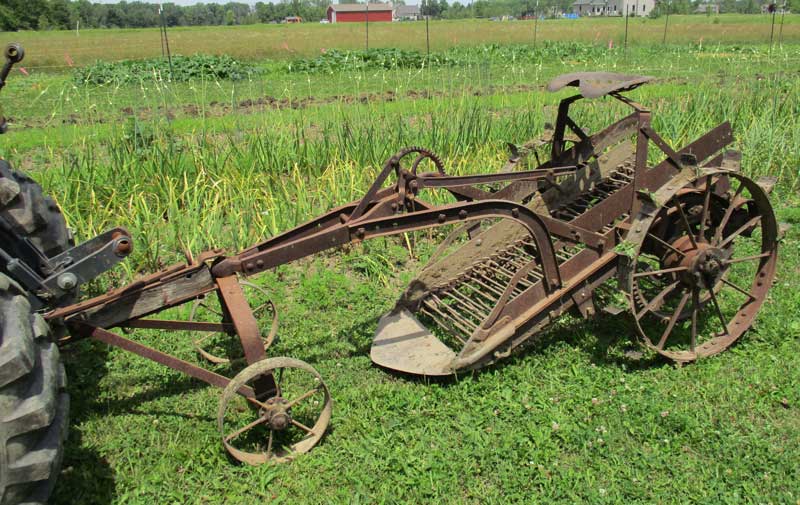
We believe this to be a 1930 John Deere potato digger.
Well the garlic was harvested last week as planned, well maybe not quite as planned, but that part of the job is complete. We had hoped that this antique potato digger, that we purchased last year, would pull the garlic out of the ground, and we would simply have to pick them up from there. Unfortunately the results of this experiment left us with too many bulbs that were either damaged or left complexly under ground while the stem and leaves lay in the field.
So my husband, who should not have even been in the field due to a injury he occurred the previous weekend, got out the shovel and began digging each individual bulb out of the soil. He placed them in trays and brought them to the shaded area, where I was working to remove excess dirt and put them in bundles to dry. At the end of the day all of the bundles were moved to shelves in our indoor drying location, where they will cure for several weeks before the stems and roots are removed and they get a final cleaning.
The job actually took us a total of three days even with some help from the kids. It was exhausting. These were probably the hottest and most humid days of the entire year, and there was just no time for a dip in the pond.
Now that the garlic is drying for the next couple weeks we will attend to other tasks until it is time to clip and clean and sort each bulb before it can be sold.
We grew five varieties this year (listed below). I was surprised as I examined this years harvest, that the varieties that I expected to produce larger bulbs seemed to only be average size, and the varieties that have not performed as well for me in the past actually seemed to produce larger bulbs. I’m mulling over possible explanations i.e. field location, type of garlic for this years weather conditions, possibility that new varieties were not acclimated to our growing area. One things I know fore sure is, regardless of the size of the bulbs the flavor is superb. 🙂
SPANISH ROJA
A Northwest heirloom brought to the Portland area before the 1900s. Many connoisseurs believe that when well grown its flavor describes true garlic.
RED TOCH
Collected in Rep. of Georgia by Hanelt about 1988, near the town of Tochliavri. Cloves streaked with red and pink. Flavor praised by many. Very popular
MUSIC
An outstanding plant producing very large bulbs. Strong, robust plants stand out in the garden. A sweet and substantial garlic when baked. Hot when consumed raw. A Bestseller.
CHESNOK RED
Our best performing Purple Stripe garlic year after year. Chesnok Red holds shape and retains flavor when cooked. Great choice for baking with a creamy texture. Produces very large bulbs that average 9 to 10 easy to peel cloves. From Shvelisi, Republic of Georgia.
S & H SILVER
Large cloved, originally from S&H Organic Acres. 15 to 20 large cloves per bulb. Clove colors off white to tan with pink blush tip. Bottom half of clove often brownish. Cloves tall and concave. A mild sweet taste that builds in heat and lingers.
I have had a few people ask recently about marshmallow root (an ingredient in my shampoo bar) so I thought I should write about it. With some of the strange food items I add to my soap recipes I can see how one might believe that I was buying a bag of the fluffy, sweet, white treats and somehow turning them into soap. But the truth is, while I, my husband, our dogs, and our chickens all love marshmallows, they are an ingredient that I really can’t imagine would work well as soap. I would however mix them with Rice Crispies and tell you something like “eat it!” or “don’t wash with it”.
The marshmallow root that I am using is from the marshmallow plant (Althaea officinalis) that we grow on our farm. I have found it not only to be a very attractive plant, but very prolific, and the honey bees like it as well. This link describes the medicinal uses of marshmallow. http://www.herbwisdom.com/herb-marshmallow.html I have yet to try any of these uses but likely will in the future. Besides the medicinal uses I have learned that marshmallows, the sweet treat were originally made from the root of this plant, and I intend to try this recipe when we dig more marshmallow root.
2 egg whites
1 tsp vanilla
1/2 cup raw cane sugar
1 tbsp powdered Marshmallow (root)
Whip egg whites until almost stiff. Add vanilla and whip until stiff. Then whip in the sugar, 1 tsp at the time. Finally, add Marshmallow and whip again. Place by teaspoonful on cookie sheet. Bake in 325 oven for 1 hour.
I decided to try adding it to my shampoo bar after reading that it is often used in “natural” hair conditioning products. So when I made my soap/shampoo recipe I first infused the liquid, in this case tea, with marshmallow root that I had dug up, dried, and ground last fall. After the root had infused and thickened the liquid I strained the solids (root pieces) out before combining the liquid with the lye to make the soap. I have to say I am very pleased with this as a soap/shampoo bar and other people have told me they like it as well.
So like most of the ingredients I use in my skin care products this marshmallow is certainly edible, but when using this soap remember “Don’t Eat It!”
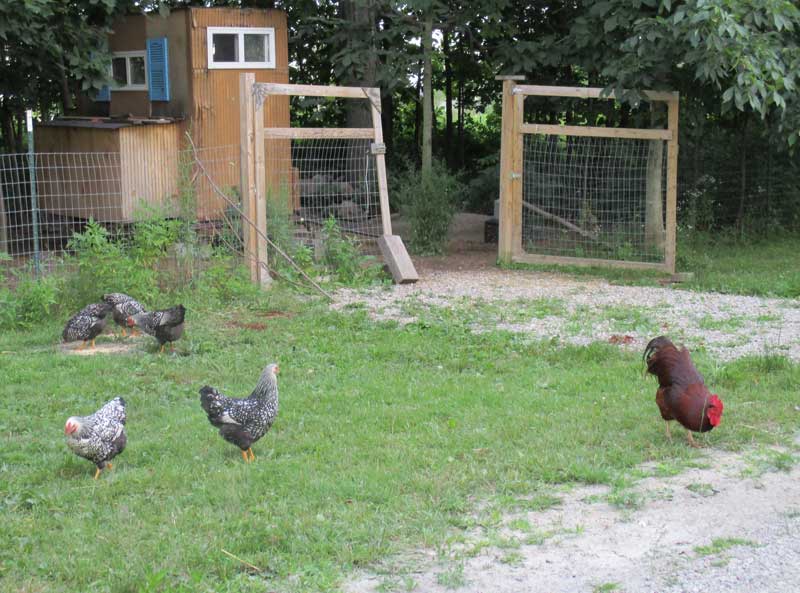
Silver Wyandotte Hens and Rhode Island Red Rooster
Bwawk! Ur ur ur ur urrr!
There is a lot of that going on at the farm. Two years ago, in the spring, we started a flock of 18 Rohde Island Red and Buff Orpington chickens. I love having the chickens. Not only do they provide us with the best eggs I have ever tasted, they are also a great source of entertainment. Our flock is truly free range. They do have a large fenced in area ,but the gate is left open most of the time so they may forage our 7.6 acres, and occasionally, they do the proverbial chicken cross the road thing; the best that I can figure is they do it to forage the neighbors property. Last year my husband and I would often pull up our chairs outside the chicken yard, in the evening, and watch “chicken TV”. It was relaxing, we didn’t have to pay for electricity to run it, and it was far more entertaining than anything on the boob tube.
By this spring, for various reasons, our flocked was down to 8 hens and 2 roosters, so we decided to add 10 Silver Wyandotte pullets. We bought chicks that were only a few days old and brooded them in the house for about the first two weeks of March. When they began to fly up and out of the brooder it was time to move them to the hutch on the deck. We covered it with canvass to protect against wind or rain, gave them warm straw for bedding, and put in a heat lamp to keep them warm. After about another two weeks, when they had most of their feathers, and seemed to be too crowded in the hutch, we decided to move them to the coop with the other chickens. I was a bit nervous about this, because I was not sure how the old hens and roosters would accept the young pullets. I read several websites and books that said, they should be slowly introduced to the flock by doing things like putting them in a separate enclosure where the adult birds could see them and get use to them for a while. None of what I read considered introducing birds this young into the flock. Well, like with wine making, we decided not to do this by “the book”, we would do it “our way” and just accept the results. We took the, approximately 4 week old, pullets and put them in the coop with the others. Though there seemed to be some curiosity from the other hens, for the most part they just left the young ones alone. I guess I should have expected this from a flock of birds who seem more than happy to let all the starlings in the neighborhood share their coop and their food all winter long. The young ones stayed together in the coop, in the yard, and all ten would cram into a single nest box at night to keep warm. It has only been in the last month or so that the Wyandotts seem to be splitting up some and doing their own thing. I attribute our success to two things: first all three breeds, Rhode Island Reds, Orpingtons, and Wyandottes are considered to have mild temperaments, second I can’t help but wonder if introducing the new birds at a young age, before they were ready to become part of the pecking order, did not play a part.
Egg from 5 month old Silver Wyandotte compared to egg from 2 year old Buff Orpington
The young Wyandotte hens recently started laying eggs. They are small and cute, compared to the large and extra large eggs laid by our older hens, but they are just as tasty. The eggs will get bigger as the hens continue to lay.
Two of our Buff Orpington hens brooded and hatched chicks last year. This spring, when one of them got broody we decided not to let her hatch chicks because we did not want her taking up that nest box for 3 weeks, and we felt our flock was at full capacity. She was, however, very insistent, she would not leave the nest, which happened to be the favorite nest box of all of the hens. Apparently she was letting others in to lay their eggs in the box, but production was dropping. She would also peck us and hiss when we would remove the eggs from underneath her. After 2+ weeks of dealing with her I thought we might be better off if we just let her sit on and hatch some eggs. My reasoning was that at least we would know that she would only be in that nest box for another three weeks, (until the chicks hatched) and that possibly after a few days we could move her with the eggs to another nest box, and the rest of the hens would then have their favorite nest box back. That did not work. So, although my husband was not really on board with it, we gave her six eggs that we marked with black X’s. We did not check the eggs to see if they were fertile, but knowing how “active” our roosters are, we assumed some of them would be. We continued to check underneath her daily and usually found one or two eggs that did not have an X. She was apparently letting others in to lay their eggs still. After 20-21days we had 3 eggs hatch. The first one did not make it completely out of it’s shell alive, but the other two were the cutest little fluff balls you’ve ever seen. (All chicks are.)
Now it’s bwawk, ur ur ur ur urrr, and peep peep, peep peep.
Buff Orpington Hen raising two 1 week old chicks
Mother hens, at least the ones that we have, are very attentive to their chicks. It’s fascinating to watch and listen as she teaches them. She is very protective when the others get curious. In the first couple days she taught them to eat and drink from the feed and water dishes we provided inside the coop. At one week old she took them outside and began teaching them to forage. She keeps them close, and she will make soft clucking noises to show them what to eat. After only two days outside she had taught them how to use the ramp to get back into the coop at night. The chicks we had last year took longer to learn this. She will mother them for several more weeks, I think last year the chicks were at least 8 weeks old before the hens stopped mothering them, but eventually they will become just two more chickens in the flock to her and will have to find their own way into the pecking order.
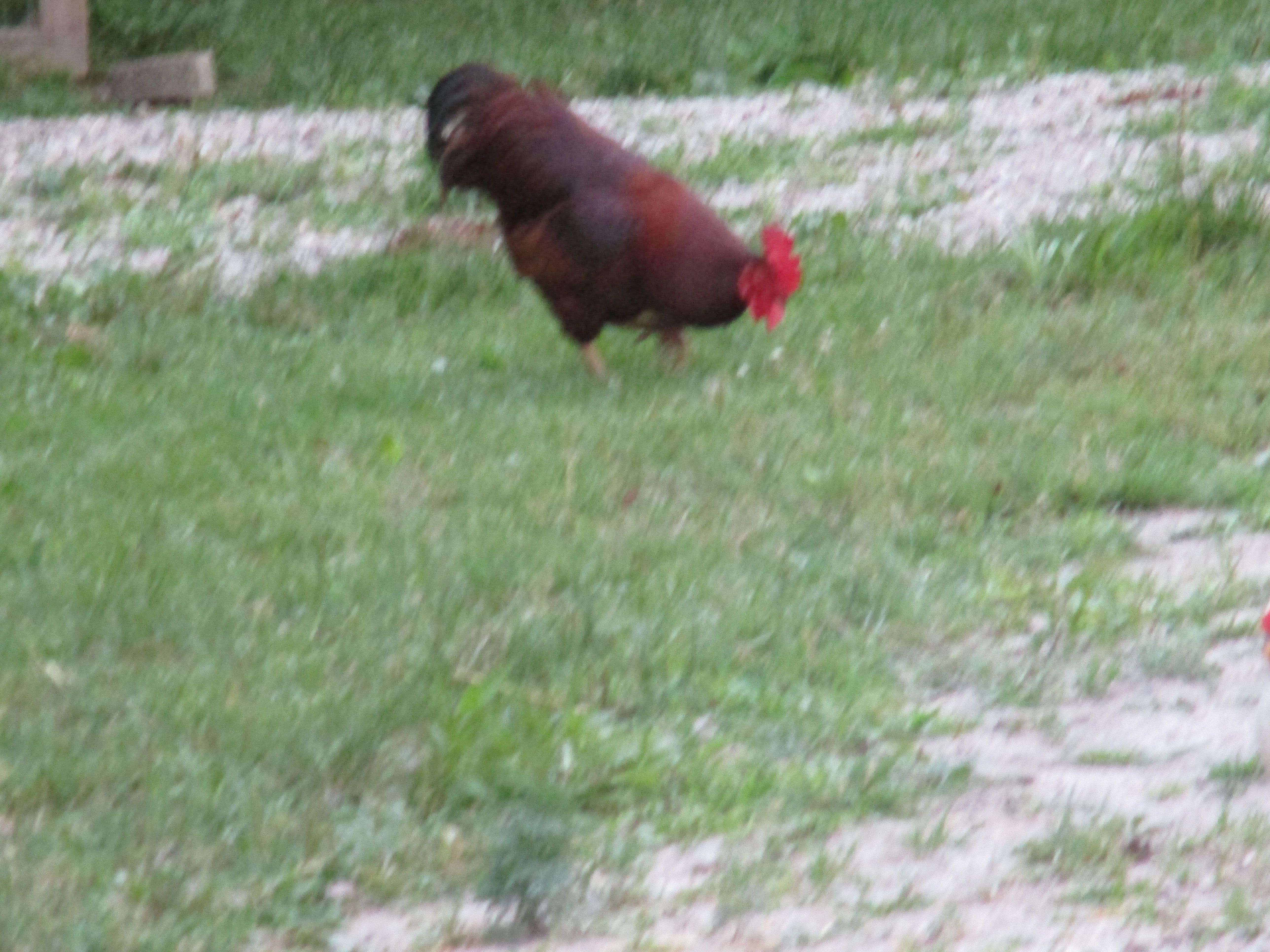
Rhode Island Red Rooster
Lastly, on the subject of chickens, BEWARE OF THE ROOSTER! I’ve know for a long time that Cocky, our Rhode Island Red Rooster, does not like me or does not trust me. I’ve made it a habit not to turn my back on him. We have sparred many times and he has been lofted off the end of my boot several times. A few days after the chicks arrived I went into the chicken yard to refill the water and food for the chicks. I didn’t bother to close the gate since Cocky was no where around. As I was refilling the small chick watering jar/dish I felt something hit the back of my calf. I turned around and saw Cocky, crouched in the sparring position. I tried staring him down, and when this didn’t work, I lofted him with my shoe. Not to be deterred he kept coming at me, so I grabbed a large stick and swung it at him a couple times until he finally walked away. When the battle was over, and I had a chance to look at my leg, I discovered that blood was running all the way down my leg from the spot where his spur had punctured me. I have taken good care to wash and disinfect this wound often in order to prevent an infection, and it seems to be healing nicely. I told my husband that I thought this rooster would look nice on the tines of a pitch fork. Bwawk!
Since the currants were so abundant this year, and I had already made currant jam, I decided to attempt to make currant wine. I had most of the supplies that I needed, but needed to pick up a one gallon fermenting jug and an air lock to fit this jug. I also bought a siphon to use to transfer the wine from one container to another.
I found a recipe online, but being the person who likes to experiment and do things my way, I immediately decided that I did not need yeast enhancer. So I put my currants in a jelly bag and let them sit in the mixture of sugar and boiling water, in my 2 gallon crock, for 24+ hours. It was important to keep it covered because if fruit flies got in they could contaminate the product. After that I squeezed out the jelly bag and took the starting measurements. (if you are a wine maker you will know what this refers to, if you are not, it’s not important) I then added the wine yeast and covered it again. After several days nothing seemed to be happening, so I decided that my way was not working. At this point, I could have trashed the project, or we could have just drank currant juice, but I decided to keep trying. I added a package of active dry yeast and it wasn’t long before I knew that fermentation had begun.
Currant Wine fermenting in the crock
After about 5 days the bubbling had slowed significantly so I decided to check my measurements again and after doing so decided it was time to put it in the jug. So I siphoned it from the crock into the glass gallon jug and put the air lock in place so the fermentation can continue.
Currant Wine fermenting with airlock in place
Of course during the transfer I did get a taste of the product and, to my unrefined palate, it was really good. At this point it had a sweet flavor which is what I prefer in wine. The recipe, (the one I kinda followed) said that this would be a borderline dry wine so, if it turns out anything like the recipe, it may be more to my husband’s liking.
It has been just over a week since I put it in the jug. It is becoming less opaque and a deeper red in color. The recipe says that it can take 4 or more weeks before it is finished, but there are so many variables at play, including the temperature, which has been very warm but dropped some when we turned the AC on one day, and the fact that I completely changed the recipe when I added the active dry yeast, that I really don’t know when to expect it to be done. The only thing I do know is that it looks and smells so good that I’ll be surprised if we don’t drink it before it is actually done.
Well did it happen? You know, that thing that rarely happens. You know, you’ve probably said it… “once in a blue moon,” or maybe, ” once in a full blue moon,” which is actually redundant, since the definition of a blue moon is the second full moon occurring in a month. http://detroit.cbslocal.com/2015/07/29/look-up-rare-blue-moon-to-shine-bright-on-friday/ Last night, July 31, 2015 was theinfamous blue moon.
I have used this phrase at least a dozen times in my lifetime, usually to mean “that’s not gonna happen”. I never realized that I was actually saying, “once every 2-3 years”. That does not seem very rare. I mean, that is every two and a half years on average. So at my age I’ve lived through 20 of these according to this website. http://www.themoonfaqs.com/2010/01/blue-moon-dates_31.html
During the blue moon, the moon is not really blue in color. From what I understand a moon that appears blue would indicate that there was a major fire, volcanic eruption, or something else, that was sending particles into the atmosphere that were blocking out the true color of the moon. Even though it was not blue, and not necessarily rare, it was certainly beautiful. We watched as it began to come up in the east, appearing as a big orange ball, through the trees around dusk. We continued to watch, as we sat by the camp fire and enjoyed the beautiful, peaceful summer night. As it rose high, in the night sky, it became yellow and bright enough that, although the only other light we had was the fire light, we did not need a flash light to see our way around.
I did not note any other rare (every 30 months) occurrences last night, so maybe I’ve been more correct when I say “every other blue moon”, but I think from now on when I’m talking about something that isnot likely to happen, I will say “on the 12th of never”.