Tag Archives: Homesteading

Coming Clean – Aloe Soap With Yogurt

A while back I wrote about making  Aloe Soap with Yogurt  and since my husband and I have recently tested this soap I wanted to share our thoughts on it.

Before I do I find it necessary offer this prelude. When our daughters were growing up we had some pretty strict rules that they had to follow. These rules served several  purposes: help maintain order, live within a budget, teach the girls responsibility and self discipline… One of the rules was that their showers were limited to eight minutes. We generally find that eight minutes is an adequate amount of time for us to get in, wash, rinse and get out. We bought a kitchen timer to keep in their bathroom. They were required to set the timer for 8 minutes and when the timer went off they had to get out of the shower.  It was done on an honor system, but if my husband or I were around when they got in the shower we would occasionally set the timer in the kitchen for 8 minutes to see if they were cheating.

It’s been about two weeks now since I first showered with the new Aloe Soap . I was thrilled with the outcome. The lather was rich, bubbly and creamy, it rinsed off well and left my skin feeling soft and clean.

After I had used this soap for a few days I gave my husband a bar. I didn’t tell him what I thought of it. I just asked him to let me know what he thought. After his shower he told me that he loved the soap. Several (at least four  probably more like six) times throughout the day he repeated to me how much he loved the soap. “That lather is amazing.”

The following morning after breakfast my husband said, “I’m afraid to get in the shower.” His statement caught me off guard and I asked him why. “That soap feels so good I don’t think I will want to get out. I might stay in there for a couple hours until I use up the whole bar.”

“Oh, no!” I laughed. “Eight minutes.”

He said he had already considered finding the timer and setting it. (I’m sure none of the girls took it when they moved out.) He also had wondered, if he did set the timer, if he could/ would cheat.

I found this pretty funny and I thought it was a wonderful testimony for my soap, but knowing that the girls read my blog could I really I confess his temptation to them and the whole world?

He didn’t really get out the timer, and I don’t know whether he stuck to eight minute showers, but I did not notice his showers taking longer than normal. A few days ago he announced to me that the bar lasted him for six showers which is about average for him.

As you now know I did decide to “come clean” because even if the girls try to hold this over his/our head the worst they can do is razz him about it since they are now paying for their own hot water. Hmm, I wonder if they will use this soap.
 

Things I Have Learned About Raising Chickens – Why Did The Chicken Cross The Road?

Let me start by saying that I am no authority on chickens (or anything else for that matter). When writing these posts I am simply sharing what I have learned through experience.

img_1952

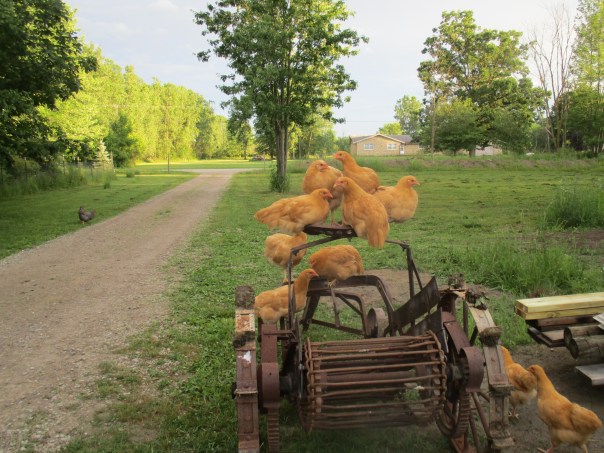
All joking aside – Why Did The Chicken Cross The Road?  I find the answer to this dilemma to be nearly as simple as the lame joke that’s been told over and over throughout the decades. The answer is the chicken crossed the road because it could. Chickens have absolutely no natural boundaries, left on their own they just wander aimlessly and tirelessly scratching and pecking. The world, as much as they can access, is their playground and their dinner table. Chickens are not trainable, they are not obedient, and they have seemingly short attention spans so giving them something to entice them to stay where you want them will only work for a short time.

If there is somewhere you don’t want the chickens to go you must set up a boundary.

IMG_2851

In our case crossing the road is not the worst case scenario. Our neighbors haven’t complained about the chickens foraging in their yard, and drivers who encounter the chickens crossing tend to yield the right of way to our girls. There are, however, some things the chickens find especially enticing, such as freshly worked soil, wood mulch, and straw, and these things can become a problem. Chickens are quick to wander into the freshly planted garden and scratch up all of our hard work. They will dine on the grass seed we just planted, and rearranging the flower bed while digging through a fresh layer of mulch is something a chicken can not resist. It doesn’t take long at all for chickens to destroy all of that hard work.

IMG_1499

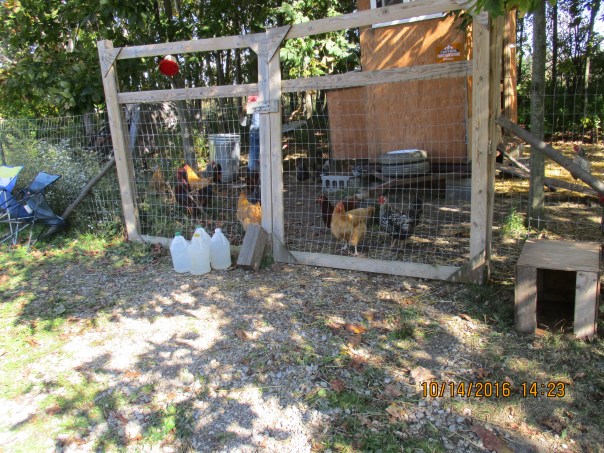
In 2012 when we began planning to raise chickens on our farm we first built the chicken yard. Our chicken yard is what I consider prime real-estate as it is built in a grove of beautiful mature Shagbark Hickory trees. The dimensions are 90 ft. by 45 ft. so the chickens have plenty of room to roam. The four foot high welded wire fence is generally sufficient to keep the chickens  in, although we do have an occasional escapee. In addition to the shade provided by the Hickory trees the chicken yard also had a wide swath of shrubs that not only offers shade from the sun and protection from the wind, it helps to protect them from overhead predators.  Even with all these amenities our chicken yard is not perfect. It does not have the assortment of grasses, clover, plantain and other plants that are found elsewhere on our farm. Thus as much as possible we allow our chickens to roam the farm and forage for their food. We have fence around all of our garden areas that keeps the chickens out but to be fair the fence serves to keep deer out as well.

We have accepted the fact that the mulch in the prayer garden may not always stay pretty and neat, and that we will inevitably find ourselves herding chickens back to our side of the road, but the lower feed costs, the delicious and nutritious eggs, and the insect control provided by our free range chickens https://www.healthambition.com/caged-versus-free-range-eggs-nutritionally/  are certainly worth it.

Thanks for reading and follow along so you don’t miss future posts is this series – “Don’t Put All Of You Eggs In One Basket” and “Chickens Come Home To Roost”.


Planning Future Gardens – A Seed Saving Tip

Spring is just around the corner here in the U.S. and garden planning is in full swing. Are you are gardener who plans to grow several varieties of each type of vegetable? Are you a frugal gardener who will purchase heirloom or open pollenated seeds so that you can save the seeds and not have to purchase seeds again next year or the next. If you are new to gardening it might be worth noting that these two methods of garden management are not necessarily compatible.

When growing multiple varieties of the same plant cross pollination can occur. If two varieties of the same type of plant do cross pollinate the product of that year will not be affected. The plant will still bare the fruit of the seed that was planted. Changes that occur due to cross pollination will only become apparent when seeds from the current years crop are grown in future years. Cross pollination can effect the color, size, and/or shape of the fruit or there may be less visible changes like flavor or texture. While the product would still be edible you may be sadly disappointed with the results.

102_0656

Squash and pumpkin crosses (like the one above) are usually visually apparent. Changes in corn or tomatoes might not be as noticeable.

I have included the some links that you might find useful in preventing cross pollination

https://faq.gardenweb.com/discussions/2766772/how-do-i-prevent-tomatoes-from-cross-pollinating

https://agrowinggarden.com/blog/what-types-of-squash-cross-pollinate/

http://homeguides.sfgate.com/crosspollination-melons-75606.html

and I hope that all of your gardens are bountiful. 🙂

Fire Starters

IMG_3261

During the winter months we use our wood burning fire place to supplement our heat and lower our monthly natural gas bill. In the summer we often build a fire at the farm. We might use it for cooking our dinner or just enjoy sitting around the fire to unwind at the end of the day. Without the proper materials building a wood fire can be more difficult than it sounds. In the past we have bought fat wood, sticks of pine wood that contain natural flammable oils, in order to get the fire going. This year we decided that the convenience that fat wood provides did not justify the expense. We could do better.

Some of the fire starters that we have used include:

  • Balled up news paper
  • A small paper bag stuffed with shredded paper – out of the paper shredder
  • Cheese cloth or paper towels that I have used for filtering bees wax
  • and my most recent discovery –  A paper towel soaked with bacon grease. When I cook bacon I place a paper towel on a plate and then place the cooked bacon on this as I take the bacon out of the pan.  As the excess grease drains off it is absorbed into the paper towel. I had always just tossed these paper towels in the trash. Last week while I was cleaning up after breakfast and getting ready to start the fire I  though it why not give it a try. I place the greased soaked paper towel in the fireplace under the kindling and lit it with a match.  It got the fire started very quickly. It worked so well that the following day when I was going to start the fire ( but hadn’t cooked bacon again) I took about a teaspoon of bacon grease and put it on a piece of scrap paper. I folded the paper, put it in the fire place under the kindling and lit it with a match. Again the fire was burning hot in no time.

All of these methods worked well for starting a fire and coupled with the fact that we used things that we had on hand, that might otherwise been tossed in the trash, I would consider this a win-win.

Do you use a wood fire for heating your home or enjoy sitting around an outdoor fire  when the weather is nice? What methods do you use for starting a fire? Please share them in the comments section below.


Things I Have Learned About Raising Chickens – Which Came First?

After starting with the toughest lesson so far, I  am happy to back up to the beginning and on a much lighter note answer the question –

Which came first? The chicken or the egg?

This post is not going to be a debate in creation verses evolution nor is it going to be a lesson in biology. The fact is you really should not spend too much time pondering this question at all as it could potentially cause undue stress in your life. Don’t you have enough of that already??? So just forget this question and move on to much more important things unless………………………………………………………………………………………………..

…….you want to enjoy the goodness of fresh eggs from your very own chicken. If this is your desire then you will first need a (female) chicken. Probably the easiest way to do this is to obtain (beg, barter, buy…) pullets or hens. In this case (and this is the way we do it) The Chicken Came First.

Now if you are a contrary type person who likes to experiment or live life on the wild side, you might choose to hatch your own chicks. To do this you will need some form of an incubator and some fertile eggs. We have never hatched eggs in an incubator so you will have to look elsewhere for instruction. If you do indeed successfully hatch your own chicks you may join the ranks of those who can argue that in their case The Egg Came First.

That being said, if you are indeed going to raise chickens in order to produce eggs you will probably want to know a little about how that all works. In our experience hens will not start laying eggs until they are at least 18 weeks old. Even then there are many factors that contribute to egg production including the breed of chicken you have. We have found our Buff Orpingtons to be the earliest layer of the breeds that we have raised, usually beginning to lay between 18 and 20 weeks of age.

Our coop originally had four built in nest boxes available and for the most part the hens  lay their eggs in the nest boxes.  We didn’t have to provide any training for our hens to do this. It seemed to come naturally. The eggs are collected several times a day and clean straw is added daily and as needed. One year we did have a group of hens who decided to lay their eggs in a hidden outdoor location. Fortunately we discovered them and were able to collect them daily. That is when we added two more nest spaces to the coop. While having enough nest boxes seems to be important it does not mean that they will all get used. We often have several hens lined up waiting for one box while two or three other boxes are empty. Go Figure!

If you take nothing else away from this post, remember this: the only time it is appropriate to ask the question “Which came first….?” is if you are talking someone who raises chickens. Stop the needless stress! LOL

Next in the series: Why Did The Chicken Cross The Road?