All posts by ruthsoaper

Garlic Harvest

Our garlic harvest started this morning. In case you are not a regular reader I have posted the links for the series I did last October about planting the garlic.

https://donteatitsoap.com/2015/10/08/this-is-a-lot-of-work/

https://donteatitsoap.com/2015/10/09/garlic-update-and-cold-and-flu-season/

https://donteatitsoap.com/2015/10/12/another-garlic-update/

https://donteatitsoap.com/2015/10/13/woo-hoo-the-2016-garlic-crop-is-planted/

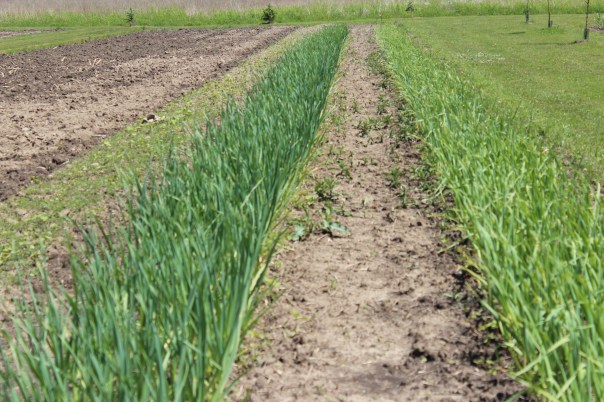
I’ll admit I had concerns about the garlic throughout the winter but my husband continually reassured me that the garlic would be fine. The garlic sprouted before the freeze ever came and then winter brought continual freeze and thaw cycles. The young leaves on the garlic were frost bit.  In spring the garlic was already growing up through the straw mulch so there was no need to pull the straw away. We did give it a small dose of fertilizer.

IMG_1272

The month of June was very dry and required much watering along with weeding of the garlic.

While watering the plants I began noticing that some of the plants seemed substantially bigger than in past years. The last watering was done during the last week of June since it is recommended to stop watering two weeks before harvesting.

Like with last falls planting we saw no need to do marathon harvest. We decided to harvest one variety at a time.

The rains that finally arrived last week, and brought our ground moisture levels much closer to normal, were such a blessing. We were able to take a break from watering crops and actually took much of the weekend off. The moisture also softened up the ground so digging would be easier. On Friday I decided that we would begin digging the Red Toch garlic on Monday morning.

Kara (my daughter who recently graduated from college and needed some summer work)and I began this project around 9:00 A.M.

IMG_1534

This is my tool of choice for digging garlic. The long narrow blade is perfect for loosening the soil close to the individual plants and digging deep enough to loosen the roots. The handle is also at a comfortable height for me.

We worked as a team, while I loosened the soil around the plants, Kara picked them up and shook up the extra soil.

IMG_1527

I was immediately amazed at the size of the bulbs. We both used phrases  like “Wow “or “Look at that!” or “WOW!” several times. “Some of these are the size of small apples” I told her. Truthfully I believe that at least 90% of the bulbs we dug today were as big or bigger than the original seed garlic that I purchased 4 years ago.

IMG_1525

We stacked the garlic in trays to carry to todays outdoor drying station.

IMG_1537

We placed them on tarps and layered them so the bulb parts were exposed to the air, the purpose being to allow the rest of the soil that is stuck to them to dry so it can be brushed off. Todays cloudy skies also proved to be a blessing, because while I wanted the bulbs exposed to air I did not want them baking in the hot sun.

IMG_1532

Guess who showed up to help. Kara, who was not fond of all the worms and spiders she was seeing, was happy to see this girl.

IMG_1536

I don’t have an exact count, but there are somewhere between 800 and 900 hundred garlic plants that we dug this morning. It took us about two hours to get this much done. Once the soil dries and can be brushed from the bulbs they will be moved to indoor drying shelves for the next two to four weeks where the bulbs will continue to dry or cure.

While I am super excited about this bountiful harvest, I am assessing the growing season to determine what factors contributed. The first thing we did differently was change the location of the garlic bed. This plot, which in previous years had served as our main garden, was tilled last summer and then seeded with clover as a cover crop. Throughout the summer as the clover would grow up we would mow it down before it could go to seed. Just days before we planted garlic last fall the clover was tilled under. The soil in this plot was much more of a loam than a clay compared to our previous garlic beds.  The drainage in this area was also very good. The straw mulch aided in keeping the weeds down. For this particular variety the warmer winter temperatures were probably beneficial as Red Toch is a soft neck  garlic, and soft neck garlic are normally grown in the south or in warmer climates. I am certain that the early fertilizer as well as the watering and weeding throughout the month of June aided in the growth, but I also remember the simple prayer that we said after we planted our garlic last fall. “Lord please bless our efforts.”

Yes, I am sure that each of these factors has played a roll in producing such a extraordinary crop, and even though the entire crop is not yet harvested, our prayer today is, “Thank You, Lord”.


Chicken Fun

We often find our chickens providing us with great entertainment. Sometimes in the evening, before they are all inside, we will even sit down near the coop and watch, what we call, chicken TV.

IMG_1407

This is Honey. She is one of our oldest hens and has always loved my husband. This particular evening she was curious about what he had in his hand.

IMG_1411

She then decided she wanted to sit on his lap. When she pays attention to me she is usually pecking at my ring, my buttons, or my jeans.  Honey has and will always have a special place in our hearts.

This young buff decided my lap was a good place to sit. The Buff Orpingtons are definitely the most friendly breed we have.

IMG_1367

We have a group of Silver Wyandotte’s that like to visit the campsite around dinner time. They like to check out what is on the grill, and despite my warnings that someday that could be them, they keep showing up and begging for food.

IMG_1369They are also interested in what the dogs are eating. If they get too close Trooper will pounce at them to scare them away. He doesn’t hurt them though and they just keep coming back. They have learned that they will often end up with some kind of “treats”.

IMG_1496

Anytime we do landscaping the chickens are sure to show up especially if it involves fresh topsoil. They love to peck and scratch and most of all dust themselves in the newly placed dirt.

Yesterday evening  as my husband and I were filling in this trench at least a dozen hens showed up to add the finishing touches. My husband would shovel the soil into the trench, pack it down, put another layer on top and rake it so it was even with the ground on either side. The chickens would then peck, scratch, and then nestle their little bodies down into the loose soil leaving nest shapes holes in the soil.

While we may not have the prettiest landscaping we do have happy chickens 🙂

Strawberries At Last!

It’s been my dream for more than a decade to grow a nice strawberry patch, ever since the first year I made homemade strawberry jam and my family loved it so much that store bought strawberry jam was no-longer welcome in our home. Since growing our own berries would lower the cost involved in making homemade jam, we decided to put in a strawberry patch. We started with a few plants in a raised bed, and over the next several years made several strawberry beds in our yard. We never yielded more than a few handfuls of small berries, so every June, when the strawberries were ripe, I would go to one of our local strawberry farms and buy at least 2 (10 quart) flats of fresh, Michigan grown strawberries and make most of them into jam.

When we bought the farm in 2011, having a nice strawberry patch was still one of my dreams. After we got the garden area worked up, where I would plant perennial plants, I moved some of my strawberry plants from the house to the farm. We planted, mulched and watered the plants and watched them take root, but within a few weeks tragedy struck. The deer discovered our strawberry patch. The plants were being eaten and some even dug up. It wasn’t long before the strawberry patch was completely annihilated. I have to admit that I was, and still am, baffled by the fact that wild strawberries grow all over the farm and go completely untouched by the deer, yet the strawberry plants we put in were devoured.

Since fencing is our best option to protect our food against deer, in the fall of 2014 the area, known as garden number 2, was fenced in. The following spring we planted strawberry crowns. I think we put in about 30 of them. Since the deer were now denied access to the area the plants were able to develop and grow. Being their first year we saw only a few blossoms that developed into small berries before the plants began making runners. We left all the runners in tact and our two rows of strawberries became one big strawberry patch.

This spring the plants were quick to green up and they had loads of blossoms. We picked our first, and probably our biggest, berry on June 5th. It was big, beautiful and oh so sweet.

IMG_1347
Our first strawberry compared to a quarter

A few days later we picked about two quarts, and then the daily picking became a two person job. For about a week and a half we picked daily with each picking yielding between 4 and 10 quarts.

Since I didn’t have time to make jam I decided to freeze the berries. After washing and cutting the stems I let them dry on a paper towel.I then put them on trays in the freezer to freeze them individually before putting them in quart size freezer bags.

I made strawberry shortcake for dessert. The strawberries were so good they did not need added sugar, but the shortcake was horrible so I won’t share the recipe.

After I had about 30+ quarts in the freezer my husband suggested dehydrating some. It took about 4 quarts to fill up my nine tray dehydrator.

IMG_1394

It took less than 24 hours to dehydrate them.

IMG_1395

The nearly 4 quarts turned into less than a quart when dried. These sweet little strawberry chips are delicious on their own, but they can be added to my morning oatmeal, cooked into pancakes, muffins or sweet breads, added to yogurt, or mixed into a trail mix.

IMG_1424Since the berries were still coming I decided to make my jam. I made 20 pints of strawberry jam.

The following day I called two of my sisters who I knew were planning on making jam as well. For about the next 5 days they took turns getting the berries we picked the night before. I think they each ended up with between 12 and 15 quarts of berries.

One of my sisters sent me a recipe for strawberry lemonade concentrate that she had made and really liked, so yesterday, when the weather had cooled, I canned 7 1/2 quarts of it. Here is the link for the recipe.  http://www.sbcanning.com/2012/04/strawberries-and-summer-strawberry.html?m=1 

We are so thrilled and thankful for a bountiful strawberry harvest this year.

Coincidently, or not, the day after we did our last large strawberry picking we picked our first ripe blueberry.


Garlic Scapes

IMG_1393

What are garlic scapes???

They are the seed heads produced by hardneck garlic varieties. They appear in the spring, and if left to grow they will flower and produce dozens of tiny garlic bubils (seeds). Most growers cut the scape off the garlic plant in order to allow the garlic to put more energy into growing a bigger bulb. If cut early the scapes are tender and delicious. They are said to have the same nutritional value as garlic bulbs, and although they possess a milder flavor when cooked, they are a culinary delight. They are great roasted, grilled, stir fried or used raw in dips, salads and pesto. To discover great garlic scape recipes simply do an internet search for garlic scape recipes. They are only available for a short time in the spring but can be preserved by freezing or pickling.

IMG_1426

I will be selling garlic scapes at the Memphis farmers market tomorrow morning, in Memphis, Michigan, from 9 a.m. until 1 p.m. or if you are interested in purchasing garlic scapes send me an email at ruth20012001@yahoo.com put “garlic” in the subject line.