Category Archives: homemade

Two New Soap Recipes

I am really excited about the two new soap recipes I made this week. The soap I made on Monday was inspired by the dandelions that are popping up everywhere screaming “spring is here.” I decided that those yellow beauties might just make a nice soap.

Usually before I try something new with a soap recipe I do an internet search to see if others have done similar. Artisan soap makers are a creative bunch and it seems there is not much they haven’t tried and wrote about. I did indeed find several sites with dandelion soap recipes, stories, and for sale. I do not use other peoples recipes but I like to get an idea of how others have used particular ingredients, what the results were and if there is anything major that might go wrong.

By this time I have learned that when adding botanicals to cold process soaps you will very rarely capture any fragrance and I have no way of testing to see if any potential therapeutic benefits from them survive the process. The most I could hope for is to capture some of the cheery yellow color. Hoping to double up on any benefits I infused both the water and the oils with dandelion flowers. I decided to add honey as well.

This recipe is now out of the molds and has a deep yellow color. It still has to cure for about six weeks and doubtless the color will change as the soap cures. I’ll let you know how it turns out.

Todays soap experiment is maple. When I did my internet search for maple soap I found that maple syrup is often used as an ingredient in handcrafted soap. My plan was a little different. When my husband was collecting sap to make syrup this spring I asked him to save me a couple of quarts so I could make a batch of soap with it. “Are you sure you know what you are doing?” he asked. I explained that I plan to use the sap in place of the water in my soap recipe. He graciously obliged my request and I have kept the sap in the freezer waiting to be turned into soap.

One morning when we were having our homemade syrup on our pancakes and I looked at the sugar sand that had collected at the bottom of the jar and wondered about using it in soap. Will the sand particles remain sand or will they dissolve during the processing. I remembered reading that it is mostly composed of calcium salts and malic acid. It is not harmful to eat and upon further research I learned that those ingredients can be beneficial for skin care. Again I can’t make any claims about my soap providing these therapeutic benefits because it is questionable whether they survive the soap making process. The sand in that jar was gone before I had a chance to tell my husband that I wanted to save some for making soap. We had a few more jars with sand at the bottom, so I opened one this morning, poured most of the syrup into an empty jar and put it in the refrigerator for future breakfast. The sand and a small portion of the syrup that was left in the bottom of the jar were added to my soap.

The maple soap, if it turns out well, will definitely be a seasonal soap and I expect the sweet dandelion soap will be as well. Although they won’t be ready for 6+ weeks you can contact me by email ( ruth20012001@yahoo.com) if you are interested in purchasing either of these soaps. 🙂

2017 Maple Syrup Season Is Over

The following picture was sent to me as an email. The sender apparently found it on Facebook. Since I’m not on Facebook I thought I would share it here.

IMG_5103

Our maple syrup season ended Saturday, March 25th . This is the second year we have made our own maple syrup, and I will share some of the things that we learned this year.

We started the syrup season by tapping the silver maple trees on our farm  on February 13th.  The weather over the four weeks that followed was very erratic as was the sap flow. Some days were warm and sunny and the sap seemed to flow good, then the temperatures would drop back down below freezing and the sap would stop. Some of the trees stopped flowing early on, so we moved taps to trees that had better sap flow. We lost track of the amount of sap that we harvested and the amount of syrup we made. I guess next year we should keep a daily log.

A few things we learned about the silver maples are that they seem to have a sugar content equal to or better than the sugar maples. When we cooked the sap down into syrup it took about 10 gallons or 40 quarts of sap to make 1 quart of syrup. Silver maples make a dark syrup with a robust flavor. Silver maples bud out earlier than sugar maples so their sap flow season ends earlier.

We pulled all of the buckets before the wild wind storm that came through on March 8th. At this time the sap flow on the silver maples was to a minimum and the trees were beginning to bud.

The weekend following the storm we had freezing (winter) temperatures, but once the weather began to warm again my husband noticed that the sugar maples in the woods behind our house were not yet budding. With permission from the community manager he set 20 taps in the sugar maples.

From March 13 until March 25th he collect the sap from the sugar maples. The weather was still erratic with some days having great sap flow while others yielded little. As with the silver maples we cooked sap on days when we had collected 10 or more gallons of syrup. On March 25th, when my husband collected the last of the sap, the trees were flowing slowly but had not completely stopped and the sap had not turned cloudy. We were, however, done.  My best guestimate is that we cooked 3 1/2 gallons of syrup all together which at the ratio of 40 to 1 means we collected about 140 gallons of sap.

The syrup made from sugar maples was much lighter in both color and flavor than that of the silver maple. Both are very good.

Our biggest challenge in making syrup is finishing and filtering. Real maple syrup is usually very runny but we like our syrup a little thicker, so we first started cooking it down to a quite thick consistency. When we did this the we were unable to filter the final product, as the syrup was too thick to run through a filter. We discovered that there was no need to filter this because apparently any sand, or niter, had cooked into the syrup. We had no sand settle to the bottom of the jars. The other thing that happens is that the syrup has a tendency to turn to sugar. We didn’t consider it ruined because it still goes good on pancakes, French toast or waffles.

When we began cooking the syrup so that it was not so thick filtering it was still a challenge. We first tried pouring the syrup through a store bought filter. Even though it was still hot enough the syrup just sat on top of the filter. We next tried filtering it through felt. This worked well to remove a lot of the sand, but we still ended up with some sand in the bottom of the jar. After reading some websites I learned that before using the store bought filter it is best to pour hot or boiling water through it. So we tried this and the syrup ran through. Much of the sand was removed but we still ended up with a small amount of sand on the bottom of the jar. The sand is really nothing to worry about as it is largely comprised of calcium salts and malic acid, neither which are harmful when consumed. The act of removing the sand is purely for aesthetic purposes and a must for commercial producers.

It may seem like a lot of time and effort for so little syrup, but we consider this time well spent. Fortunately the season does not conflict with planting, growing or harvest seasons, and it is a great activity to get us out of the house in the late winter/early spring.


For Garlic Lovers

I am a bit afraid that things are getting somewhat confusing on my blog since I’ve recently written about soap and sap, but I still feel the need to add this post about a soup that I made recently. To be clear this is definitely a recipe to eat but I would not recommend bathing with it 🙂 .

The soup which I might call cream of potato with mushroom and garlic was loosely based on this recipe  http://allrecipes.com/recipe/13131/cream-of-garlic-soup/ . I’m really not sure how much you have to change a recipe before it can become your own, but I am fairly sure that the original recipe would be good as well. I didn’t precisely measure most of the ingredients so I’ll just share with you the changes that I made to this recipe.

I started with three medium size bulbs of garlic, I peeled each clove and minced it in the garlic press, this was at least 3/4 of a cup maybe more. I heated the olive oil in a pan and then added the minced garlic to the hot olive oil and turned off the heat. I had also peeled, cubed and boiled three good size potatoes. Instead of white wine (in the original recipe) I increased the amount of chicken broth to about 3 1/2 cups. I added the garlic/olive oil to the chicken broth. I drained and mashed the potatoes. I then began using a mixer to beat the potatoes and slowly adding the broth. If you decide to use the mixer like I did, instead of a blender that is recommended in the original recipe, it is important to add the broth slowly because at some point the mixture might become so thin that it begins to splatter. Take it from me, you really don’t want to find yourself washing it off the counter, walls,  your shirt and anywhere else it happens to land. When the mixture did get too thin to use the mixer I found that I was able to stir in the rest of the broth. I put this mixture on the stove over medium heat, stirred in about 3 cups of half and half and added about one teaspoon of salt.

While that was cooking I washed, sliced and sautéed about 12 ounces of fresh mushrooms. I then added them to the soup. I let this cook over low heat for about an hour, stirring every now and then to make sure it was not scorching.

As my title says this soup is for garlic lovers. It does have a very strong garlic flavor. Yumm!  I am not sure that I would like it as much without the mushrooms and it might even be better with cheese melted on top.

As garlic farmers we are interested in all things garlic, so I invite you to share how you like to use garlic. Do you use it medicinally? Do you have a favorite recipe? Please feel free to comment on this page.


Soap Of The Week – Pumpkin

Lately it seems that I have traded (Don’t Eat It!) soap making for (I can’t wait to eat it!) sap/syrup cooking, so I didn’t make this, or any soap in the past week, but the Pumpkin Spice Soap that I made back in December is ready.

This is not a new recipe. In fact I think adding pumpkin to soap was one of my first experiments in soap making, probably 7 or 8 years ago. “You’re out of control! 🙂 ” was my husband’s response the first time I made this. He has laughingly repeated this phrase several times since – coconut soap, coffee soap, peanut butter soap. Nowadays, however, he is more likely to instigate a new recipe, than he is to be shocked but my creations.

I have made changes to the recipe over the years, but I am very pleased with the ingredients that I am now using.  The fats/oils that I use are olive oil, coconut oil and tallow. This combination makes a hard bar that lathers nicely and rinses off well.

The other ingredients I add to this soap are pumpkin (our home grown), cinnamon, nutmeg, and sugar. While pumpkin, cinnamon and nutmeg are all said to be beneficial in skincare, I really can’t say whether they retain their beneficial properties though the soap making process. They do however add color and a light, spicy fragrance to the soap. When sugar is added to a soap recipe it is said to intensify the lather.

When each batch of soap has been cured for at least six weeks my husband and I test the soap before anyone else gets to use it. Our test is simple – grab a bar and hop in the shower. “It’s a nice soap,” my husband said after showering with this batch of pumpkin spice. After my critical evaluation I think the word that best describes this soap is fun. In case you’re thinking, “this woman needs to get a life,” please remember that soap making is a big part of my life. I say “fun” because I enjoyed the light cinnamon/nutmeg scent of this soap, and the nutmeg which has a bit of a coarse texture felt like small sand particles embedded in the soap –  adding a bit of scrubbing power, but mostly it was fun to see the large bubbles magically appear as the soap was rubbed across wet skin. It does develop into a rich lather that feels really nice. This is a soap I am pleased to sell.

If you are interested in purchasing this or any “Don’t Eat It!” soap or skin care products found in my store email me at ruth20012001@yahoo.com and put soap in the subject line.


The Week’s Soap- Hops

My original plan for this week was to make the soap I call “Hint of Mint” which is made with mint leaves infused into the water as the liquid, and mint leaves imbedded in the bars as well. This all changed when I announced to my husband “I’m going to make soap tomorrow”. As I mentioned this to him he was in the midst of moving a hops vine that had been hanging and drying in our backroom for several months. “You could make hops soap” he said.

I began pulling the dried flowers or seed cones off the vine, I crushed some up on a plate, I smelled them and I said “why not?”. I decided to infuse the hops into the liquid that I would use to make the soap, so I heated some water and put the crushed hops flowers in it. I let them infuse overnight.

I then went to the internet to do a little research. I really didn’t know anything about hops except that they are used to make beer.  I found many articles such as this one, http://www.stylecraze.com/articles/surprising-benefits-of-hops-for-skin-hair-and-health/#gref that tell of the potential health benefits of hops. I found that hops are being used therapeutically in the forms of tea, tinctures and essential oils. They are also added to skin and hair care products. I felt good about this experiment.

Before making the soap the next morning I strained the hops flowers from the liquid and set them aside in case I decided to put some in the soap. The hops infused water was bright yellow and smelled like hops. While I was pretty certain the scent would fade away, I thought this liquid would give the soap a yellowish color.

I occasionally have people tell me that they are allergic to specific ingredients in soap, and I like to be able to offer alternatives, so for this soap I decided to leave out the olive oil. I decided to use coconut oil, sunflower oil and tallow. With that in mind I went to this soap calculator, one of my favorite online tools http://soapcalc.net/calc/SoapCalcWP.asp  to formulate my recipe. To use the soap calculator I enter the amount of each oil or fat that I want to use and the calculator will tell me the correct amount of liquid and lye that I need to use. It will also give me an idea of how my soap will turn out, using a numeric scale to rate the degrees of hardness, cleansing, conditioning, bubbliness, and creaminess the soap will have. I adjust the amounts of each oil/fat until I am satisfied that the soap will have sufficient amounts of each of these properties. I really do love this soap calculator; it has allowed me to successfully formulate all of my own soap recipes. It is a free online tool and I would recommend it for anyone who wants to create their own soap recipes.

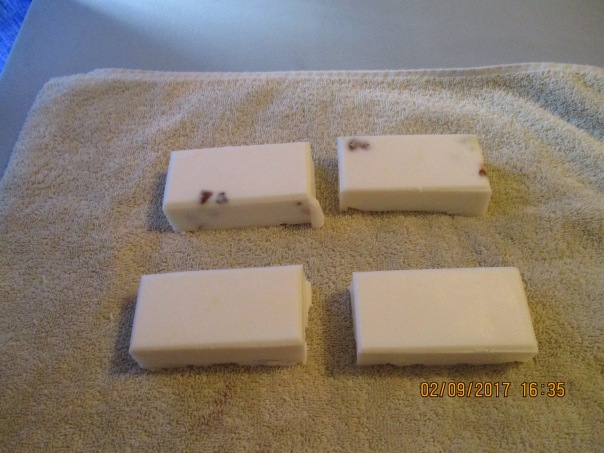
It was no surprise that when I added the lye to the liquid the smell of hops was no longer present. I was, however, surprised when I added the lye liquid to the oils that the yellow color also disappeared. The soap turned white. I decided to add some of the hops petals to one tray (half the batch). I didn’t want to over do it, a lesson I learned from making soap with clover blossoms in it (too many blossoms make a big mess in the shower). I thought maybe I could just have some on the top layer of each bar. Since the soap gets poured into the bottom of the mold I put a layer of petals down before putting in the soap. Even though I tried carefully spooning the soap onto the petals they still floated up into the soap. Oh well you can’t win ’em all.

After two days in the mold the soap came out easily.

img_2234
Hops Soap

These are a hard bars of soap evidenced by the way the edges cracked when I cut them into bars. In about six weeks we will test this soap and discover what else we like or don’t like about it. I keep you posted.