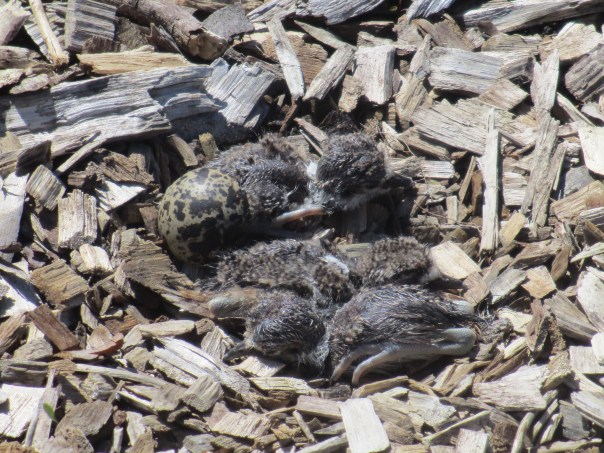
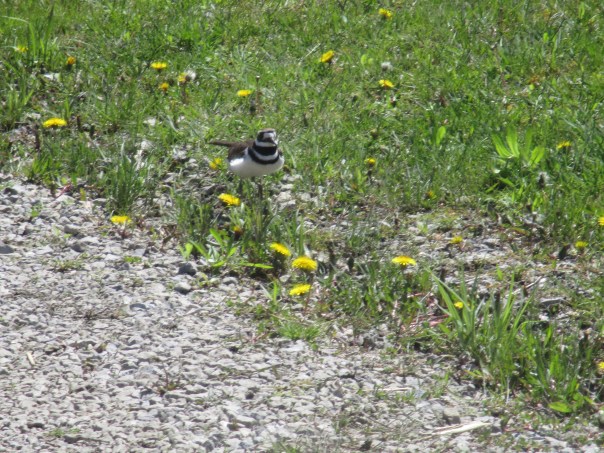
I didn’t make it out to the farm until yesterday afternoon. As I walked past the prayer garden I and looked for the killdeer eggs this is what I saw.
“They weren’t hatched this morning” my husband said.
Both parents were near by screeching and doing the broken wing act to try to get us out of the area. I expect the babies will be running all around the area soon. I am happy that I can weed that side of the prayer garden now.
My husband’s main task for the day was cleaning frames from the bee hives. He first lets the bees do their part. He sets out the frames that still have honey and wax and lets the bees take what they want. Once they stop visiting a frame he finishes cleaning it before putting it back in a hive.
As I walked around the farm I observed bees foraging amongst the apple blossoms. I made many attempts at photographing them. They were too busy to pose for a picture, so this was the best I got.
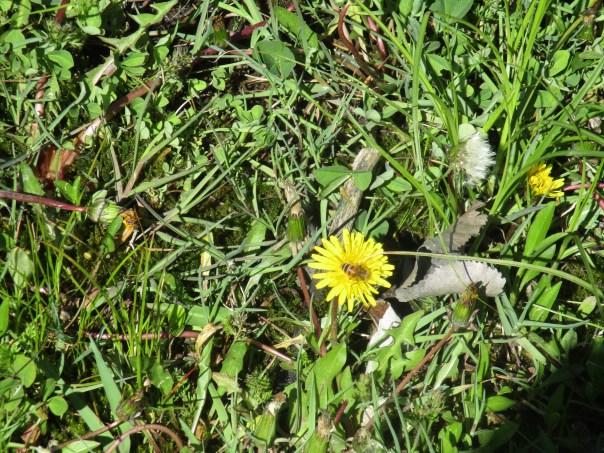
The bees were also collecting a lot of dandelion pollen. This lady stopped for a few seconds, so I was able to get a clear shot before she moved on.
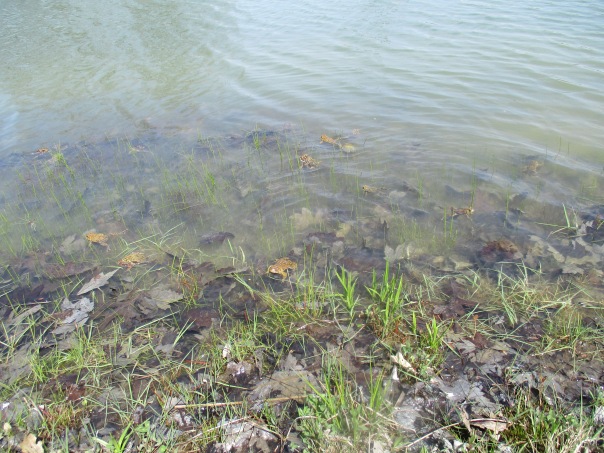
Last week we observed something that neither my husband, who has spent much of his life around ponds, creeks, rivers and lakes, or I have ever witnessed before. The toads had all made their way to this shallow grassy area of our pond and were mating there.
There were too many to count and as we stood there watching more toads were arriving for the party.
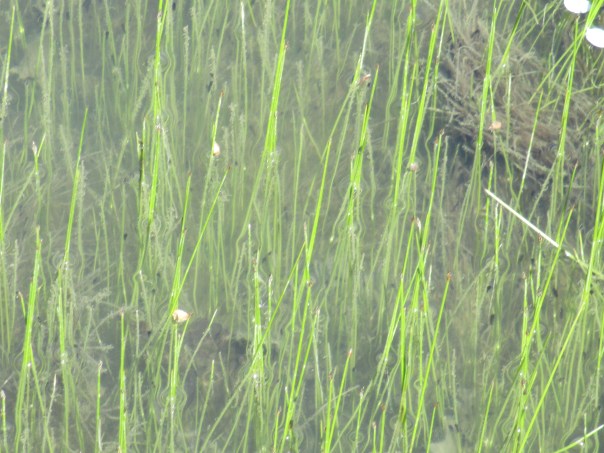
Yesterday as I walked by that area of the pond I noticed tiny black tadpoles apparently just hatching.
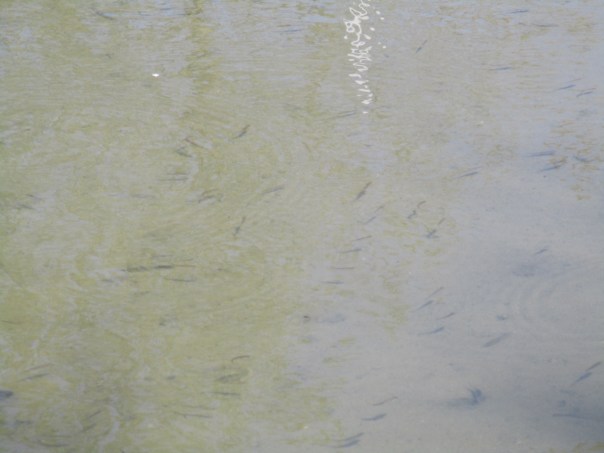
We also spotted minnows swimming in the beach area.
For the past two years only one of our young lilac bushes has blossomed. When I mentioned this to my son-in-law last summer he suggested that I spread wood ash around them. Last fall I did spread wood ash around all of the lilac bushes and some of our apple trees as well.
This year 10 of our 15 lilac bushes have blossoms.
Our apple trees also have more blossoms than they ever have before.
Several years ago around just before Mother’s day my husband and I planted some trilliums in a wooded area of our farm. These were one of my mom’s favorite wild flowers, and we planted them as a tribute to mom who passed away the same year we bought our farm.
Mom’s trilliums are beginning to bloom, appropriately, in time for Mother’s day.
Visitors are another common sight at the farm during the warm weather seasons, and it was good to have our first visitors of spring.
Two of our daughters, Kara and Lindell, stopped by for a visit yesterday afternoon. They were dancing as they came up the driveway since my husband had a classic rock station playing on the radio.
Over the weekend, as we looked ahead at the 10 day weather forecast and saw that 8 out of 10 days were predicted to have high temperatures above freezing, we decided it was time to tap maple trees. Here is the link to my past from last year about tapping maple trees. https://donteatitsoap.com/2016/02/20/tapping-maple-trees/?iframe=true&theme_preview=true
So yesterday, (Monday, February 13) we set a total of 18 taps (and buckets) in 8 maple trees at our farm. It seems early to be tapping the trees, but the sap began flowing as soon as the taps were in place. I guess, like many things farming related, weather conditions mean more than the date on the calendar. We also set up a fire pit where the sap will be boiled down.
Today, after lunch, we went to the farm to collect the sap. When all 18 buckets were emptied we had collected 10 gallons of sap. Our plan is to collect the sap for the next couple of days before we begin boiling it down. Our intention is to leave the taps in place, and continue to collect sap and make syrup, as long as the sap runs clear. When the sap turns cloudy maple syrup season is finished.
Throughout the month of December the chickens’ egg production gradually slowed, and through the month of January we only collected one or two eggs per day. Last week we began getting 5 or 6 eggs daily and now we are up to 8 or 9. As the days grow longer, and the chickens enjoy more sunny days, egg production will continue to increase. This makes feeding the hens all winter worth while.
The bees were out today when the afternoon temperature climbed to around 50 degrees. I don’t think there was anything for them to forage, but at least they could take a cleansing flight. Later this week when temps get back into the 50’s we will check their food supplies and feed them if necessary. We do have honey and wax reserved for them so we do not have to feed them sugar water. We did lose one hive earlier this winter. We could not determine the reason for the loss, as the hive was not full of dead bees. At this point it seems as if the three remaining hives are okay, and we plan to start two new hives in May. We will also capture swarms to if the opportunity arises.
Regardless of the date on the calendar, or the groundhog’s prediction, all signs on the farm are pointing to an early spring.
I told my husband that I need a t-shirt that says “I brake for bees” but probably more appropriate would be a bumper sticker pasted on the back of our riding lawn tractor.
This may be something only another beekeeper can understand, and even among beekeepers I might be in the minority. It wasn’t something that I thought about before I realized I was doing it, but as I mow the lawn at the farm I often see honey bees foraging on the dandelion or clover blossoms. My natural reaction is to yield them the right of way. Of course having wrote the check to purchase packages of bees, along with reaping the rewards of their labors, I have a great understanding of their value. Now it may or may not be the case that they will move out of the way of the mower just like the chickens and dogs move out of the way of vehicles at the last minute, but I am just not certain.
Few other creatures get this kind of consideration but among them are frogs, toads and snakes.
This past summer, my husband, who is totally on the same page with me as he has been known to get off the mower and move a toad to a safe place before continuing to mow, and I decided to restrict our mowing to the later evening hours after the bees were mostly back to the hive. It may be crazy, but I consider this a small sacrifice to help keep our hives healthy and strong.
This title should really be “Bee Where?” We were anticipating a delivery of packaged bees on Friday. We had placed the order back in January – three packages of bees to be delivered the first week of May. My husband received a call from the apiary during the first week of May telling him that the bees would be delayed a week because of weather. The bees were to be shipped on May 11.
I received an email from the USPS on May 11 stating that the bees had been shipped from Tennessee. They were sent second day priority mail. They had left that post office at 4:30 pm on May 11, and our expected delivery date was May 13th.
Friday, May 13th came and even though he hadn’t received a phone call, my husband stopped by the post office in the morning since he was already in town. The bees had not arrived yet but they were expecting another truck around 11:00 A.M. When we hadn’t heard from them by about noon, he called the post office and was told that the bees were not on that truck. The online tracking had not been updated since the bees left the Tennessee post office at 4:30 P.M. on Wednesday. Frustrated, we resigned ourselves to the fact that even though the weather was not forecast to be favorable for it, we would be hiving bees on Saturday.
Saturday morning when we got up, I checked the USPS website and the tracking had still not been updated. My husband kept his phone nearby awaiting the frantic phone call from the post office eager to get those things out of there. By 9:30 when the call did not come he called them again. Still no bees, but they again were expecting a truck in an hour or so. Again around noon he made the call to the post office. No bees, was their answer, and was he sure they were shipped. According to their website, which still had not been updated, they were.
At this point we were not only frustrated, but also left with a lot of questions. Where are the bees? Will they ever arrive? Will they be alive and healthy when/if they do arrive? What happens if they are not?
Sunday, May 15, 2016 I checked the USPS tracking site and received this message “The package is delayed and will not be delivered by the expected delivery date. An updated delivery date will be provided when available. Your item departed our USPS facility in GRAND RAPIDS, MI 49588 on May 15, 2016 at 3:17 am. The item is currently in transit to the destination” Checking the website several times later on Sunday gave me the same results.
This morning, Monday, May 16 the USPS tracking finally reported that the bees were at our local post office. My husband also received a phone call telling him that the bees were there. He went to the post office and upon his return one look at his face told me that things were not good. I felt like crying when I saw that all of the bees were dead.
The feeder cans still had plenty of sugar water in them so we know the bees did not starve to death. Without knowing where the bees were for the past five days leaves us only guessing that, since we have had overnight temperatures in the 30’s, the bees perhaps froze to death.
It’s hard to define the emotions we felt today- sadness about the death of so many bees, disappointment that we will not be starting the new hives as planned and anger that perhaps feels like hopelessness because we don’t know who to be angry with. We can’t blame the entire USPS and I sure we will never have an explanation as to why this happened, but somewhere along the way their system failed. We trusted them to deliver our bees in just two days. It ended up taking more than twice that long and it cost the bees their lives.
I am certainly not writing this to bash the USPS, if fact I have always been satisfied with their service, and the two previous times the we received bees through the mail we did receive them alive, healthy, and in just two days.
Bee Packages Received Through USPS in 2013
It’s been a pretty quiet and somber day around here today, and we are now waiting for a return call from our supplier to see if they will ship more bees or our money will be refunded.
I am glad I did not publish at this point, because it turns out there is more to the story. Even though it was difficult to get motivated to do anything else, because of this whole ordeal, my husband decided to go to the farm and getsome tractor work done play on the tractor for a while. Shortly before I expected him home my phone rang. When I answered, my husband informed me that we had just received a gift from God. One of our hives had swarmed, and the swarm had landed in a spot where he could capture it.
I grabbed some honey, that we had saved for feeding the new bees, and my camera, and headed to the farm. He filled the feeder so he could place it on top of the hive as soon as he got the bees inside, and I snapped a couple of photos.
My husband captured the swarm by brushing them, with his gloved hands, off the branch and into a five gallon bucket. He then dumped the bucket into a hive that we had ready for the new bees. He made a second trip up the ladder to get more bees that had gathered on the branch.
So our day ended on a positive note, with a message from God saying, “Hey, don’t worry. I got this.” I believe the moral of this story is, that people will fail you, but God will not.
Since we decided to become beekeepers I have read many recommendations about what to plant for the bees including the above picture. I feel very strongly that it is important for the health of the bees that they have a variety of foods (plants) to forage. Although it is not our only consideration when deciding what to plant, planting for the bees is something that we have been doing since we bought the farm and decided to become beekeepers.
Other things we take into consideration are:
1. Is the plant annual or perennial? Except for food and herbs we usually don’t plant annuals.
2. To know if a perennial will survive it is important to know the hardiness zone that you live in. Some plants that are perennial will not survive the colder temperatures of our winter and some will not even grow long enough to blossom.
3. It is also good to know the growing conditions that the plant requires – type of soil, wet or dry, and sun or shade are all important considerations when deciding where to plant something.
4. I love things that have multiple purposes. So I consider other uses for the plant – are they edible, medicinal, a good cover crop that will nourish the soil, or simply planted for their beauty ?
5. I also have to consider what critters will eat these plants before either the we or the bees can benefit from them. I have found some plants that the deer and rabbits simply don’t bother with, yet there are many others that have to be fenced in order to protect them.
6. When planting for the bees, another thing to consider is the bloom time of the plant. It is good to have plants that blossom at different times of the year. Early spring is probably the time when the bees are most in need. As they emerge from their hives in the spring, their winter food stores are running low if not depleted, they need to be able to find food in order to survive.
What we have planted:
Lavender was a plant of choice before we ever knew we were going to become bee keepers. I originally planted lavender at the house because I loved the plant, loved the fragrance, loved the dried flowers that could be made into sachets, sleep pillows, tea, or infused into oil. I also add them to my chamomile/lavender soap. It was on the plants at the house that I first observed honey bees foraging and realized what a good bee plant it was. When we bought the farm, planting lavender was a no-brainer and it is now a large part of our prayer garden. Another thing that I appreciate about lavender is that deer and rabbits leave it alone.
Our Prayer Garden
Thyme is also grown in our prayer garden. It is a low creeping plant that makes a nice ground cover. It has both culinary and medicinal uses. http://www.delallo.com/articles/thyme Last spring, when the thyme was flowering, I noticed that the honey bees were all over it. I was happy to see this because thyme essential oil is recommended as a natural treatment for varroa mites. While I haven’t seen it written anywhere, my theory is that by feeding on thyme, perhaps, the bees can extract the thymol that is reported to be effective for controlling the varroa mites, thus not requiring human intervention. Thyme is another plant that is not bothered by deer or rabbits. This year I will divide the roots and spread thyme throughout the prayer garden.
Sage and Salvia are of the same family. This link provides a growing guide for the different types. http://www.bhg.com/gardening/flowers/perennials/guide-to-salvias/ When planting sage/salvia it is important to note the hardiness zone for the variety you are planting. I have grown several varieties of sage. They grow well during the summer, and I have been able to harvest their leaves, but since they are not hardy in our (zone 5) growing area they have never blossomed and have not survived our winters. Since they do not flower they are not useful to the bees. On the other hand I do have a salvia plant (I’m not sure what variety it is) that has beautiful purple spiked flowers in the spring and summer. I have had it for three years and the honey bees love it. Salvia and sage seem to be plants that the deer and rabbits leave alone.
Basil – I have grown basil for many years. I use it fresh during the summer and dry it to have on hand year round. I pick the leaves off before it begins to flower and continue to pick them until I want it to flower and go to seed. Late last summer, when I let the basil plants flower, I noticed the honey bees were heavily foraging them.
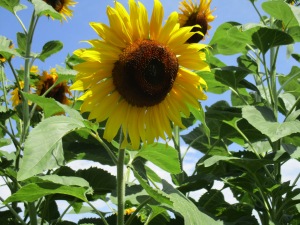
Sunflower is one of the annuals that we grow. I can not speak for all varieties of sunflowers but our bees visit the Grey Stripe Mammoth variety often.
After planting sunflowers once, don’t be surprised if they come up voluntarily in surprising places as these did. They always made me smile 🙂
Asters grow wild in our field. They blossom in the late summer and fall and last year we witnessed the bees feeding heavily on them.
Clover is the one thing that we plant most often, that is great bee food. We sometimes use clover as a cover crop to nourish the soil for future crops, but most often we use it combined with grass seed when we landscape areas. Call me crazy, and you might if you’ve been paying a lawn care company to keep your lawn weed free, but I feel that white clover compliments the grass. It grows at a similar rate, it fixes nitrogen that helps the grass grow, and it is soft to walk on. I also like that if I mow the white clover when it is blossoming, it will blossom again.
Buckwheat – Another plant that we have used as a cover crop that the bees seem to enjoy. Buckwheat makes a dark honey with a strong flavor. It also makes a good cover crop as it grows fast and is said to choke out competing weeds.
Last summer my husband and I were in the garden center department of one of the local home improvement stores. I was looking for more of the salvia plant that I have, but was unable to find any. We noticed honey bees visiting several different flowering plants. You should probably know that for me going to a garden center and not buying plants is almost like going to the Dairy Queen and not buying ice cream. I absolutely hate shopping and the only exception is going to a green house or garden center. I could spend way too many hours and way too much money in these places. That being said we ended up buying some of the plants that we saw honey bees visiting.
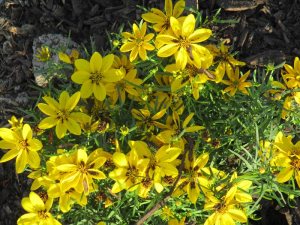
They included a Coreopsis also known as Tickseed.
Tickseed
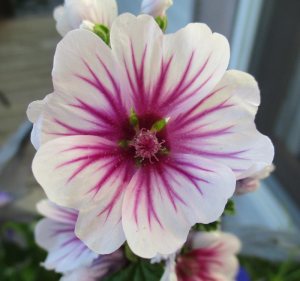
A Mallow
Mallow
and a Balloon Flower that I don’t have a picture of. After planting these in our prayer garden I didn’t notice any bees on them. I suspect that there were so many other things blossoming in the area that the bees did not pay any attention to these flowers. Thus, the lesson I take from this is that my focus should be 0n sticking to what we already have. I will add more lavender, (I started some by seed) I will divide the thyme and let it spread, and perhaps I will divide my salvia in order to have more plants. I will cherish the clover, the asters and the golden rod that grow wild in our field, and I will not curse the thistle (much).

 The bees were also collecting a lot of dandelion pollen. This lady stopped for a few seconds, so I was able to get a clear shot before she moved on.