Category Archives: Chickens

Welcome Spring

This post is dedicated to my friend and fellow blogger Linda who blogs at Walkin’, Writin’ Wit and Whimsy. Linda, who takes readers along as she walks at various parks in South East Michigan and introduces us to the furry and feathered friends she meets along the way, has been as eager as I have for the arrival of spring. On occasion her posts reference classic songs – oldies but goodies –  leaving me with an ear worm for the day. As we welcome spring, Linda, I thought I’d return the favor.

So let me tell ya ’bout the –

BIRDS

Sunday morning as I walked out the door on my way to open up the chicken coop for the day I was greeted by the song of a robin. It is a sound I have become quite familiar with over the past few years as each spring a robin nests in the maple tree outside our bedroom window. He or she starts singing each morning long before the sun comes up, (sometimes as early as 3:30 a.m.) and long before my husband and I are ready to awaken. If the early bird catches the worm then this is one well fed robin.

In Michigan it is said that robins are a sure sign of spring but the truth is that some robins stay in Michigan throughout the winter. Robins that migrate south for the winter are doing so because of the limited food supply available this time of year, not because of the cold temperatures. During the winter those that stay will eat fruit and berries that are left on the trees/bushes.

As I arrived at the farm to open the chicken coop two robins flew swiftly past me. 🙂

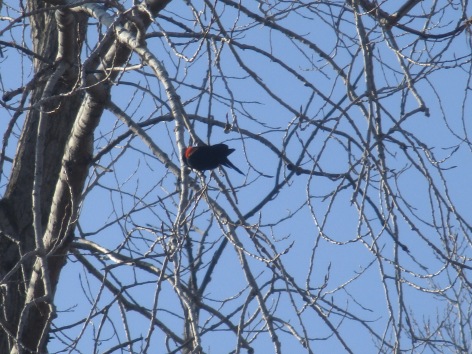
Red winged black birds are also said to be a sign of spring.


IMG_4803.JPG

I spotted this one as Trooper and I walked the back field yesterday.

Our hens have been enjoying the weather and egg laying has increased – we are now averaging about 12 eggs a day from our 23 hens.

IMG_4800

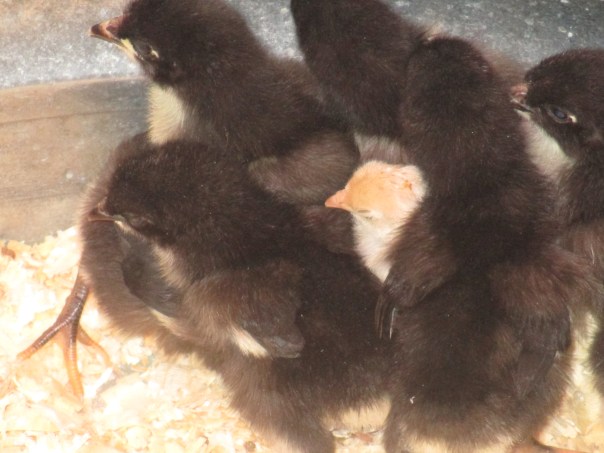
Spring is also the time of year when baby chicks show up in the farm stores. Each year that I have been blogging I have shown pictures of adorable little chicks that will be raised on our farm. Thus far we have only raised egg layer but this year is a little different. These will not be laying hens.

IMG_4799It’s ok to say “awe, they’re cute” – just don’t get attached because they won’t be with us long. (That note is as much for me as it is for you).

and the BEES
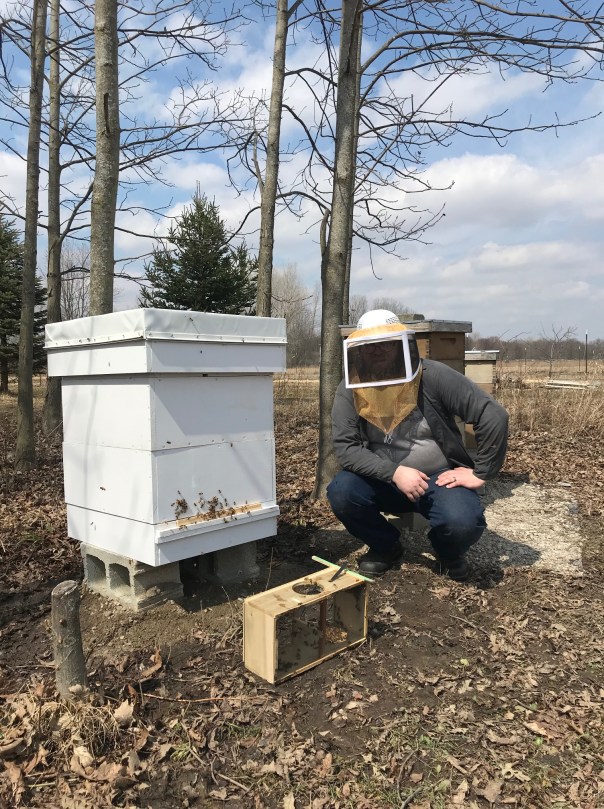
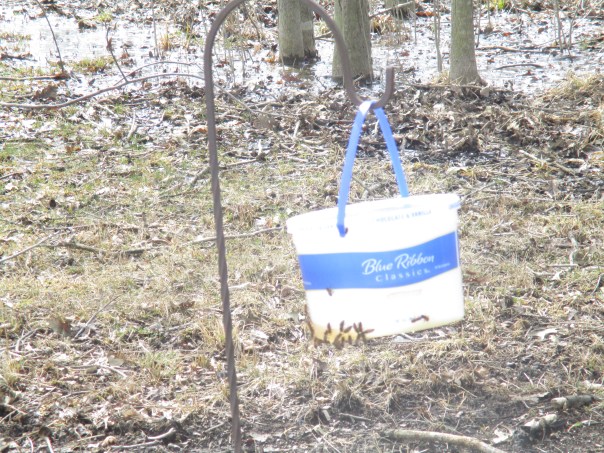
Several days last week temperatures warmed enough for the bees to come out for a cleansing flight. We had just one hive going into winter and were relieved to see that they are still alive. It is not warm enough to open the hive yet and since nothing is in bloom they are still dependent on their winter food stores.

and the FLOWERS

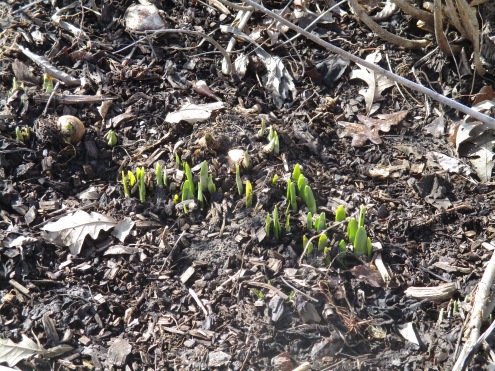
Even more promising than seeing robins were the daffodils that have begun to emerge from their winter sleep.

IMG_4793

Soon we will be seeing their smiling yellow blossoms at various places throughout the farm. 🙂

and the TREES:

We decided not to make maple syrup this year but if  you are interested in how we do that you can check out my posts from previous syrup seasons 2018, 2017 , 2016 and 2016. Based on temperatures that we have had last week and this week I suspect that had we tapped our trees this year we would be cooking syrup this week.

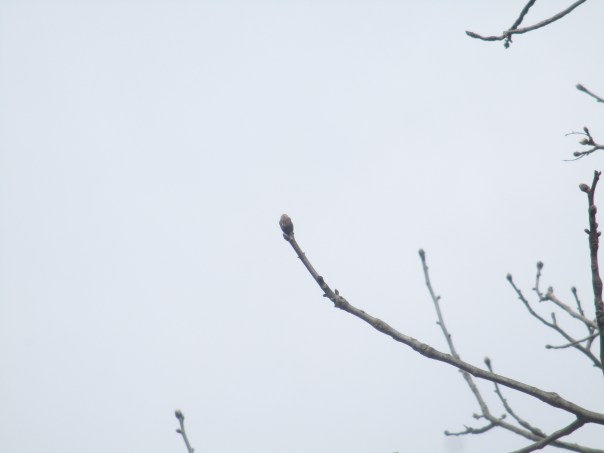
In the past few years it has been my observation that the first trees to bud in our area are the poplar trees. Their flowers, that actually look more like caterpillars, provide resin that is collected by honey bees and used to make propolis.

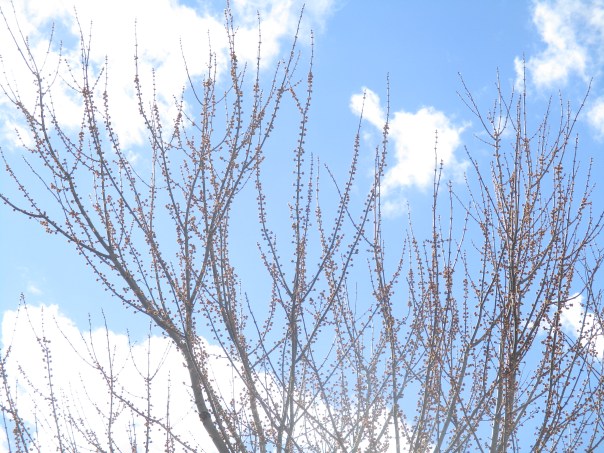
The maples seem to bud out next and while this triggers the end of the syrup season it is good for the bees as the flowers of the maple trees seem to be their first source of food in the spring.

and the Moon Up Above

Last night my husband mentioned that the moon was close to being full. This morning, before daybreak, the sky was clear and the moon was bright. This year spring is being ushered in by the full moon.

IMG_4805


and a Little Thing Called Mud

IMG_4792

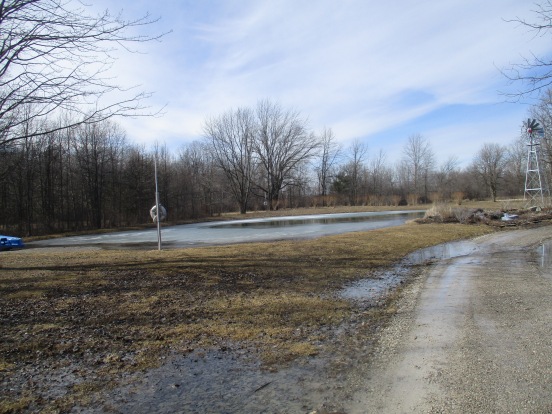
As the snow melts and the ground thaws there is no avoiding it. When you live in the country mud is more than a “little thing”. Water + dirt = MUD. Lots of mud. You learn to deal with it. For us that means wearing a pair of rubber boots and rinsing off our boots and the boys paws with a garden hose before we go into the house.

Over the past 8 years we have learned that starting the year with this kind of moisture in the ground is more of a benefit than a nuisance. By mid June we often find ourselves in a dry spell and are using the pond water to keep our gardens alive.


If there is one this that is certain about spring in Michigan it is that the weather is extremely uncertain. Currently our day time temperatures are getting above freezing while the nights drop back below freezing. Today as I look at the 10 day forecast it shows that trend will continue for about the next week. Tomorrow when I look at the forecast that might change. It’s not surprising to have snow storms and freezing temperatures well into April and even May. On the other hand summer weather might show up at anytime and be here to stay. For better or worse the calendar says spring is here.

WELCOME SPRING! (Happy Dance 🙂 )

What is your favorite season?


Fresh Eggs Year Round

If you have been following my blog for a while now you may remember in this post from last spring I mentioned that we were adding to our flock with hopes that they would continue to provide us with fresh eggs through the winter. At that time we bought 12 chicks – 8 buff orpingtons and 4 black astralorps. When they were just a few days old one of the black astralorps became sick and died. We lost a second astralorp during the summer to some kind of predator, likely a hawk that carried it away, and we lost one of our young buffs due to an injury that wouldn’t heal. Thus we ended up adding 9 new layers to our flock.

I am happy to report that our plan has been a huge success. From December 1st through today our flock has provided an average of 7 eggs per day. Way more than my husband and I use.

Our current chicken count is 24. Here is the lineup –

  •  1 rooster and 23 hens
  • 2 of the hens will be 6 years old this coming spring (probably no longer laying)
  • 2 of the hens will be 4 years old this coming spring (probably laying few if any eggs)
  • 7 of the hens will be either 2 or 3 years old this spring ( we have had so many buff orpingtons it is hard to keep track of which ones we have lost) (should still be laying but maybe not as many as they once did).
  • 3 hens that will be two years old this coming spring (should be laying regularly)
  • 9 hens that will I year old this spring and just began laying late this past summer (laying regularly)

Having excess eggs has allowed us to continue to share them with family and friends. A couple days ago when we dropped some off for a neighbor he told us “these are the best eggs.” My husband replied “because we have happy chickens”.

img_4684

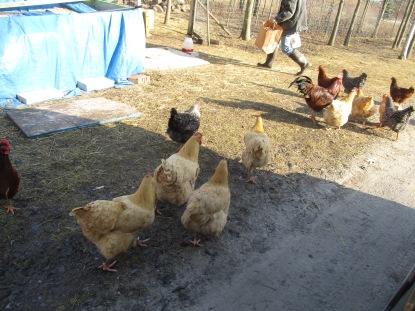
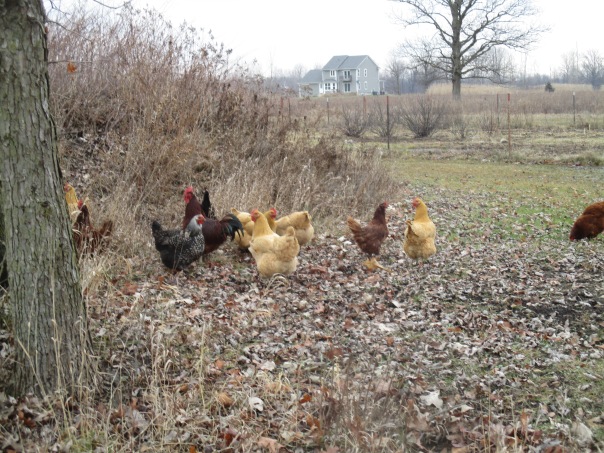
We keep happy chickens by allowing them to free range. They have plenty of room to spread out and peck and scratch and do what chickens love to do. Yes, there are risks involved and some times we lose chickens to predators, but thus far the rewards have far outweighed the risks.

img_4680

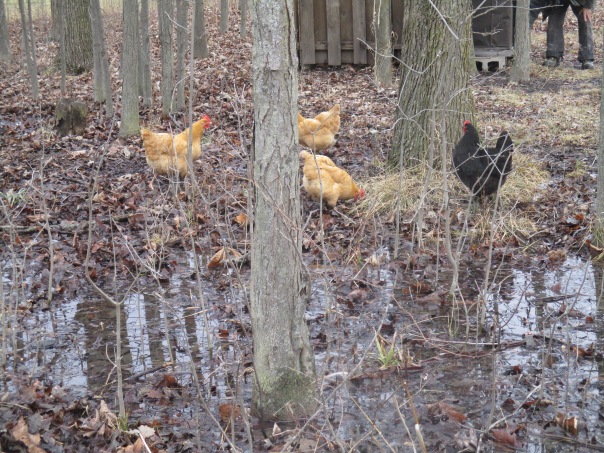
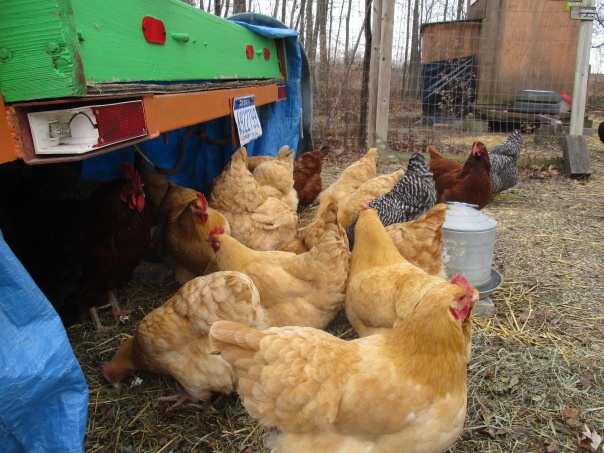
During the winter months it becomes more of a challenge to keep “happy chickens”. While we allow them access to the outdoors every day, when temperatures are bitter cold or there is snow on the ground the chickens seek protection from the elements.

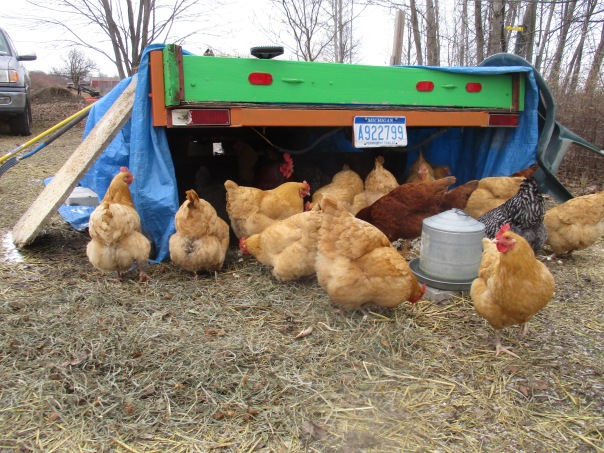
This year my husband made them an additional sheltered area. He pulled our trailer near the chicken yard where it would be stored for the winter. After he blocked up the wheels to keep them off the ground, he  covered it with a large tarp. The tarp drapes over both sides all the way to the ground. He placed bricks on the tarp, both on the ground and on the trailer, to keep it from blowing in the wind.

img_4693

Underneath the trailer he spread straw and hay for the chickens to nestle in or scratch and peck through. He also places their food dish under the trailer each day.

img_4695

Thus far we have had an unseasonably warm winter and snow has been scarce, but on the days that we have had cold winds or snow, the chickens have taken advantage of this shelter rather than stay in the coop all day.

Do these look like happy chickens? 🙂


From Peepers to Laying Hens – Right On Track

When we got our new chicks this past April I estimated it would be some time in August that they would start laying eggs. My estimate was based on our previous experience with Buff Orpingtons; they have pretty consistently started laying eggs at around 18 weeks of age.

Yesterday when my husband gave me the eggs he had collected I was thrilled to discover that the young ones (or at least one of them) had began laying.

If you are not familiar with raising chickens, you may be wondering how I concluded that the young ones were laying by just seeing the eggs. Nope – hens do not sign their eggs or even leave a trade mark. Without monitoring the nest boxes all day long we have no way of knowing who lays what eggs. (We don’t watch the nest boxes all day.)

But…

IMG_4407

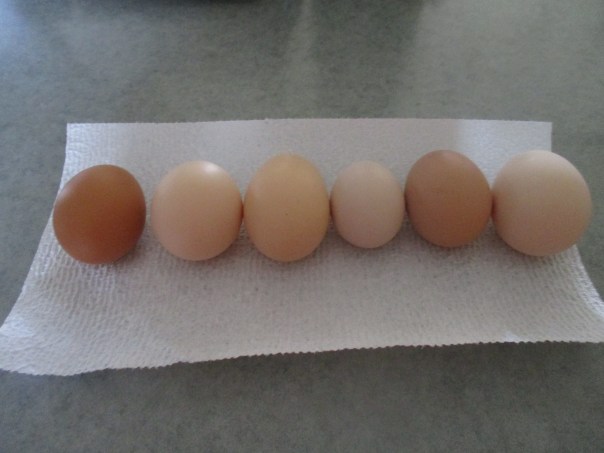
when a hen first starts laying she lays mini-eggs, eggs that are much smaller than normal. In the photo above the smallest egg is from one peepers turned laying hen.

I suspect that it is one of our Buff Orpingtons who gave us this egg, because it is much like the mini eggs we have gotten from Buffs in the past, but the truth is we have never raised Austrolorps before so I am uncertain how soon to expect them to start laying or what their eggs will look like. Some of the other breeds we have raised have produced mini eggs that are much smaller than this one and when opened they only have a small dot of yolk while the rest is egg white. When opened this egg contained both yolk and white that were proportionate to a regular egg.

Today my husband brought home a second mini egg which makes me wonder if a second hen started laying or the same hen gave us small eggs two days in a row. I expect over the next few weeks we will have several mini eggs as all of the girls become regular with their laying.

It’s exciting that our “peepers” are growing up as we are counting on them to keep us in fresh eggs through the winter. 🙂

Thanks for reading. Until next time – be well.

Chickens Come Home To Roost

The idiom “chickens come home to roost”  may be difficult to understand. It is used to relate the fact that actions will always have a consequence and normally applied in a negative way. https://idioms.thefreedictionary.com/chickens+come+home+to+roost Making a connection between chickens roosting and consequences to your actions can be quite a stretch. In order to make this connection there is one thing that you need to realize – chickens always come home to roost.

I admit this was one of my fears when we first started raising chickens – how are we going to get all on those chickens in the coop every night? Well it really doesn’t take much training for the chickens to learn that the coop is their nighttime home.  If chicks are raised by a hen then the hens does all of the training. When we raise chicks this is what we do – we introduce the chicks to the coop at the farm once they have feathered out, usually around four to six weeks. We set up a small pen near the coop where the chicks can spend their days.   You can read about that here. At night we can then gather them up to put them in the coop. The young chicks huddle together at night usually in one of the nest boxes. We continue this routine for about 5-7 days or until the chicks learn to get into the coop on their own. After that when darkness falls the chicks will naturally go to the coop each night. It will become their safe space.

Eventually they will outgrow the nest box, and the need to huddle together at night, and will spend their nights sleeping perched on a roost within the coop. Our coop has roosts at various heights and the chickens tend to seek out the higher roosts. It is a chicken’s instinct to roost high up at night.

We have been raising chickens on the farm for five years and it has been our experience that with few exceptions the chickens always come home to roost. Exceptions – every rule seems to have them so let me share the exceptions that we have found for this rule.

Why The Chickens Don’t Come Home To Roost:

Each night we do a head (beak) count to assure that all of the chickens have returned and are safely inside the coop. If any are missing we do a search. Occasionally we have discovered that a hen has fallen prey to a wild predator and we have found either a headless body or a pile of feathers.

On other occasions we have found that one or more hen(s) have gotten into one of our fenced garden areas because someone, either intentionally or (oops) unintentionally, left the gate open. If given enough time they will usually find their way back to the gate and out of the garden, but when darkness is closing in their instinct is to head in the direction of their coop (the gate is in the opposite direction) and they keep running into the fence trying to get home. (You may have heard that chickens are stupid.)

One other thing that we have experienced, that is really only a partial exception, is when the a hen decides that rather go into the coop she would rather roost in one of the trees outside the coop for the night. The reason that this is only a partial exception is that we have never had a hen try to roost in a tree elsewhere on the farm. They first return to the coop area, then fly up onto what ever tree branch they can get to. Possibly because the branches are higher than the roosts inside the coop, they think this is a good option. It is not! Some nighttime predators can climb trees and we have lost a couple of hens when we have allowed them to roost in a tree at night.

There is one other scenario that, although we have not experienced it, I think is worth mentioning. It is a broody hen. A hen may lay several (or even a whole bunch of) eggs in a secluded area and when she thinks the time is right will begin to brood (sit on the eggs). She will not leave the nest at night to return to the coop. I have read stories of hens disappearing and then showing up three weeks later with a bunch of chicks. What a surprise that would be.

Now if you were thinking about raising free range chickens but worried about having to play chicken rodeo every night, do not fear – chickens come home to roost.

Thanks for reading. 🙂


What I Have Learned About Raising Chickens – Peep, Peep, Peep-Peep

If you walk into the local farm store this time of year you can generally hear them before you see them. Peep, Peep, Peep-peep, peep, peep-peep…………………………………It’s such a precious sound you can’t help but go take a look. If you are not in the market for chicks taking a look might not be a good idea because when you see how cute they are you will certainly want to take one or a dozen home.

Buying chicks from the farm store was actually what my husband planned when he went there on Tuesday. After some debate we decided to replace part of the flock we  lost. Even though the remaining flock is currently giving us between 8 and 12 eggs a day, far more than we need for our own use, most of the hens that remain are between 3 and 5 years old. The main reason we did decide to get more is because for about 6 to 8 weeks during the winter egg production slows down substantially. This past winter we observed that it was primarily our first year layers that were still laying eggs. During that time period they continued to give us enough eggs to meet our needs.  In looking ahead to next winter we decided that getting more chicks now was a good move.

He had to go to two different stores in order to find the breed(s) we wanted.

IMG_3843

Our first choice was Buff Orpingtons. Of the four breeds that we have raised so far these are our favorite. In addition to being a hardy breed, good layers and good foragers, they are docile and friendly.

They can be quite entertaining when we opt for an evening of chicken TV.

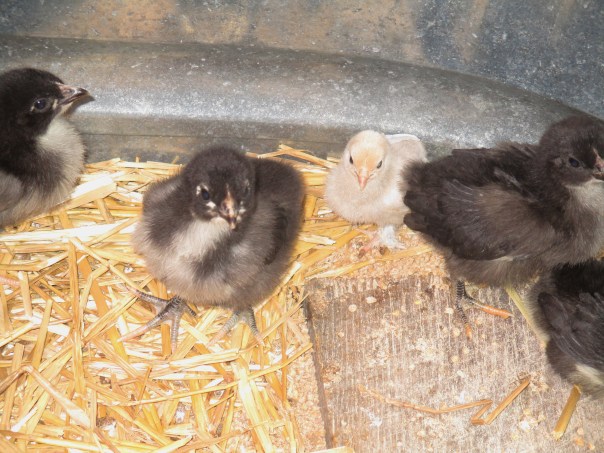
We also decided on a second breed that we have never raised before.IMG_3856Black Australorps. This breed is supposed to be much like the Orpington except harder to spell. Just kidding, they supposedly lay more eggs than the Orpington. They certainly are adorable chicks.

IMG_3860

Peep, peep, peep-peep, peep,peep, peep-peep, peep……………………………………

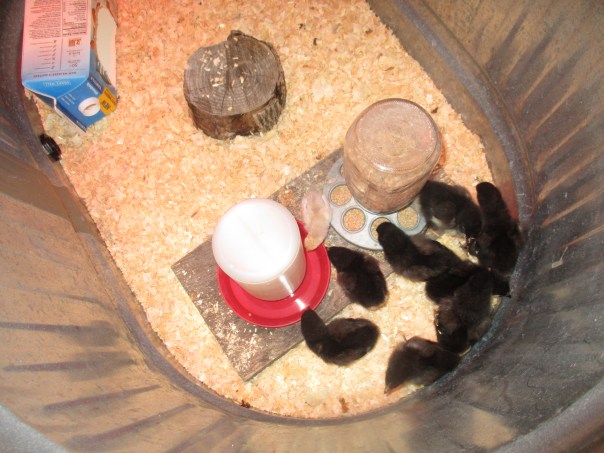
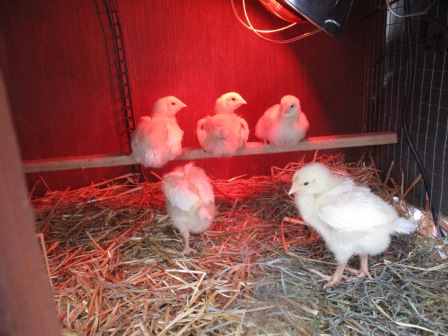
Acting as surrogate parents we got out a galvanized stock tank that works well as a brooder for the first couple of weeks. We used wood shavings for bedding and gave them food and water. I dipped each beak in the water because I was not certain if they had learned to drink yet. We use a heat lamp clamped to the stock tank to keep the chicks warm enough. I also checked each chick’s butt to see if they had poop on it. This is a condition called pasty butt, and if the poop blocks the chicks vent it can cause death. I did find two of the buffs with this condition, so I used a warm wet washcloth to soften the dried poop and remove it.

My husband always likes to make the chicks a little playhouse out of a Silk carton. He cuts a hole in a side so the chicks can go in and out. So far this group seems more fascinated by pecking at it. It’s pretty amazing how much noise those little beaks can make when they are pecking on something hard. It can actually sound like someone knocking on the door. They have started to hop on top of the carton, and I’m sure it won’t be long before the venture inside. It’s surprising how many of them can cuddle up inside that carton.

In about 2 weeks I expect we will see the peepers craning their necks trying to see the world beyond the stock tank. They will also have a lot of their feathers and be discovering their wings. They will be able to get on top of the container that holds their water and attempt to fly out of the brooder. Some might succeed. At this time we will have to move them to what I’ll refer to as our second stage brooder. I don’t have any pictures of this so I will give you an update with pictures when the move occurs.