Category Archives: garlic

A Year In Growing Garlic (Part IX)

IMG_3039

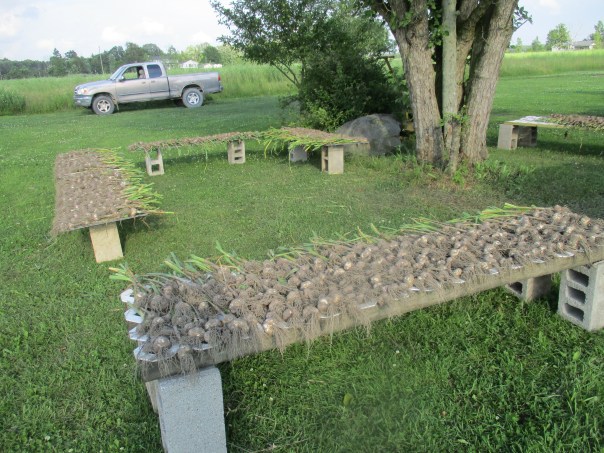
I just wanted to do a quick update to let you know that we have started our harvest and at this time we are up to our ponytails in garlic. Well, I am up to my ponytail in garlic, but my husband who doesn’t have a ponytail is in just as deep.

IMG_3034

To harvest the garlic we have to dig it out of the ground, remove most of the dirt from each bulb, tie the bulbs in bundles the store them in their drying area where they will remain for about three weeks or so until the bulbs are cured. There really is a lot of work involved, at least if you are growing 1000’s of bulbs of garlic.

So if I seem to be MIA for the next week or so there is no need to worry or send a search party or anything. If you do send a search party we will probably hand them a shovel or give a quick tutorial on how to clean and bundle the garlic and put them to work. Hmm, on second thought, go ahead and send the search party. 🙂

IMG_3036

I will do a more in depth post about this as time allows, but I just though I would let you know that if you are growing garlic and have not yet dug it up, you probably want to do it soon. If the bottom leaves are turning brown and drying up it is probably time. A good way to be sure it to do a test dig. If the bulbs are a decent size and have formed cloves it is time to harvest.


Garlic Scapes at Nino Salvaggio International Marketplace

In case you missed my previous post about garlic scapes and are scratching your head thinking garlic what?

Garlic scapes are the seed heads produced by hardneck garlic varieties. They appear in the spring, and if left to grow they will flower and produce dozens of tiny garlic bubils (seeds). Most growers cut the scape off the garlic plant in order to allow the garlic to put more energy into growing a bigger bulb. If cut early the scapes are tender and delicious. They are said to have the same nutritional value as garlic bulbs, and although they possess a milder flavor when cooked, they are a culinary delight. They are great roasted, grilled, stir fried or used raw in dips, salads and pesto. To discover great garlic scape recipes simply do an internet search for garlic scape recipes. They are only available for a short time in the spring but can be preserved by freezing or pickling.

IMG_2731


Yesterday I spent many hours cutting and bundling more than 1500 garlic scapes.

This morning my worked paid off as we delivered the garlic scapes to the Nino Salvaggio Saint Clair Shores, Michigan store.  http://www.ninosalvaggio.com/

The scapes were set out for sale immediately. It was encouraging that the employees at Nino Salvaggio were eager to learn what the scapes were and how they can be used, and they can now share this information with their customers.

We would like to send out a big thank you to Nino Salvaggio for helping us get our garlic scapes into the hands of those who will use them. If you shop at Nino Salvaggio you, too, might want to let them know that you appreciate their efforts to support local farmers while making quality products available to the customers.


A Year In Growing Garlic Part (VIII) Garlic Scapes

It’s time to start cutting the scapes. The music garlic has formed scapes and we want to cut them while they are still young and tender.

What are garlic scapes???

They are the seed heads produced by hardneck garlic varieties. They appear in the spring, and if left to grow they will flower and produce dozens of tiny garlic bubils (seeds). Most growers cut the scape off the garlic plant in order to allow the garlic to put more energy into growing a bigger bulb. If cut early the scapes are tender and delicious. They are said to have the same nutritional value as garlic bulbs, and although they possess a milder flavor when cooked, they are a culinary delight. They are great roasted, grilled, stir fried or used raw in dips, salads and pesto. To discover great garlic scape recipes simply do an internet search for garlic scape recipes or try the pesto recipe at the bottom of the page. They are only available for a short time in the spring but can be preserved by freezing or pickling.

IMG_2731

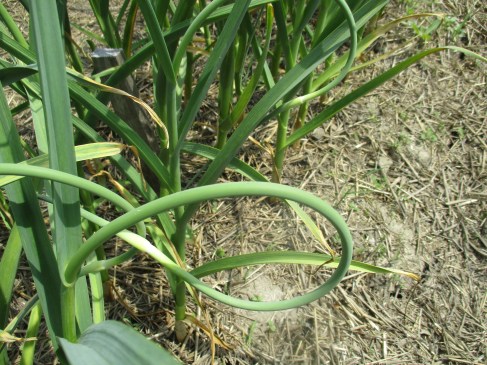
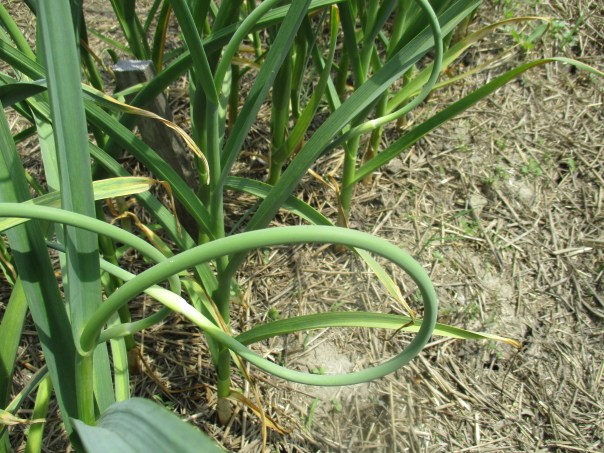
The above is a photo of a garlic scape forming. If allowed to grow it will probably form a second curl before straightening up and forming a seed head on top.

IMG_1426

This photo is some of the scapes I cut last year.

Garlic Scape Pesto

Ingredients:

1 cup garlic scapes (8 or 9 scapes), top flowery part removed, cut into 14-inch slices
13 cup walnuts
34cup olive oil
14to 12 cup grated Parmesan cheese
12 teaspoon salt, or to taste
Ground black pepper

Method:

1. Place the scapes and walnuts in the bowl of a food processor and blend until well combined and somewhat smooth. Slowly drizzle in the oil and process until integrated.

2. With a rubber spatula, scoop the pesto out of the bowl and into a mixing bowl. Add Parmesan and salt and pepper to taste.

3. Keeps for up to one week in the refrigerator. Also freezes well; the cheese can be added to the pesto after it has thawed.

Makes about 34 cup.

Garlic scapes are only available for a few short weeks in the spring. If you are looking for scapes sent me an email at ruth20012001@yahoo.com.


Time Flies

It is said that as you get older time seems to go faster. It is also said that time flies when you’re having fun. I’m not sure which it is, and I suspect it is a combination of the two, but time sure does seem to be going quickly. Here it is well into June already and it  seems I have missed a lot of the things I should have written about. I thought I’d make this a catch up post.

Planting and weeding were two of our priorities in the last week of May and first week of June. My husband and I worked mostly together to do a thorough weeding of the entire garlic field. We spread it out over 5 or 6 days working 2 to 4 hours each day and it looked really good when it was finished. We are now just pulling big weeds as needed in the garlic. I have also spent time pulling weeds in the Prayer Garden, and devoted almost a full day to weeding the strawberry patch and asparagus. We have pretty much waged war on weeds and for now we seem to be winning the battle.

My husband has also spent a lot of time getting the garden planted. He started with the fifty tomato plants that he has grown from heirloom seed, as well as some green peppers, cabbage, and cucumbers.  We had our annual date to the local green house. The green house is one of the few places I enjoy shopping and usually I spend way too much money buying plants. This year there were only a few thing that we needed because my husband had started much of what we needed from seed. He picked out a couple of egg plants and some leeks and I bought a couple of rosemary plants but they were all out of culinary sage that I wanted. I did get a couple of Russian sage plants. Although they are not edible they should look nice in the prayer garden and the blossoms are said to attract butterflies. Maybe the bees will like them as well.

IMG_2695

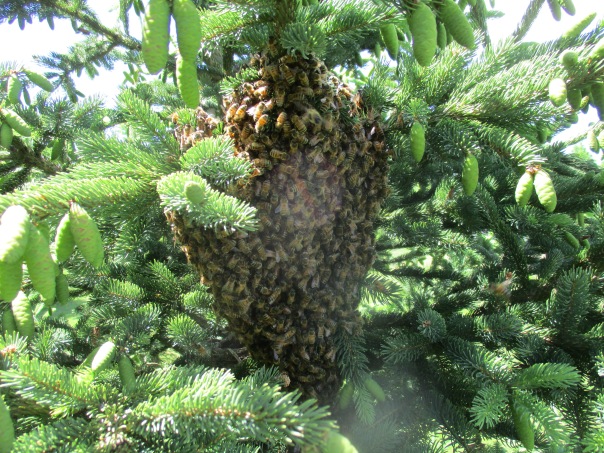
We had another swarm of bees. We watched the entire event. Above is the beginning when the group was starting to leave the hive.

IMG_2692

It’s hard to make out in the above photo but all the little yellow spots against the green areas and all of the black spots against the blue sky are bees. They settled in a picturesque location nearby.
IMG_2700

The flexibility of the  pine branches made it easy for my husband to slip a bucket up over the swarm. He then shook the branch while holding the bucket around the swarm. Nearly all of the bees fell into the bucket. He covered it with a lid and carried it to the empty hive.

IMG_2704

He dumped the bees into the hive and put the inner cover on. He placed a piece of wood over the hole in the top of the inner cover to keep the bees inside. He went back to the pine tree and repeated the process to collect the bees that were left behind.

We watched the hive and saw bees gathering at the small slot in the side of the inner cover. This was a good indication that the queen was inside and the workers were going in to be with the queen.

It’s now about a week later and this hive along with our other 5 are all doing well.

IMG_2687

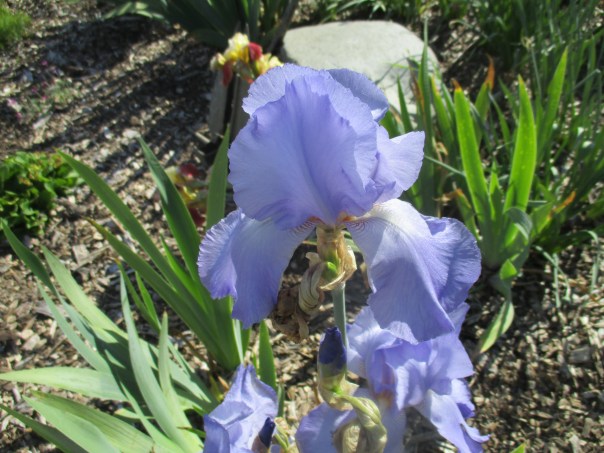
The Irises are in full bloom in the Prayer Garden. When I was planting rosemary and sage the other day a lovely fragrance caught my attention. Since the Irises were the nearest blossoms I walked to them and took a sniff. Wow! Spicy-sweet. I then took a long deep breathe to fill myself with this wonderful scent. These have only been in place for a couple of years and have really just taken off this year. I always thought that Irises were planted for their showy flowers, and that is why I planted them. I never realized that they were aromatic as well.
IMG_2723

I guess this just goes to show that we should take time to stop and smell the Irises. I’ll consider this a lesson learned.

Harvesting and watering are now our primary activities. Our asparagus crop was significantly affected by the wet weather this year and we harvested less than 50% of what we had last year. The strawberries are ripening and I have picked about 7 quarts so far. I am freezing them for now and will make jam with many of them when I have more time. I have also picked and dried oregano, spearmint and chocolate mint.

We are now having to water daily as we have gone from overly wet weather to overly dry. I think our last good rain was before Memorial Day, and the lack of rain plus the summerlike temperatures, equals very thirsty plants. This post explains our watering system on the farm. Since the farm is off grid watering takes a little more time and effort than just turning on a faucet. https://donteatitsoap.com/2016/06/05/our-off-grid-irrigation-system/?iframe=true&theme_preview=true

While there are many other things going on here, there is much work to be done and precious little time to write about it, so until next time 🙂



A Year In Growing Garlic (Part VII)

IMG_2617

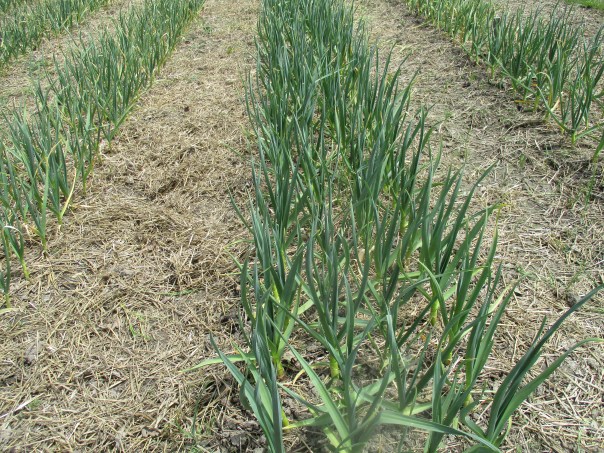
If you planted garlic last fall, as we did, by now you should be seeing vigorous green top growth. How vigorous can depend on many things. Variety of garlic you planted, clove size that was planted and soil conditions are all major factors. If You are not seeing vigorous green growth you will probably need to add some nitrogen fertilizer to give it a boost. It is recommended that nitrogen only be given up until the time that the bulbs start forming. This article explains that bulbs start forming around the time the ground temperature reaches around 60 degrees. http://greyduckgarlic.com/Southern_Garlic_Grower_Guide.html  Another article I read said that bulbs start forming around Memorial day. That article I’m assuming was referring to growing garlic in a cooler, northern climate like ours.

This time of year it is also important to make sure that garlic is getting enough water. This year our problem has been too much water, since we have had “April showers” in January, February, March, April and the first part of May. Although our garlic has shown signs of being stressed with some yellowing of the leaves, due to too much water, we are optimistic that we will have a decent crop.

It is recommended that garlic receive 1 inch of water a week during dry periods up until about two weeks before harvest. At this time we have no intention of watering the garlic anytime soon.

Keeping garlic weeded is the other chore that needs to be done from now until harvest. “Weed early, weed often” seems to be a garlic growers mantra as I seen it written in more then one article that I’ve read about growing garlic. Last week my husband and I spent several hours on two separate days weeding the garlic. Weeding garlic is something that needs to be done by hand, especially if it is planted with several rows close together, like our is.  At this point the weeds were still small and with the ground being wet the weeds came out easily. I believe this is the reason for the “weed early” advice. As bulb formation begins making sure the garlic weed free is even more important, as garlic that is crowded by weeds or roots of weeds will produce smaller bulbs. I do expect that we will be on our hands and knees weeding the garlic a couple more times before harvest. 🙂