Tallow is an ingredient that is commonly used in soap making and if you are buying commercially made soap, tallow is likely an ingredient. You won’t see tallow listed as such on the package. As an ingredient it will be listed as sodium tallowate, which is the name for soap that has been made by combining tallow with sodium hydroxide (lye). This Wikipedia article explains other uses for tallow. https://en.wikipedia.org/wiki/Tallow#Food
Unlike coconut oil, olive oil, lard and some of the other oils used in soap making, tallow is not readily available in most grocery stores. When I first began making soap I used oils that were readily available and while I could have ordered tallow online or perhaps sought it out at a butcher shop, I never did. It wasn’t until we started buying our beef from a local farmer that I began using tallow as an ingredient in some of my soap.
We had ordered a quarter of a cow. When I called the processing facility to tell them how I wanted our beef cut up, I asked if I could get some tallow as well. At that point I had not done all of my homework, I didn’t know that the fat that I wanted was called suet before it was rendered, so the lady did correct me. I did know that I would have to render the fat before it would be suitable for soap making.
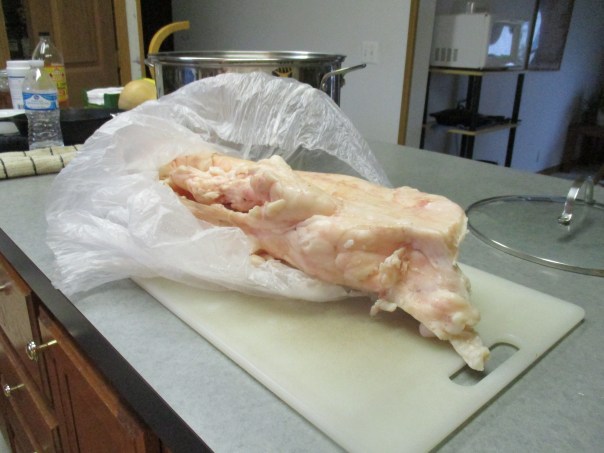
When we picked up our meat order I found that the suet was a large chunk of fat wrapped in a large plastic bag. I put it in the freezer until I was ready to use it.
Suet
I had read several tutorials and I realized that in rendering the suet into tallow the objective was to melt the fat in order to separate out any parts that were not pure fat.
I’ll share with you the method that I used and have continued to use ever since.
I started by taking the suet out of the freezer and letting it thaw for a while. It seems that it is easiest to cut while it is still cold but not frozen. I cut it into fairly small pieces. The smaller they are the faster they will melt or the less cooking time it will take. I put the suet pieces in my large stock pot and added enough water to cover it. I put it on the stove and brought it to a boil. Since I did not want the water to cook off I put a cover on it but I tilted the cover so that some of the steam could escape.
Rendering Tallow
It took a few hours of boiling before most of the fat chunks were completely melted. At this point I dipped in with a sieve and took out some pieces of meat that would obviously not melt.
I then let it cool. Since outside temperatures were in the 40’s (Fahrenheit) and lower, I decided to let it cool outside overnight. The next day the tallow had hardened and floated to the top. The water and some remaining meat particles were in the bottom of the pan. I had to break through the layer of tallow to drain the water off. I did this outside because I didn’t want any tallow particles clogging up my drain.
When I removed the tallow from the pan the bottom was covered in a layer of mushy grey stuff. I scraped off this layer and discarded it. My tallow was not yet as clean as I wanted it so I put it back in the pan, covered it with water and repeated the process.
The tallow did not take nearly as long to melt as the suet did so my cooking time was greatly reduced. After letting the second rendering cool and harden, I again scraped the mushy stuff off the bottom and decided to repeat the process once again.
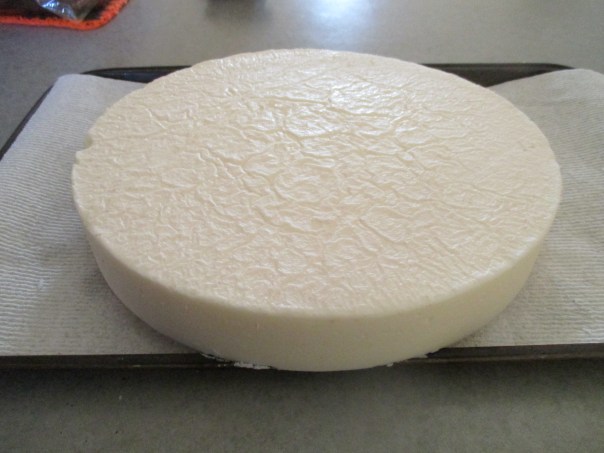
After the third rendering the tallow looked clean and pure. I placed it on a tray lined with paper towel to dry and patted the top and sides dry with paper towel as well.
Tallow
I then cut it into chunks, but because it is very hard it cracks rather than cuts, and placed the chunks in a freezer bag. I then store the tallow in the freezer until I am ready to use it.
Tallow is not an essential oil for soap making, and I realize there are individuals who prefer not to use animal fats in their soaps, but tallow does make a hard bar of soap and adds a creaminess to the lather. For me the greatest advantage of tallow is that it can be locally sourced, unlike coconut oil, olive oil and many others that must travel hundreds, if not thousands, of miles to arrive at my home and be turned into soap.
This afternoon as we were driving back from the farm we saw two deer run across the road. Fortunately they were far enough ahead of us that we didn’t have to slow down, but my husband said, “When you talk to the girls remind them that it is rutting season”.
The girls have heard this term before as every year since they have been driving we give them the warning. Rutting or mating season means an increase in deer activity. The deer are often running at full speed, a male chasing a female, and have no awareness of, or regard for, traffic in the area. So when we tell the girls that it is rutting season we warn them to be extra carful when driving.
What should they do to be extra careful?
Focus on driving. Do not allow yourself to become distracted by passengers, eating, cell phones or anything else.
Scan from right to left taking in as much of the area as you can.
Slow down, especially if you are in an area where you cannot see far off to the side of the road.
Use bright lights when driving at night if there is not oncoming traffic.
If a deer runs in front of you DON’T SWERVE. Swerving increases the risk of hitting oncoming traffic, trees or other objects, or even losing control and rolling the vehicle. It is better to slow your car down as much as possible to try to avoid, or at least lessen, the impact.
I originally published this post in December of 2016 but as winter approaches I thought it was worth repeating.
Whether you dread the cold, snowy weather that winter brings, or say “bring it on” and are ready to play in the snow; whether you are ready or not here it comes. I personally prefer to be ready.
I’d like to offer just one suggestion that might make your life during a power outage easier and safer. Have flashlights ready. When I say flashlight, if you think “I have a flashlight – somewhere,” if you have to search for a flashlight when you need it, if you don’t know immediately where to reach for one, or if there is not one within about 5-10 steps from where you are at any given time, then you do not have your flashlight(s) ready.
Lets face it, during the winter the hours of darkness are greater than the hours of daylight, so chances are greater that the power will go out when it is already dark. When you are left in the dark a flashlight is your first line of defense. With flashlight in hand you can then go on to activate your other systems for providing light like lighting candles or oil lamps, or starting a generator .
My advice is to have at least one flashlight in every room. Place flashlights where you spend a lot of time and can naturally reach for them. In our case flashlights are located on a shelf near the main entrance of our home, on my bedside table, in the living room on the entertainment center and one in the drawer of the table between our recliners, and on the kitchen counter. I also carry a small flashlight in my purse and my husband wears one attached to his belt. When the kids were at home I gave them each a flashlight for their bedroom. They were told to put it somewhere in their room where they would automatically know where to reach for it if the power went out. It was to be kept in that spot and if they used it for something it needed to be returned to that spot. They knew the importance of having the flashlight at the ready.
With 100’s or perhaps thousands of types of flashlights on the market you may ask “what is the best flashlight?” If you want good quality, long lasting, bright light, or other such features I suggest you do some research and read some customer reviews. My answer, in this case, is simple, “one that works”. I do suggest that you check your flashlights periodically to make sure that they work, and while having extra batteries on hand is important, having another (working) flashlight near by is just as important. Another thing is to make sure that you know how to use the flashlight. This might sound silly but I have discovered over the past few years that not all flashlights can be turned on and off with a simple slide or click of the button. Figuring out how or where to twist a flashlight to get it to turn on can be tricky. I have actually taken battery covers and light covers off while twisting a flashlight trying to turn it on. So do become familiar with how to use the flashlight before you really need to use it. Another thing to consider when buying multiple flashlights it is a good idea if they use the same type of batteries. That way you only need to stock up on one type of battery that can be used in any of your flashlights.
Speaking from a previous experience I have one final thought on what type of flashlight(s) to have. It was an evening several years ago when my daughter and I were home and the power went out. We each grabbed flashlights near by and met in the kitchen. I then lit an oil lamp and got a fire going in the fire place. The next thing on my list was to bring in more firewood. I knew that carrying a flashlight and a bin full of firewood was not going to work. I was thankful that I had a headlamp flashlight. I used it to light my path while having my hands free to carry firewood. I realize I could have had my daughter hold a light for me that time, but if I had been home alone that would not have been the case. I don’t use my headlamp very often, but I do consider it a wise investment and I keep it ready for when I need it.
While you may find my advice extreme or think it is totally unnecessary to have that many flashlights sitting around, it is too late to change your mind when you are tripping over the cat, walking into furniture, or falling down the stairs while trying to find your flashlight in the dark.
Whatever this upcoming season brings your way, I do hope you are ready.





 Don't Eat It! Soap and Skin Care