A Year In Growing Garlic (Part V)

If you are new to reading my blog you may have missed these earlier posts, so check them out and catch up on our year in growing garlic.

https://donteatitsoap.com/2016/09/30/a-year-in-growing-garlic-part-i/

https://donteatitsoap.com/2016/10/13/a-year-in-growing-garlic-part-ii/

https://donteatitsoap.com/2016/10/18/a-year-in-growing-garlic-part-iii/

https://donteatitsoap.com/2017/01/28/a-year-in-growing-garlic-part-iv/

In my Part IV post that I wrote in January I expressed our great concerns about how well the garlic would grow in the wet conditions that we were having this past winter. The wet conditions continued pretty much throughout the winter, with only short freezing periods, and now into the spring. At this point we have learned that garlic is much more resilient that we believed it to be.

IMG_2407

The garlic is coming up beautifully and we are so thankful. Since it has all grown up through the straw, we will leave the straw in place to help with weed control. If the garlic had not grown through the straw we would be raking the straw away in hopes of revealing the garlic spouts.

As the ground dries and temperatures warm I expect to see vigorous green growth on the garlic. We will keep them weeded and watered as necessary and probably side dress it with nitrogen fertilizer in the spring to encourage the green growth. It is recommended that fertilizer not be given after May because at this point the bulb will be developing.


Old Dog New Chicks

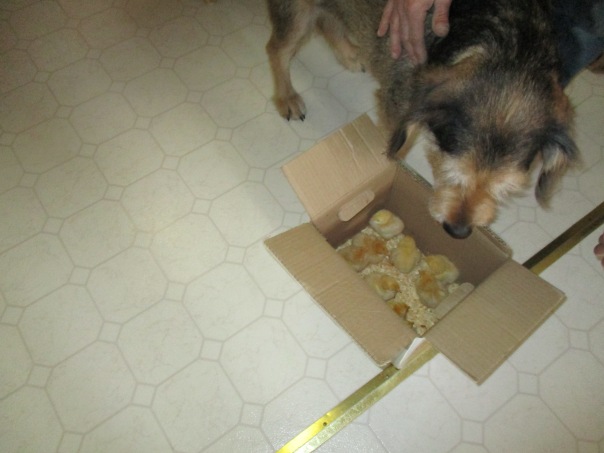
A few days ago, as we prepared to get chicks, my husband brought in the stock tank that we use as a brooder. When Scout saw this he began looking around for the chicks. We had to tell him “not yet, Scout”. We weren’t planning on getting the chicks until the following day. Scout has been down this road before, in fact 4 out of the past five years we have brought home baby chicks and raised them.

The first year I had great concerns about Scout being around the chicks. When we adopted him from the shelter in 2011 we were told he was about 3 years old and part terrier. Nobody knows what kind of terrier but that was not important to us. Over the next several years we found that he definitely had the terrier instinct to hunt and kill small animals and he was quite proficient at it. He could quickly and cleanly dispatch a raccoon, possum, ground hog, cat or baby turkey by just snapping it’s neck. He was about eight years old when we first started raising chickens.

I pretty much left it to my husband to train Scout with the chicks. Dom would hold a chick and let Scout sniff it and nudge it with his nose and he would tell Scout that those were his (Scout’s) babies. “You have to be nice to your babies,” we would say. Scout would become very excited, and want to look into the brooder, whenever he would hear the chicks make a noise, and anytime my husband or I were doing anything with the chicks (feeding, watering, holding or cleaning the brooder) Scout wanted to be involved.

That spring Scout learned that he was not allowed to chase and kill the chickens, unfortunately it was at the expense of one of our hens, but for a dog of his age and breed to learn not to chase chickens, or any other small critter, is a huge success.

IMG_0706
Scout Welcoming Our New Chicks

Nowadays I have no concerns about Scout chasing the chickens. Our free range chickens wander, peck and scratch throughout the farm and we have total confidence that neither Scout nor our other dog, Trooper, will cause them any harm.


One of Scout’s nicknames is “Chicken Daddy”, and he loves it when we tell him he is a good  Chicken Daddy. At age 13 (in people years) Scout has slowed down a lot. He does not pay as much attention to the chicks, but he was still very eager to see/sniff them when we brought them home.

The other thing he really enjoys is helping close up the chicken coop at night. When we go into the coop to count chickens and make sure everyone made it back home, Scout will step inside and sniff a couple of chickens to say “good night to his babies”.

IMG_0715

He really is a good chicken daddy.

2017 Maple Syrup Season Is Over

The following picture was sent to me as an email. The sender apparently found it on Facebook. Since I’m not on Facebook I thought I would share it here.

IMG_5103

Our maple syrup season ended Saturday, March 25th . This is the second year we have made our own maple syrup, and I will share some of the things that we learned this year.

We started the syrup season by tapping the silver maple trees on our farm  on February 13th.  The weather over the four weeks that followed was very erratic as was the sap flow. Some days were warm and sunny and the sap seemed to flow good, then the temperatures would drop back down below freezing and the sap would stop. Some of the trees stopped flowing early on, so we moved taps to trees that had better sap flow. We lost track of the amount of sap that we harvested and the amount of syrup we made. I guess next year we should keep a daily log.

A few things we learned about the silver maples are that they seem to have a sugar content equal to or better than the sugar maples. When we cooked the sap down into syrup it took about 10 gallons or 40 quarts of sap to make 1 quart of syrup. Silver maples make a dark syrup with a robust flavor. Silver maples bud out earlier than sugar maples so their sap flow season ends earlier.

We pulled all of the buckets before the wild wind storm that came through on March 8th. At this time the sap flow on the silver maples was to a minimum and the trees were beginning to bud.

The weekend following the storm we had freezing (winter) temperatures, but once the weather began to warm again my husband noticed that the sugar maples in the woods behind our house were not yet budding. With permission from the community manager he set 20 taps in the sugar maples.

From March 13 until March 25th he collect the sap from the sugar maples. The weather was still erratic with some days having great sap flow while others yielded little. As with the silver maples we cooked sap on days when we had collected 10 or more gallons of syrup. On March 25th, when my husband collected the last of the sap, the trees were flowing slowly but had not completely stopped and the sap had not turned cloudy. We were, however, done.  My best guestimate is that we cooked 3 1/2 gallons of syrup all together which at the ratio of 40 to 1 means we collected about 140 gallons of sap.

The syrup made from sugar maples was much lighter in both color and flavor than that of the silver maple. Both are very good.

Our biggest challenge in making syrup is finishing and filtering. Real maple syrup is usually very runny but we like our syrup a little thicker, so we first started cooking it down to a quite thick consistency. When we did this the we were unable to filter the final product, as the syrup was too thick to run through a filter. We discovered that there was no need to filter this because apparently any sand, or niter, had cooked into the syrup. We had no sand settle to the bottom of the jars. The other thing that happens is that the syrup has a tendency to turn to sugar. We didn’t consider it ruined because it still goes good on pancakes, French toast or waffles.

When we began cooking the syrup so that it was not so thick filtering it was still a challenge. We first tried pouring the syrup through a store bought filter. Even though it was still hot enough the syrup just sat on top of the filter. We next tried filtering it through felt. This worked well to remove a lot of the sand, but we still ended up with some sand in the bottom of the jar. After reading some websites I learned that before using the store bought filter it is best to pour hot or boiling water through it. So we tried this and the syrup ran through. Much of the sand was removed but we still ended up with a small amount of sand on the bottom of the jar. The sand is really nothing to worry about as it is largely comprised of calcium salts and malic acid, neither which are harmful when consumed. The act of removing the sand is purely for aesthetic purposes and a must for commercial producers.

It may seem like a lot of time and effort for so little syrup, but we consider this time well spent. Fortunately the season does not conflict with planting, growing or harvest seasons, and it is a great activity to get us out of the house in the late winter/early spring.


Frogs on the Farm

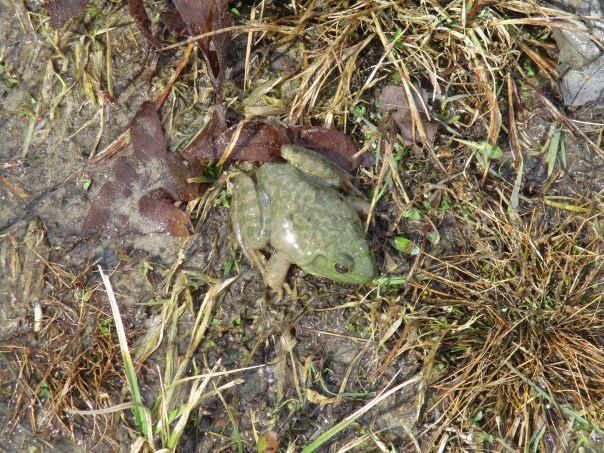
Last week on one of our sap cooking days, in addition to helping keep the fire going, I took on the secondary chore of raking the leaves out of the pond. As I came up with one rake full of leaves and shook them into the pile just beyond the beach, this frog hopped out of the leaves.
IMG_2362

I felt kind of guilty about awakening him or her, because I was yet to see or hear any frogs this spring. It did however spend a good deal of time sunning itself on the beach. It wasn’t until one of the chickens came running up behind it that it took a three foot leap back into the safety of the pond.

It was two days later that we heard the frogs for the first time this year. I remember my mom telling me, that her mom had told her, that after you hear frogs for the first time in the spring you will have three more freezes. Although I’m always am excited to hear the frogs in the spring, I haven’t really tested this theory.

Frogs and toads lived on our farm before we put in the pond. I remember the first spring there were tadpoles that had hatched in a puddle of water and my husband was dumping buckets of water in the puddle to keep it from drying up before the tadpoles reached their adolescent stage of life.

Our property does provide the perfect habitat for frogs and toads. The pond offers conditions needed for frogs to lay eggs, for the eggs to hatch into tadpoles and for the tadpoles to live until they grow legs and their lungs develop so they can leave the water. This can take over a year for bull frogs. Even mature frogs, who can live out of water, continue to need a wet area to keep their skin from drying out. Not only does our farm have the pond but we have wooded areas where the ground is covered with dead leaves that keep the ground moist even in the hot and dry summer conditions.

According to the Michigan Department of Natural Resources article that I have linked below of the more than 3400 species of frogs/toads only 13 live in Michigan. I am certain we have at least 4 species that populate our farm.

Frogs and toads are wonderful for pest control. The aforementioned article relates that a single frog will consume thousands of insects per year. Last year we discovered that we were reaping the benefits of this. As we picked our bountiful harvest of strawberries  https://donteatitsoap.com/2016/06/30/strawberries-at-last/ last June my husband and I spoke several times about the fact that we did not have any slugs eating the berries. This is a problem the we have had with strawberries we have grown at the house in the past. It wasn’t until my husband told me that he had been surprised by a frog hiding in the strawberry patch, while he was picking berries, that I realized that this frog was probably enjoying a regular diet of slugs and any other pests that threatened to consume our strawberry crop. I am hopeful that a frog will take up residence in the strawberry patch again this year.

Frogs are a good indicator of the health of wetlands, ponds, lakes and such as they do not survive in polluted areas. The Michigan DNR article that I have linked below explains that chemical fertilizers and pesticides are a threat to frog populations; not only can the chemicals kills frogs and toads, but the pesticides also reduce their food supply.

http://www.michigan.gov/dnr/0,4570,7-153-10370_12145_12201-35089–,00.html

The frogs on our farm are also entertaining. In the summer time when we walk around the edge of the pond the frogs jump into the pond one right after the next. It’s kind of funny because there may be 50-100 frogs sitting around the outer edge of the pond. The dogs like to chase the frogs but rarely are they able to catch them. Last year Scout spent hours in the evenings looking for frogs along the edge of the pond, he enjoyed the search immensely even though he never caught any. After dark we are often treated to a campfire symphony, in surround sound I might add, as the several different species of frogs sing from different areas of the farm.

While not everyone has the luxury of being able to put a pond on their property I have included the following link for those who may be interested in creating a frog habitat. I would encourage you to read through the end of the article, as it does explain that the best way to introduce frogs to this habitat is to let them come to it naturally and this may take a year or more. It also explains that not all parts of the U.S. are favorable for creating frog habitats.

https://www.nwf.org/News-and-Magazines/National-Wildlife/Gardening/Archives/2000/Want-to-Host-a-Garden-Party-for-Frogs.aspx

Don’t Believe Everything You Read – “Happy Spring” Correction

Last night as I was falling to sleep, I began thinking about what day it was, then what we would do the rest of this week, then what we had done already this week. It was at that point I realized that I had made a major error in my last blog post. This is what I wrote.

“On Monday, the last day of winter, we spent much of the day cooking sap at the farm. This little guy (Squirrel!) spent the whole time in the poplar tree near by. I will be sharing more about this years maple syrup season in an upcoming post, but for now I wish you all a Happy Spring. 🙂 ”

The post should have read: “On Sunday, the last day of winter,”. I will be editing the post to read this way.

I’m not sure exactly what to think about this. Admittedly my blog is not read by thousands of people, but I am surprised that of those who did view this post that no one mentioned it. Perhaps viewers just glanced over the post and took away my main message, “Happy Spring” not even realizing there was an error; or maybe someone read this and thought, “what planet is this person living on?” but decide not to challenge or correct my statement; readers may have just decided to overlook my error feeling sympathetic to a person who gets their days confused; but the worse case scenario I could imagine is that a someone would have read this and went on to believe that Monday was the last day of winter.

While I can’t think of any case where my error could have a dramatic or detrimental effect on someone’s life, believing everything one reads certainly can. In this day and age when anyone can write anything and publish it on the internet where it has the potential of being viewed by millions of people, fake news is all the buzz, and scams are rampant, I encourage you to read carefully, think critically and know the source of information before you believe that what you read is true.

Again Happy Spring! 🙂