Category Archives: Chickens

What I Have Learned About Raising Chickens – The Toughest Lesson

I have been planning to write a series of posts about what I have learned from our experience with raising chickens over the last 5 years. A heartbreaking incident this week has prompted me to start with the toughest lesson of them all.

We use a natural approach to farming and with raising chickens that means allowing our flock to free range. When I say “free range” I mean that the chickens roam the farm, and at times the neighboring properties, and even cross the road (that’s a topic for a future post) scratching,  pecking and foraging for their food. We are aware of the inherent danger of predators when raising free range chickens, but we feel the benefits of healthier chickens, healthier eggs and stress free birds far outweigh the risks. Over the years we have lost a chicken now and then to a hawk, or found a chicken body with no head that left us wondering what kind of predator does that, and occasionally we have one or two come up missing, apparently carried off to become dinner for one of God’s creatures.

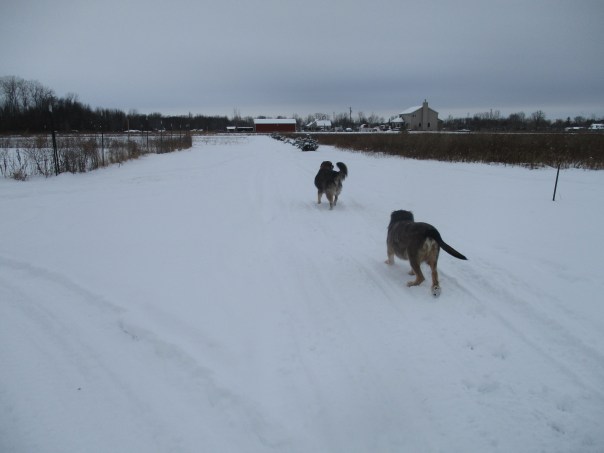
This week was different. It was bright and sunny Monday afternoon and my husband had been to the farm around 4:00 P.M. to check on the chickens, give them fresh water and take Scout and Trooper for their afternoon walk. He left the gate to the chicken yard open as some of the chickens were happily scratching and pecking in a pile of straw near the chicken yard.

He came home for dinner and then waited until 6:00 P.M. to return to close up the coop for the night. He called from the farm, “Something Bad has happened” he said, his voice quivering. “A fox got to the chickens, I’m going to be here awhile,” he explained.  Quite awhile later he returned to the house telling me that as he pulled in the driveway he witnessed the attacker (our neighbors claims it was a coyote) running off. There were dead chickens scattered around the area. He found 9 dead chickens. He only counted 17 chickens who had returned to the coop for the night so there were still 5 missing. He needed to put new batteries in his flashlight before returning to search for the missing birds. I offered to go along but he refused my help, as he wanted to protect me from the horrific  scene. Upon searching the area he discover two more dead and the other three were completely gone, apparently carried off by their assassin(s).

Last Spring we became aware that there were fox living in the area when we got a call from a neighbor telling us that a fox had tried to get some of our chickens as they were foraging in her yard. She witnessed the attack and scared off the predator by banging on the window. We ended up with one injured chicken who we nursed back to health. We took further measures to protect our flock. We began leaving them penned inside the chicken yard when we were not at the farm. Several times a day we, along with Scout and Trooper, would walk the farm, especially areas that do not have open sightlines, and make our presence know. My husband mowed the overgrown ditch that runs along side the chicken yard including about a 20 foot strip into the neighboring field to open up the sightlines. He also mowed a series of paths through the field so that we were able to walk/patrol that field as well. As we continued these practices through the summer and fall we heard stories of several neighbors who had lost large portions of their unprotected flocks to violent fox or coyote attacks.

With the snow and cold of winter the chickens have spent much of their time either in the coop or at least in the chicken yard. We were recently discussing how happy we were that our flock was thriving in spite of the bitter cold temperatures that we have had this winter and that egg production was increasing due to the longer hours of daylight. There were many days that my husband spent at the farm this winter  mostly cutting wood or riding the snowmobile and during these times he maintained our routine opening the gate so the chickens had access to the farm and making his (human) presence known. With no recent predator incidents he grew comfortable that he could leave the farm for short periods of time to retrieve things he needed at home or bring the boys (dogs) back to the house. Our lack of vigilance proved to be a fatal error.

I am not looking for your sympathy as I tell this story but hope that you might learn a lesson from our mistake. I think we have gained a better understanding of the predator’s MO. He is sly, sneaky, and cunning. He is an opportunist and will cause much damage (death) quickly. He may run from confrontation but will likely return to the scene of the crime when no one is around. With this in mind we realize that we will have to maintain constant vigilance in order to protect our flock.

We are also reminded that (as my husband likes to say), “Nobody ever told us that farming would be easy” and (my reply), “If it was easy everyone would be doing it.”

Now that I’ve got the tough stuff out of the way be sure to follow along as  I will soon be answering the age old question of “Which Came First?”


Making Maple Syrup

It doesn’t seem like a whole year has gone by since we last tapped maple trees and made our maple syrup. Maybe that’s because it hasn’t really been a whole year. While I didn’t remember the exact date that we tapped trees last year I was able to review the post I wrote about it, and I discovered that last year we tapped the trees on February 13th. Last year’s sap flow was considered early and we read that some syrup producers actually missed the season because the were not expecting the season to come so soon.

It was only January 20th according to the calendar but nature doesn’t necessarily go by the calendar. Despite the brutal cold we have had this winter we had been watching the forecast and preparing for the sap season to start. This is only our third year making syrup, so we don’t have much experience to go by, but since temperatures were forecast to be in the high 30’s and low 40’s Fahrenheit (between 3 and 7 degrees Celsius) 7 out of the next 10 days we thought this might be the right time. My husband thought that it would be a good idea to do a few test taps to see if the sap was flowing. So we took supplies for four taps to the farm.

IMG_3685
January 20, 2017


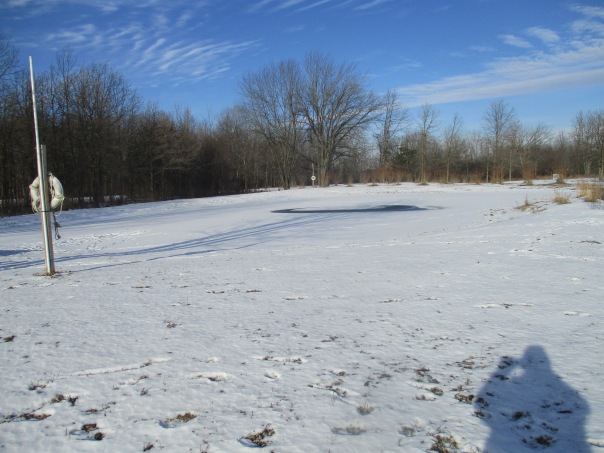
The day was very reminiscent of the day we tapped last year. The sun was shining, there was still a thin layer of snow on the ground, and the pond was mostly still frozen.

IMG_3681
Happy Hens


The chickens were happy to be out scratching , pecking and even dusting themselves.


My husband and I worked together, taking turns drilling the holes and setting the taps.

IMG_3696
First Drop Of Sap


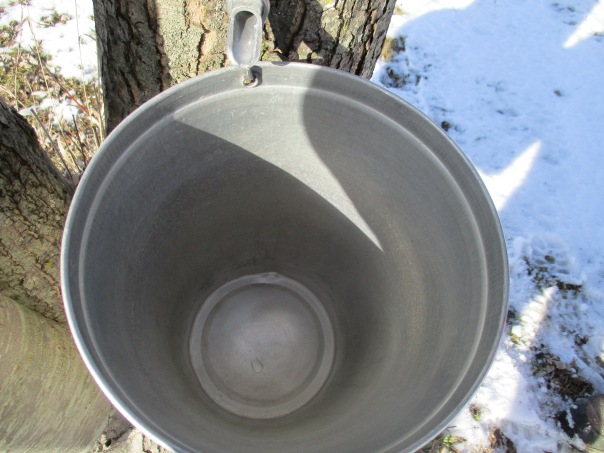
When the sap began running within seconds of being tapped we knew we were on the right track. After setting the first four, we went home, gathered the supplies and returned to set the remaining 13.

A couple days after tapping the trees the high temperatures again stayed below freezing so no sap was flowing. Then we had a couple more day where temperatures reached into the 40’s F so the sap began to flow again. By Friday my husband determined that he had collected enough sap to make syrup. We would cook it Saturday.

My husband had the cooking station set up in the driveway. Because cooking sap produces so much steam cooking it the house would be a horrible mistake, and we are not equipped with a sugar shack so we do it much the way we imagine our ancestors  would have – outdoors over a wood fire.

The fire pit is simple – made of two layers of concrete blocks on three side

IMG_3704

He spaces the concrete blocks so that the shallow stainless steel pan sits on the edges of the blocks. We build the fire within the blocks and continually feed wood into it from the open side.


IMG_3702

We used a mixture of hardwood limbs and logs that we had cut on the farm and some scrap lumber my husband had picked up from the local sawmill. We began cooking the sap around 11:30 A.M. and by 4:30 P.M. we had reduced the estimated 23 gallons of sap  to the point that we could finish it on our kitchen stove.

Before cooking it on the stove we poured it through a sieve to remove some of the ash that was floating in it. I then brought it back to a boil and continued cooking it until it reached 7 degrees above the boiling point on the candy thermometer 219 degrees F.

Filtering the sugar sand out of the syrup is something that we have struggled with the past two years, so I decided to pay close attention to the temperatures while doing this. I let the syrup cool to between 180 and 190 F. For a filter I used one layer cheese cloth with one layer of felt placed on top of it. I placed the two layers together in my canning funnel then poured the syrup through the fabric lined funnel directly into the jar.

After pouring each jar I needed to change the filter, so I put the pan of syrup back on the stove over a low flame so I could maintain the proper temperature. The syrup flowed easily through the filters. I sealed each jar as soon as it was poured. We ended up with just a very small amount of sugar sand in the bottom of the jars. There is no harm in eating sugar sand as it is said to be made up of calcium salts and malic acid, so filtering out this sand is purely for aesthetic reasons (it does look like muck in the bottom of the jar).

IMG_3724

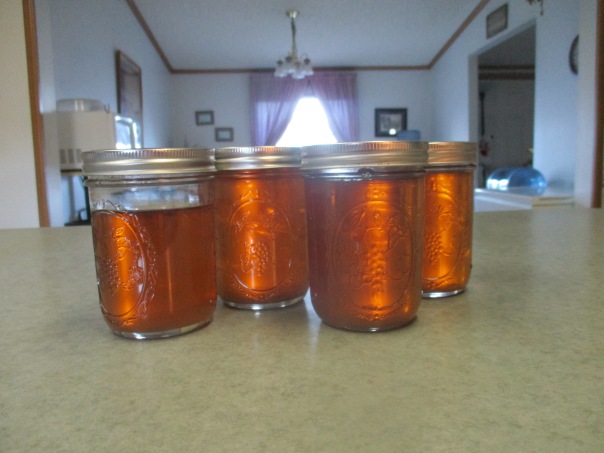
Even though once sealed the syrup should not spoil, I like to bottle the syrup in wide mouth mason jars, because as long as I leave the proper amount of head space the syrup can be stored in the freezer.  We ended up with nearly four pints of beautiful, sweet maple syrup.

What the rest of the maple syrup season will bring is anyone’s guess. Our weather forecast for the next 10 days shows daytime temperatures below freezing for all but one day, so we are not expecting the sap to run again for a while. When the temperatures do warm again, if the trees bud out quickly the sap will turn milky and is not good for making syrup, so we are grateful that we tapped the trees early and at least have some syrup this year.

I also made an interesting observation as I looked back at my post from last year, “The Sap is Flowing and the Hens are Laying”.   Again this year, as we tapped the maple trees we noticed that the hens have began laying more eggs. For five or six weeks we were getting an average of four eggs a day, this was enough to keep us in fresh eggs through the winter. On January 20, the day we tapped trees, we collected six eggs, then over the next week the amount increased so that we have collected 12 eggs each of the last two days. I honestly expected that the increase in egg production was more related to the number of hours of daylight and similarly to last year would occur in the middle of February. Perhaps it is more about the warmer temperatures we have been enjoying, I’m really not sure, but I do think I will attempt to track these two events in future years to see if they continue to coincide.

Until next time be well. 🙂


Our Christmas Tree

For the second year in a row we decided to cut our own Christmas tree. Last year, and again this year, we cut spruce trees from the farm. When we purchased the farm in 2011 there were many deciduous trees growing on the property but there were absolutely no evergreens. The following spring we placed an order with our local conservation district spring tree sale and amongst the things we ordered were 50 spruce trees, 25 Blue Spruce and 25 Norway Spruce. When the 12-15 inch seedlings arrived we had no idea where we were going to plant them, so we made a nursery area for them within our fenced garden area where they were well tended through the summer. It was a hot and dry summer, and the garden required much watering. It was the summer before we had the pond or the windmill so we carted many barrels of water in the back of the truck, from our house to the farm, in order to keep our garden alive. Having these seedlings in the garden area, where it was convenient to water them, proved to be a blessing and allowed them to flourish. By the fall of that year we were ready to plant them in their permanent places. We decided to line the North and East sides of the back field with some of them, as they would eventually provide privacy and wind breaks.

Over the last five years these trees have received much TLC, they have been fenced during the winters to protect them from the deer, they have been weeded and mulched, and during the droughts of summer we have driven the truck around the outskirts of the field delivering water to each of these trees in attempts to keep them alive. Not all of the trees have survived, but most have with some doing better than others.

We have continued to order Norway Spruce and Blue Spruce seedlings each spring and place them in a temporary nursery area until we decided where we want to plant them. Some of them have replaced spruce trees that we lost, we use some to replace dead Ash and Elm trees that we cut down, and we will also replace the trees that we cut for Christmas trees.

IMG_3491
Spruce Trees Line The East Side Of Our Field

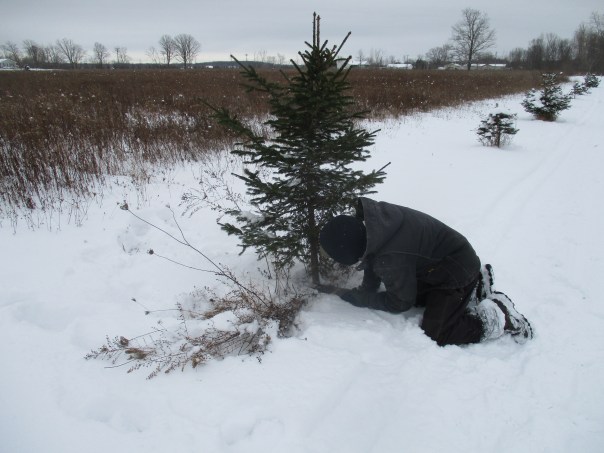
It was about 10 days before Christmas, and we had gotten our first decent snow fall, when we went out to cut our tree. My husband and I walked the path along the East and North of the property and examined each tree before we decided which one to cut.

IMG_3492

Scout and Trooper were happy to be with us.

IMG_3495

We selected this Norway Spruce. We didn’t measure it but I’m sure it was close to 5 feet tall. It took my husband less than a minute to saw through the trunk.

IMG_3505

As we walked back from the field we spotted this hen who had made her way through the snow out to the field. We were really surprised to see her there because chickens do not like to walk in snow. My husband picked her up and we gave her a lift back to the coop.

IMG_3514

We opted not to trim the longer, upper branches to achieve the “prefect” Christmas Tree shape, but left the tree in it’s natural God-given shape. The short needles and less than crowded branches made adding lights and hanging ornaments easy. And we have been enjoying the simplicity and beauty of our homegrown Christmas tree.

IMG_3611

On Christmas Day we added one final ornament after opening the gift from Tina and Ken. We hung the new “Ciani Family” ornament next to the “God Bless the Farmer” ornament they gifted to us last year. I think I am seeing a theme here to complement our new tradition. 🙂

Rescue Rooster

We’ve been raising chickens on our farm since 2013. Having a free range flock of egg layers was one of our priorities when we bought the farm and everyone that knows us knows how much we love our chickens. You can read some of my previous posts about chickens here https://donteatitsoap.com/category/chickens/ .

Ever since we put our first flock of chickens in the coop our lives have revolved around chickens. Every morning without fail, we (nowadays my husband) open up the coop as the sun is coming up, and provide fresh food and water for the flock. On days that he or we are not working at the farm it is necessary to make at least one, but usually two, midday runs to the farm to check on the chickens. Our presence helps to deter predators. Every evening, after doing a beak count,  the chickens are closed in the coop for the night. If any chickens come up missing a search ensues, sometimes resulting in finding that a hen has gotten into one of the fenced in gardens and can’t find her way out, or one has decided to roost in a tree for the night. Other times we have found that, sadly, a hen has fallen prey to a hawk or a fox, and some times they just disappear with out a trace.

Our vigilance has been rewarded with being able to maintain a flock of happy, free range, egg layers, who provide us and others with delicious, healthy, farm fresh eggs. The insect control and entertainment they provide are supplementary benefits.

One thing that we have learned over the years is that while it may be a good idea to keep a rooster to protect and service the flock, having more than one rooster causes disharmony and stresses the hens. Thus we have agreed to only keep one rooster.

IMG_2346
Meet Cocky

Earlier this year I was talking to my dad on the phone and he told me that he had picked up a statue of a rooster that someone was getting rid of. Destined for a dumpster, it was tattered and warn, but since it was not broken dad figured he could clean it up, give it a new coat of paint and bring it back to life-like. He thought this rooster would be a nice addition to our farm. I didn’t tell my husband about the gift dad was planning to give us, because I think surprise gifts are always better.

One day in August when dad stopped by to pick up some eggs and honey I carried the bag to his car and as he put the bag in the back, he took out the life-size rooster statue and handed it to me.  He had done a nice job at repainting it and not only was it as big as a real rooster, it was at least as heavy as a full grown bird.

IMG_3429
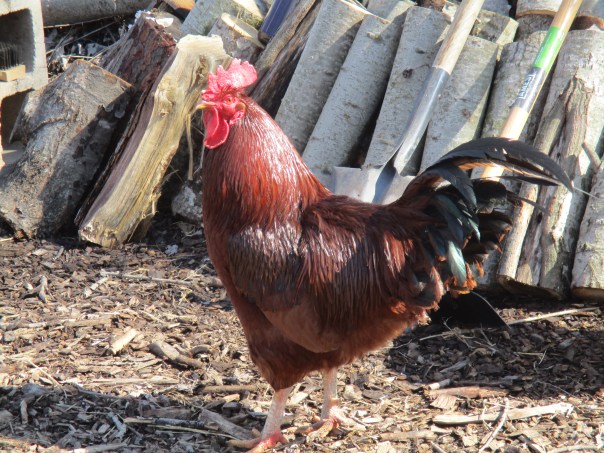
Our Rescue Rooster “Jim”


I held the statue tucked into one arm and supported by my other hand, much like I would hold one of our chickens, as dad and I stood by his car talking. I noticed my husband driving up and was happy that dad would be able to present the gift to him as well. As my husband drove closer I could see that he was shaking his head adamantly “No”. I was trying to figure out what he was upset about as he got out of the van and from across the street announced, in no uncertain terms, “it’s not staying!” I couldn’t understand his reaction and as he walked toward us I quickly explained, “dad found this rooster statue and restored it for us.” I thought that he was being rude and going to hurt my dad’s feelings.  About the same time I got the word “statue” out of my mouth my husband had walked close enough that he could get a good look at it. “Oh, it’s not real!” he exclaimed laughing in relief. Dad and I joined in the laughter as my husband explained that from a distance he thought it was a real rooster especially because of the way I was holding it.

Our rescue rooster now resides high atop the oak entertainment center in our living room. (We have kept our agreement of only one rooster at the farm.) A few nights ago my husband and I were laughing about the rooster’s arrival and my husband decided that since we hadn’t given the rooster a name yet and it will always be reminder of the unintended prank my father played on him, the roosters name would be “Jim” (my dad’s name).


Our Harvest Picnic

Sunday we invited friends and family to the farm for a picnic. While many of those invited could not make it for various reasons everyone who came seemed to have a great time.

IMG_3192

My husband added some seasonal decorations to welcome our guests.

IMG_3203

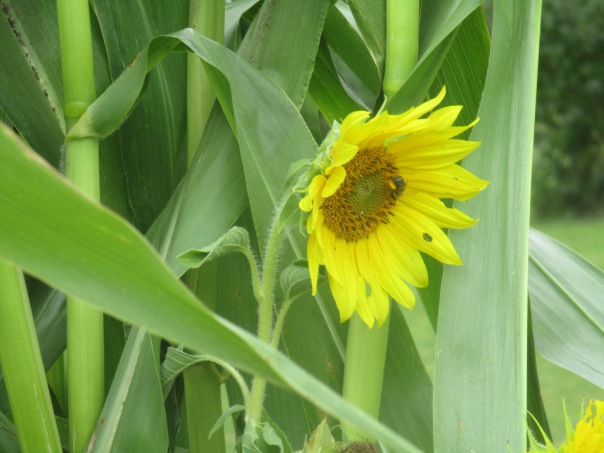
The bees wasted no time finding the sunflowers he picked.


The chickens roaming around, pecking and scratching, added to the ambience.


As summer nears it’s end Black Eyed Susans, Hibiscus and Phlox continue to adorn the farm.

When we host guests this time of year we like to make it a harvest party that includes foods from our garden. Included in yesterdays meal was potato salad – with homegrown potatoes, celery and chives along with our farm fresh eggs; apple crisp – with apples from our trees; pickled garlic scapes  https://donteatitsoap.com/2017/06/15/a-year-in-growing-garlic-part-viii-garlic-scapes/ ; and my garlic and dill chip dip https://donteatitsoap.com/2015/08/14/simple-and-fun-recipes/ . We also had fresh lettuce leaves and sliced tomatoes to top the burgers which were made with locally raised grass fed beef.

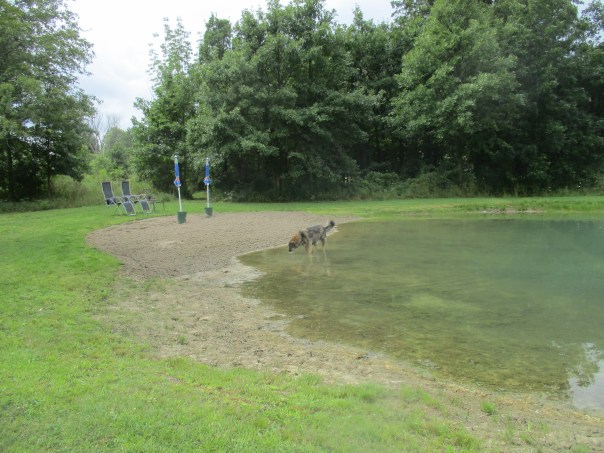
While I took many pictures of the scenery before our guests arrived I somehow forgot to take pictures our guests and the activities they enjoyed.IMG_3200Trooper played in the pond early in the day, but later on some of our young guests enjoyed catching perch in the pond and building sand castles on the beach.

I also neglected to get photos of my brother-in-law flying his remote control airplanes. He brought two planes and was able to use the path which we keep mowed around our back field as a runway. He also brought equipment that enabled him to allow others to participate. It’s called buddy boxing. To really explain buddy boxing you probably need someone who understands technology better than I do, but since I’m the one writing I’ll tell you my simplified understanding of how it works. Two transmitters or controllers are linked together and set to operate the plane. The student’s controller is allowed to operate the plane unless the teacher feels the plane is in trouble at which point the teacher has the ability to override the student’s system and take control of the plane.

I think this is a great way to be able to teach kids, or even adults, who want to learn to fly remote controlled planes without having to worry about damaging the plane or endangering objects, people or pets on the ground. Pete was certainly a great teacher and the kids had a great time flying the planes.

Other activities included greeting everyone with hugs, catching up with friends and family, most of whom we haven’t seen in a year or more, my husband gave garden tours and showed off the huge, mammoth sunflower which came up as a volunteer this year. “If it’s not the biggest sunflower you’ve ever seen I’ll give your money back,” he told people. Maybe he should have charged because everyone agreed that it was the biggest they had ever seen.

IMG_3216

While it wasn’t a homegrown water melon, it was among the produce that our grandson (and future farmer) Jackson, enjoyed. He also got excited about watching the chickens eat corn on the cob.

Some guests left with garlic and some with honey and several left with regrets about having to leave so early and hopes of returning soon. It was a great day filled with friends, family, food and love and we are grateful for all those who visited.

Unfortunately we were so busy and having such a great time that we forgot to hold one of our planned events. The rock picking contest. Participants were to be given a milk crate, shown to one of two areas that have been plowed this summer and told fill their crate with as many rocks as possible.  Cash prizes were to be awarded. Oh well guess we will be picking up rocks this week. 😉

Okay, I’m just kidding about the rock picking contest, but we will be picking up rocks this week. Have a great day.