Category Archives: The Farm

Sights of Spring

This is the day the Lord has made…

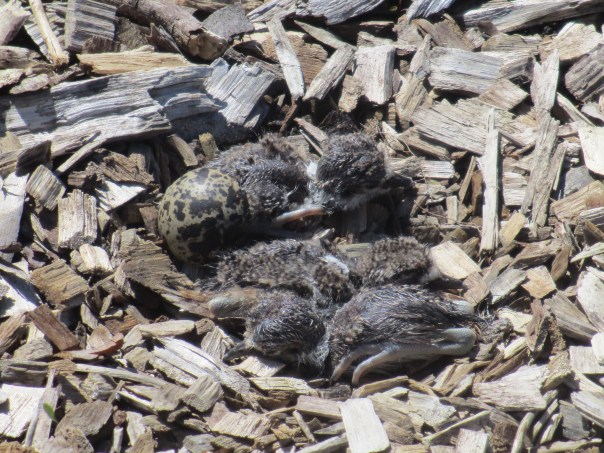
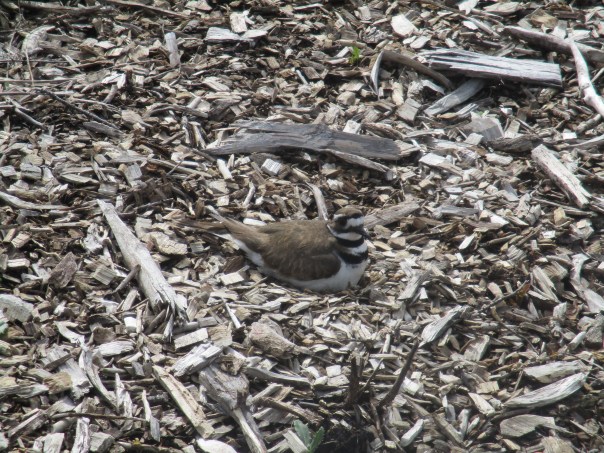
I didn’t make it out to the farm until yesterday afternoon. As I walked past the prayer garden I and looked for the killdeer eggs this is what I saw.
IMG_2557

“They weren’t hatched this morning” my husband said.
IMG_2558

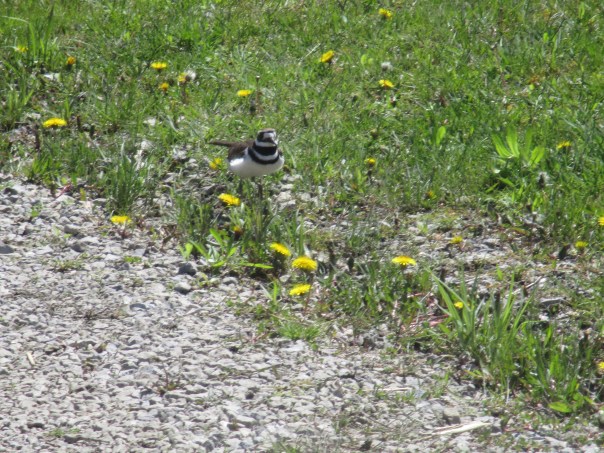
Both parents were near by screeching and doing the broken wing act to try to get us out of the area. I expect the babies will be running all around the area soon. I am happy that I can weed that side of the prayer garden now.

My husband’s main task for the day was cleaning frames from the bee hives. He first lets the bees do their part. He sets out the frames that still have honey and wax and lets the bees take what they want. Once they stop visiting a frame he finishes cleaning it before putting it back in a hive.

IMG_2580

As I walked around the farm I observed bees foraging amongst the apple blossoms. I made many attempts at photographing them. They were too busy to pose for a picture, so this was the best I got.

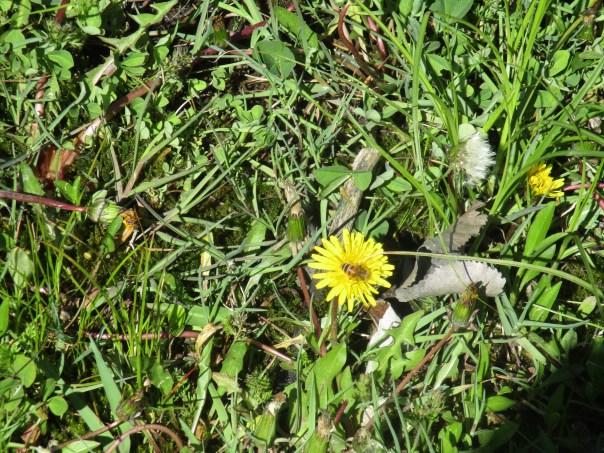
IMG_2573The bees were also collecting a lot of dandelion pollen. This lady stopped for a few seconds, so I was able to get a clear shot before she moved on.
IMG_2575

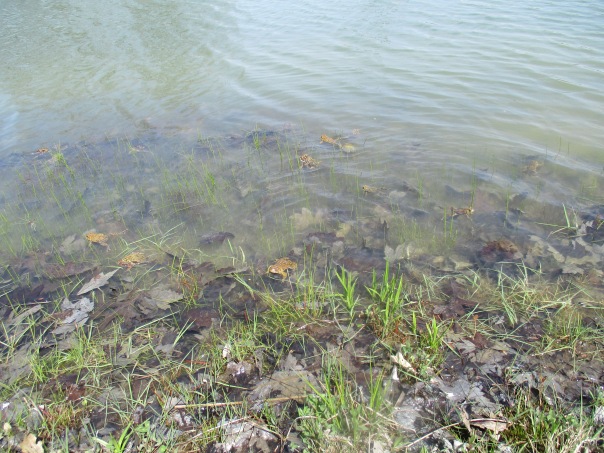
Last week we observed something that neither my husband, who has spent much of his life around ponds, creeks, rivers and lakes, or I have ever witnessed before. The toads had all made their way to this shallow grassy area of our pond and were mating there.
IMG_2520

There were too many to count and as we stood there watching more toads were arriving for the party.
IMG_2584

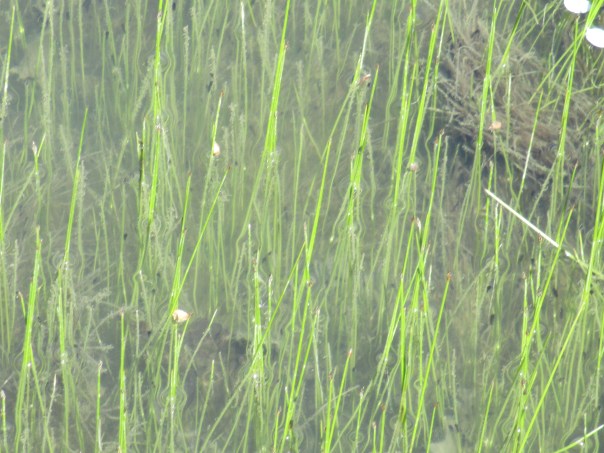
Yesterday as I walked by that area of the pond I noticed tiny black tadpoles apparently just hatching.
IMG_2587

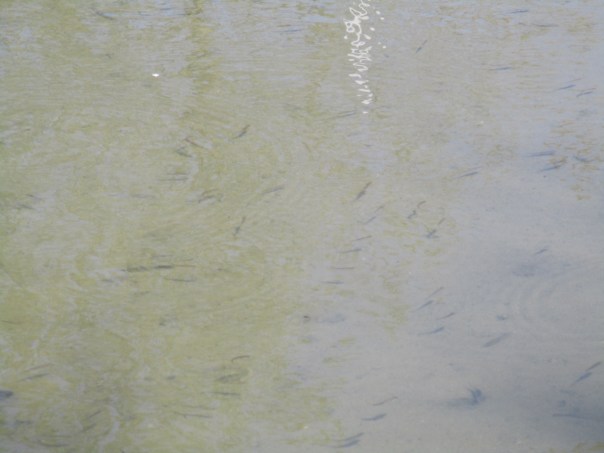
We also spotted minnows swimming in the beach area.

For the past two years only one of our young lilac bushes has blossomed. When I mentioned this to my son-in-law last summer he suggested that I spread wood ash around them. Last fall I did spread wood ash around all of the lilac bushes and some of our apple trees as well.

IMG_2569

This year 10 of our 15 lilac bushes have blossoms.

Our apple trees also have more blossoms than they ever have before.

IMG_2577

Several years ago around just before Mother’s day my husband and I planted some trilliums in a wooded area of our farm. These were one of my mom’s favorite wild flowers, and we planted them as a tribute to mom who passed away the same year we bought our farm.

IMG_2560

Mom’s trilliums are beginning to bloom, appropriately, in time for Mother’s day.

Visitors are another common sight at the farm during the warm weather seasons, and it was good to have our first visitors of spring.

IMG_2590

Two of our daughters, Kara and Lindell, stopped by for a visit yesterday afternoon. They were dancing as they came up the driveway since my husband had a classic rock station playing on the radio.

Let us rejoice and be glad in it. Psalm 118:24
 

Awaiting Their Arrival

It was no surprise when the pair of killdeer showed up in the spring. It is our assumption that it is this same pair that show up every year and build their nest in inconvenient places on our farm. The first couple years the nest was right on the edge of our driveway. My husband put large rocks near it so that it would not get run over. After we put in the pond they nested just off the beach for a couple years.

This year when I saw the pair hanging out in the prayer garden everyday I told my husband “I’m sure they have a nest there. I just don’t know where.” I was concerned because I     didn’t want to accidently step on it. As my husband examined the area he pointed out the three eggs that were camouflaged in the wood mulch nest.

IMG_2533

Now we visit Momma Killdeer, who also blends into the background, every day as we walk past. She often just sits on the nest while we stand as close as five or six feet away. Other time she gets disturbed and screeches at us. I’ve reminded her several times that she was not invited to use our prayer garden as her birthing room, and since we intend her no harm she will have to put up with us. Sometimes Daddy Killdeer will show up and do the broken wing act to try to lure us away from the area.  He does this more often if Scout and Trooper are near. In prior years the boys seemed to enjoy the chase but this year they don’t seem to pay much attention.

Since they have been there for several weeks now, we expect the chicks to hatch soon. The link below says that killdeer eggs take 24-26 days to hatch and then the parents guard them for another 25 days until they are old enough to fly. Although the screeching killdeer can be annoying, the baby killdeer running around are incredibly cute. These killdeer, who are bug and larva eaters, will do their part in keeping insect populations down, and we consider them a welcome addition to our farm.

http://www.wbu.com/chipperwoods/photos/killdeer.htm

Meat The Chicks

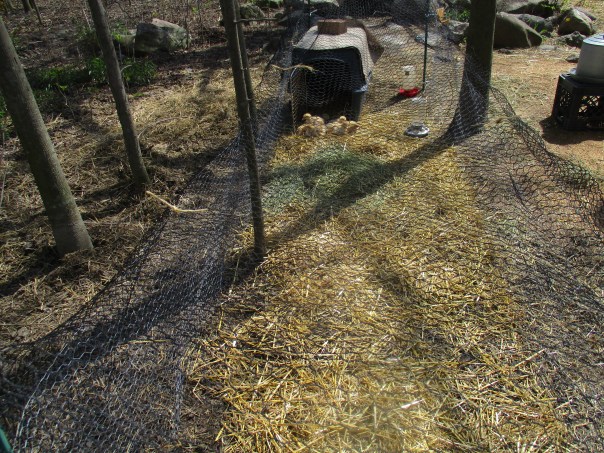
or maybe I should say “The Meat Chicks”. The plan for these chicks is to raise them only until they are large enough to butcher. Regardless of the title we have begun introducing the chicks to the farm and the rest of the flock.

IMG_2525

We set up a 12′ x 3′ run, made out of 2 foot chicken wire, near the chicken coop. We left the dog crate inside the run so the chicks could get out of the sun or wind if they need to. We covered the run with netting so the chicks can’t fly out and the other chickens or overhead predators can’t get in. We thought the chicks would go into the crate as darkness comes, this would make it easy to bring them back to the brooder for the overnight hours. We quickly learned there is a flaw in this plan. Even though the chicks spent time in and out of the crate during the day, as darkness approached all of the chicks were outside of the crate. The first night I chuckled as my husband told me that he had to crawl around the pen to catch them all and put them back in the crate. The second night I actually lost our bet when we arrived at their pen to find them all huddled next to the crate. My creative husband, who was willing to try anything so he would not have to crawl around on his hands and knees again chasing chicks, took out his flashlight, turned it on, and put it in the crate. Immediately all 10 chicks went into the crate on their own. That’s when we realized that unlike our older chickens that always return to their coop when darkness comes,    these chicks have never know darkness. The warmth that they require at their young age has always been provided by a heat lamp during the overnight hours.  They were seeking light or maybe afraid of the dark.

“I didn’t know if that would work,” 🙂 my husband said as he carried the crate to the van, but we are thankful that it did as we plan to continue this for a week or so until we feel they are ready to move to the farm permanently.

A Year In Growing Garlic (Part VI)Unintended Consequences

Tuesday’s warm temperatures allowed me to get into the garlic field to do some work. If you are growing your own garlic this is a job that you shouldn’t have to worry about, but I decided to write about it so that others can learn from our mistakes.

My task for the day was digging green garlic. The garlic that I was digging were not the cloves that we planted last October for harvest this July. This patch of garlic was coming up seemingly independently. What happened was when we planted last years crop, in the fall of 2015, we planted a short row of small cloves that we thought we would use as a test row to try out the potato digger that we hoped to use to harvest the garlic. That row went largely neglected (unweeded and unfertilized) last year as it was not really figured in as part of the crop that we would sell. When harvest season came the condition of the soil was so dry and hard that using the potato digger was out of the question. That short row of garlic also went unharvested.

When my husband tilled the area to prepare for the next planting those garlic plants were tilled under. It is very apparent that many of the cloves from that unharvested garlic survived the tilling, as they sprouted up along with the garlic that we planted for this years crop.

IMG_2462

More garlic coming up would be a good thing except that they were coming up amongst the garlic that we planted for this season. If left in place they would be too crowded which could reduce the size of the bulbs.

Needing to get rid of them, but not wanting to waste them, I decided to harvest the greens. These are referred to as green garlic. Normally to harvest green garlic I would just snip it at the base of the plant and leave the roots in place, but since I did not want this to grow back up I needed to dig it. The job was somewhat complicated by the fact that the soil was still pretty wet and therefore sticky mud, also many of the plants were growing sideways so the roots were not directly below the greens. I spent several hours Tuesday with my hands and knees in the dirt and filled up a paper shopping bag with green garlic.

When I took home the bag full of green garlic Tuesday evening I wasn’t sure exactly what I was going to do with them. I started by clipping all the roots off that evening. I would decide more in the morning.

IMG_2476

Tuesday morning I decided my next step was to clean the greens. For several reasons I decided I was not ready to send these to market. Mostly because people are not familiar with buying and using green garlic, so before market it I need to learn a little more about it myself. I need to know the best way to store them and how long the will keep. I need to experiment so I can educate others.

I expect that they will keep well for a while in the refrigerator, but they do need to be sealed in a bag to prevent the garlic smell from adulterating other foods. So I put a sealed bag of greens in the veggie drawer in the refrigerator. I’ll add some to my salad this weekend.

I then decided to see how well they would dehydrate. If they maintain their flavor they would be even better than dried chives in my opinion. Using scissors I cut them into small pieces and loaded my dehydrator. I set the temperature at 90 degrees and checked them every few hours. It probably took about six hours to completely dry them. I was quite happy with the flavor that was retained through the drying process. A word of warning for anyone who might attempt this: the dried greens are very light weight and confetti-like; the least amount of movement can make them blow around. Many of the green flakes ended up on the counter and even the floor. So move cautiously around them and DO NOT open the dehydrator when it is still running!

My sister and my aunt who stopped by while I was cleaning the green garlic were each given a bag and we talked about ways to use them. I hope to hear back from them how they used them and how well they liked them. 🙂

IMG_2475

I had enough to fill the dehydrator again on Thursday so I did a second batch. I’m sure my husband will agree that dehydrating garlic should come with this WARNING: Do Not Try This At Home. During the first few hours of the process the smell of garlic is over powering. We opened windows and put in a window fan blowing outward. We also agreed that in the future when we dehydrate garlic it will be done outside.

In conclusion, I highly recommend growing (and eating) green garlic, so watch for future posts about where I will be intentionally growing it. 🙂

Frogs on the Farm

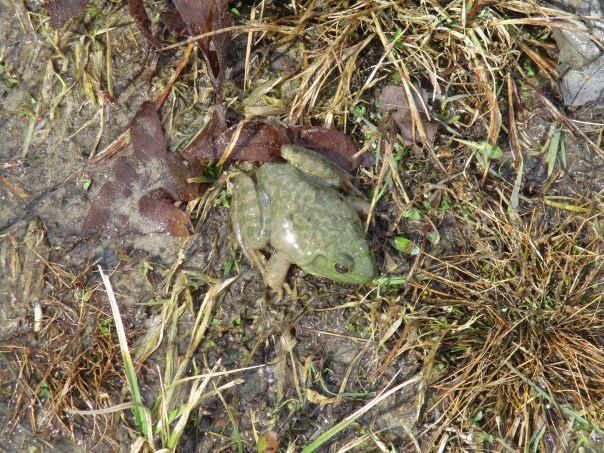
Last week on one of our sap cooking days, in addition to helping keep the fire going, I took on the secondary chore of raking the leaves out of the pond. As I came up with one rake full of leaves and shook them into the pile just beyond the beach, this frog hopped out of the leaves.

IMG_2362

I felt kind of guilty about awakening him or her, because I was yet to see or hear any frogs this spring. It did however spend a good deal of time sunning itself on the beach. It wasn’t until one of the chickens came running up behind it that it took a three foot leap back into the safety of the pond.

It was two days later that we heard the frogs for the first time this year. I remember my mom telling me, that her mom had told her, that after you hear frogs for the first time in the spring you will have three more freezes. Although I’m always am excited to hear the frogs in the spring, I haven’t really tested this theory.

Frogs and toads lived on our farm before we put in the pond. I remember the first spring there were tadpoles that had hatched in a puddle of water and my husband was dumping buckets of water in the puddle to keep it from drying up before the tadpoles reached their adolescent stage of life.

Our property does provide the perfect habitat for frogs and toads. The pond offers conditions needed for frogs to lay eggs, for the eggs to hatch into tadpoles and for the tadpoles to live until they grow legs and their lungs develop so they can leave the water. This can take over a year for bull frogs. Even mature frogs, who can live out of water, continue to need a wet area to keep their skin from drying out. Not only does our farm have the pond but we have wooded areas where the ground is covered with dead leaves that keep the ground moist even in the hot and dry summer conditions.

According to the Michigan Department of Natural Resources article that I have linked below of the more than 3400 species of frogs/toads only 13 live in Michigan. I am certain we have at least 4 species that populate our farm.

Frogs and toads are wonderful for pest control. The aforementioned article relates that a single frog will consume thousands of insects per year. Last year we discovered that we were reaping the benefits of this. As we picked our bountiful harvest of strawberries  https://donteatitsoap.com/2016/06/30/strawberries-at-last/ last June my husband and I spoke several times about the fact that we did not have any slugs eating the berries. This is a problem the we have had with strawberries we have grown at the house in the past. It wasn’t until my husband told me that he had been surprised by a frog hiding in the strawberry patch, while he was picking berries, that I realized that this frog was probably enjoying a regular diet of slugs and any other pests that threatened to consume our strawberry crop. I am hopeful that a frog will take up residence in the strawberry patch again this year.

Frogs are a good indicator of the health of wetlands, ponds, lakes and such as they do not survive in polluted areas. The Michigan DNR article that I have linked below explains that chemical fertilizers and pesticides are a threat to frog populations; not only can the chemicals kills frogs and toads, but the pesticides also reduce their food supply.

http://www.michigan.gov/dnr/0,4570,7-153-10370_12145_12201-35089–,00.html

The frogs on our farm are also entertaining. In the summer time when we walk around the edge of the pond the frogs jump into the pond one right after the next. It’s kind of funny because there may be 50-100 frogs sitting around the outer edge of the pond. The dogs like to chase the frogs but rarely are they able to catch them. Last year Scout spent hours in the evenings looking for frogs along the edge of the pond, he enjoyed the search immensely even though he never caught any. After dark we are often treated to a campfire symphony, in surround sound I might add, as the several different species of frogs sing from different areas of the farm.

While not everyone has the luxury of being able to put a pond on their property I have included the following link for those who may be interested in creating a frog habitat. I would encourage you to read through the end of the article, as it does explain that the best way to introduce frogs to this habitat is to let them come to it naturally and this may take a year or more. It also explains that not all parts of the U.S. are favorable for creating frog habitats.

https://www.nwf.org/News-and-Magazines/National-Wildlife/Gardening/Archives/2000/Want-to-Host-a-Garden-Party-for-Frogs.aspx