Category Archives: The Farm

A Year In Growing Garlic (Part VI)Unintended Consequences

Tuesday’s warm temperatures allowed me to get into the garlic field to do some work. If you are growing your own garlic this is a job that you shouldn’t have to worry about, but I decided to write about it so that others can learn from our mistakes.

My task for the day was digging green garlic. The garlic that I was digging were not the cloves that we planted last October for harvest this July. This patch of garlic was coming up seemingly independently. What happened was when we planted last years crop, in the fall of 2015, we planted a short row of small cloves that we thought we would use as a test row to try out the potato digger that we hoped to use to harvest the garlic. That row went largely neglected (unweeded and unfertilized) last year as it was not really figured in as part of the crop that we would sell. When harvest season came the condition of the soil was so dry and hard that using the potato digger was out of the question. That short row of garlic also went unharvested.

When my husband tilled the area to prepare for the next planting those garlic plants were tilled under. It is very apparent that many of the cloves from that unharvested garlic survived the tilling, as they sprouted up along with the garlic that we planted for this years crop.

IMG_2462

More garlic coming up would be a good thing except that they were coming up amongst the garlic that we planted for this season. If left in place they would be too crowded which could reduce the size of the bulbs.

Needing to get rid of them, but not wanting to waste them, I decided to harvest the greens. These are referred to as green garlic. Normally to harvest green garlic I would just snip it at the base of the plant and leave the roots in place, but since I did not want this to grow back up I needed to dig it. The job was somewhat complicated by the fact that the soil was still pretty wet and therefore sticky mud, also many of the plants were growing sideways so the roots were not directly below the greens. I spent several hours Tuesday with my hands and knees in the dirt and filled up a paper shopping bag with green garlic.

When I took home the bag full of green garlic Tuesday evening I wasn’t sure exactly what I was going to do with them. I started by clipping all the roots off that evening. I would decide more in the morning.

IMG_2476

Tuesday morning I decided my next step was to clean the greens. For several reasons I decided I was not ready to send these to market. Mostly because people are not familiar with buying and using green garlic, so before market it I need to learn a little more about it myself. I need to know the best way to store them and how long the will keep. I need to experiment so I can educate others.

I expect that they will keep well for a while in the refrigerator, but they do need to be sealed in a bag to prevent the garlic smell from adulterating other foods. So I put a sealed bag of greens in the veggie drawer in the refrigerator. I’ll add some to my salad this weekend.

I then decided to see how well they would dehydrate. If they maintain their flavor they would be even better than dried chives in my opinion. Using scissors I cut them into small pieces and loaded my dehydrator. I set the temperature at 90 degrees and checked them every few hours. It probably took about six hours to completely dry them. I was quite happy with the flavor that was retained through the drying process. A word of warning for anyone who might attempt this: the dried greens are very light weight and confetti-like; the least amount of movement can make them blow around. Many of the green flakes ended up on the counter and even the floor. So move cautiously around them and DO NOT open the dehydrator when it is still running!

My sister and my aunt who stopped by while I was cleaning the green garlic were each given a bag and we talked about ways to use them. I hope to hear back from them how they used them and how well they liked them. 🙂

IMG_2475

I had enough to fill the dehydrator again on Thursday so I did a second batch. I’m sure my husband will agree that dehydrating garlic should come with this WARNING: Do Not Try This At Home. During the first few hours of the process the smell of garlic is over powering. We opened windows and put in a window fan blowing outward. We also agreed that in the future when we dehydrate garlic it will be done outside.

In conclusion, I highly recommend growing (and eating) green garlic, so watch for future posts about where I will be intentionally growing it. 🙂

Frogs on the Farm

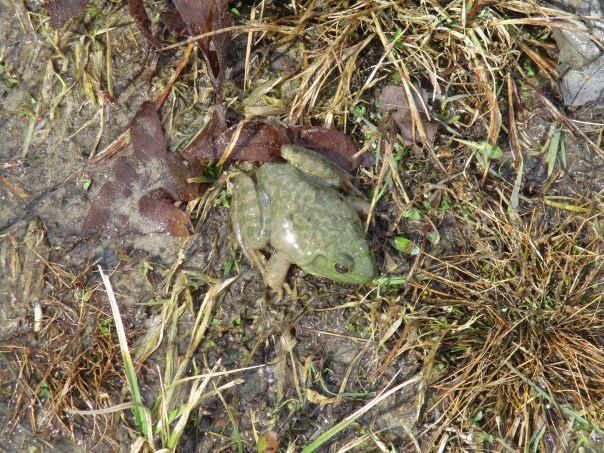
Last week on one of our sap cooking days, in addition to helping keep the fire going, I took on the secondary chore of raking the leaves out of the pond. As I came up with one rake full of leaves and shook them into the pile just beyond the beach, this frog hopped out of the leaves.
IMG_2362

I felt kind of guilty about awakening him or her, because I was yet to see or hear any frogs this spring. It did however spend a good deal of time sunning itself on the beach. It wasn’t until one of the chickens came running up behind it that it took a three foot leap back into the safety of the pond.

It was two days later that we heard the frogs for the first time this year. I remember my mom telling me, that her mom had told her, that after you hear frogs for the first time in the spring you will have three more freezes. Although I’m always am excited to hear the frogs in the spring, I haven’t really tested this theory.

Frogs and toads lived on our farm before we put in the pond. I remember the first spring there were tadpoles that had hatched in a puddle of water and my husband was dumping buckets of water in the puddle to keep it from drying up before the tadpoles reached their adolescent stage of life.

Our property does provide the perfect habitat for frogs and toads. The pond offers conditions needed for frogs to lay eggs, for the eggs to hatch into tadpoles and for the tadpoles to live until they grow legs and their lungs develop so they can leave the water. This can take over a year for bull frogs. Even mature frogs, who can live out of water, continue to need a wet area to keep their skin from drying out. Not only does our farm have the pond but we have wooded areas where the ground is covered with dead leaves that keep the ground moist even in the hot and dry summer conditions.

According to the Michigan Department of Natural Resources article that I have linked below of the more than 3400 species of frogs/toads only 13 live in Michigan. I am certain we have at least 4 species that populate our farm.

Frogs and toads are wonderful for pest control. The aforementioned article relates that a single frog will consume thousands of insects per year. Last year we discovered that we were reaping the benefits of this. As we picked our bountiful harvest of strawberries  https://donteatitsoap.com/2016/06/30/strawberries-at-last/ last June my husband and I spoke several times about the fact that we did not have any slugs eating the berries. This is a problem the we have had with strawberries we have grown at the house in the past. It wasn’t until my husband told me that he had been surprised by a frog hiding in the strawberry patch, while he was picking berries, that I realized that this frog was probably enjoying a regular diet of slugs and any other pests that threatened to consume our strawberry crop. I am hopeful that a frog will take up residence in the strawberry patch again this year.

Frogs are a good indicator of the health of wetlands, ponds, lakes and such as they do not survive in polluted areas. The Michigan DNR article that I have linked below explains that chemical fertilizers and pesticides are a threat to frog populations; not only can the chemicals kills frogs and toads, but the pesticides also reduce their food supply.

http://www.michigan.gov/dnr/0,4570,7-153-10370_12145_12201-35089–,00.html

The frogs on our farm are also entertaining. In the summer time when we walk around the edge of the pond the frogs jump into the pond one right after the next. It’s kind of funny because there may be 50-100 frogs sitting around the outer edge of the pond. The dogs like to chase the frogs but rarely are they able to catch them. Last year Scout spent hours in the evenings looking for frogs along the edge of the pond, he enjoyed the search immensely even though he never caught any. After dark we are often treated to a campfire symphony, in surround sound I might add, as the several different species of frogs sing from different areas of the farm.

While not everyone has the luxury of being able to put a pond on their property I have included the following link for those who may be interested in creating a frog habitat. I would encourage you to read through the end of the article, as it does explain that the best way to introduce frogs to this habitat is to let them come to it naturally and this may take a year or more. It also explains that not all parts of the U.S. are favorable for creating frog habitats.

https://www.nwf.org/News-and-Magazines/National-Wildlife/Gardening/Archives/2000/Want-to-Host-a-Garden-Party-for-Frogs.aspx
The Sap Is Flowing and The Hens Are Laying

Over the weekend, as we looked ahead at the 10 day weather forecast and saw that 8 out of 10 days were predicted to have high temperatures above freezing, we decided it was time to tap maple trees. Here is the link to my past from last year about tapping maple trees. https://donteatitsoap.com/2016/02/20/tapping-maple-trees/?iframe=true&theme_preview=true

So yesterday, (Monday, February 13) we set a total of 18 taps (and buckets) in 8 maple trees at our farm. It seems early to be tapping the trees, but the sap began flowing as soon as the taps were in place. I guess, like many things farming related, weather conditions mean more than the date on the calendar. We also set up a fire pit where the sap will be boiled down.

img_2237

Today, after lunch, we went to the farm to collect the sap. When all 18 buckets were emptied we had collected 10 gallons of sap. Our plan is to collect the sap for the next couple of days before we begin boiling it down. Our intention is to leave the taps in place, and continue to collect sap and make syrup, as long as the sap runs clear. When the sap turns cloudy maple syrup season is finished.

img_2242

Throughout the month of December the chickens’ egg production gradually slowed, and through the month of January we only collected one or two eggs per day. Last week we began getting 5 or 6 eggs daily and now we are up to 8 or 9. As the days grow longer, and the chickens enjoy more sunny days, egg production will continue to increase. This makes feeding the hens all winter worth while.

img_2239

The bees were out today when the afternoon temperature climbed to around 50 degrees. I don’t think there was anything for them to forage, but at least they could take a cleansing flight. Later this week when temps get back into the 50’s we will check their food supplies and feed them if necessary. We do have honey and wax reserved for them so we do not have to feed them sugar water. We did lose one hive earlier this winter. We could not determine the reason for the loss, as the hive was not full of dead bees. At this point it seems as if the three remaining hives are okay, and we plan to start two new hives in May. We will also capture swarms to if the opportunity arises.

Regardless of the date on the calendar, or the groundhog’s prediction, all signs on the farm are pointing to an early spring.

I Brake For Bees


I told my husband that I need a t-shirt that says “I brake for bees” but probably more appropriate would be a bumper sticker pasted on the back of our riding lawn tractor.

This may be something only another beekeeper can understand, and even among beekeepers I might be in the minority. It wasn’t something that I thought about before I realized I was doing it, but as I mow the lawn at the farm I often see honey bees foraging on the dandelion or clover blossoms. My natural reaction is to yield them the right of way. Of course having wrote the check to purchase packages of bees, along with reaping the rewards of their labors, I have a great understanding of their value. Now it may or may not be the case that they will move out of the way of the mower just like the chickens and dogs move out of the way of vehicles at the last minute, but I am just not certain.

Few other creatures get this kind of consideration but among them are frogs, toads and snakes.

This past summer, my husband, who is totally on the same page with me as he has been known to get off the mower and move a toad to a safe place before continuing to mow, and I decided to restrict our mowing to the later evening hours after the bees were mostly back to the hive. It may be crazy, but I consider this a small sacrifice to help keep our hives healthy and strong.

img_1650


Spring 2016

I do love spring in Michigan. I’m not really sure that I’d call it my favorite season. In fact I am happy to live in a place where we can enjoy the unique qualities of each season, seeing the earth come alive in the spring, then the summer heat and growing season, followed by the crispness of fall and the glorious colors when the leaves change, and while I’m not a huge fan of cold weather I do enjoy a fire in the fireplace and snow in the winter.

To me spring seems to be a magical time. As we walk our farm I am fascinated by seeing the life emerge from below the ground. I observe the daily changes in the vegetation as the trees get their buds then the  buds turn to leaves and blossoms. I enjoy walking in the wild areas of the farm and trying to identify the various plants, as much as I love seeing our first asparagus shoots appear, the blueberries blossoming, or picking a piece of green garlic and chewing on it.

I have to say that I am truly thankful for my husband who also has a great appreciation for nature. We shared the excitement of watching the daffodils flower, we were delighted to see the bees foraging on the dandelions, and we marveled this year as our forsythia’s, that were just small twigs 4 years ago when we planted them, have brightened the back of the pond with their beautiful yellow blossoms. Yellow is the color of early spring on our farm. A very appropriate color in deed. Yellow is a happy color. It makes me smile.

My husband doesn’t think it’s corny when I give him daily reports about what is blossoming. He indulges my crazy ideas, and he will help preserve the natural beauty of our farm by doing things like moving wild rose plants before we disturb the ground in which they reside.

IMG_1166
These rocks have become my rose garden. Four wild roses have been relocated here. They are all doing well.

He has also designated an area where we can transplant Mullein this year. We have discovered mullein coming up in several areas where we will be mowing, and rather than kill these valuable plants we have decided to give them their own spot. Mullein is a medicinal plant which I will use for teas, infused oils and tinctures. This website explains it’s uses http://www.herbcraft.org/mullein.html

We also enjoy bringing new life to our farm. So far this year we have planted 4 basswood trees, 3 willow trees, 25 new asparagus crowns which are sending up small shoots, a row of potatoes which are beginning to grow, a small row of sugar peas, and two rows of cabbage.

We also planted my Mother’s Day gifts from Tina and her husband Ken. Tina knows of my love for growing things so she called me a couple weeks ago and said rather than her just picking out something, she thought it was a good idea to ask what I wanted.  Upon going to the website of the nursery she shops at I discovered that they had the one plant that I thought would be hard to find. Solomon’s Seal.

Solomon’s Seal grows in wooded or shady areas, and although we have some wooded areas where Solomon’s Seal might grow wild I had never noticed it growing on our farm. It is another plant that has desirable medicinal properties, and even though I will not harvest it this year I intend to use it for teas, infused oils and tinctures in the future. You can check out this website to learn more http://www.herbcraft.org/solseal.html I also planted the three Thyme plants, that Tina and Ken brought me, in the prayer garden.

The new life of Spring is not limited to plants. We had the first hatching of tadpoles in the pond this week. I believe these are baby toads since we have seen many toads in the pond lately. Toads are beneficial for the farm as they live on the land and eat insects, grubs and slugs that that might cause problems in the gardens.

IMG_1183

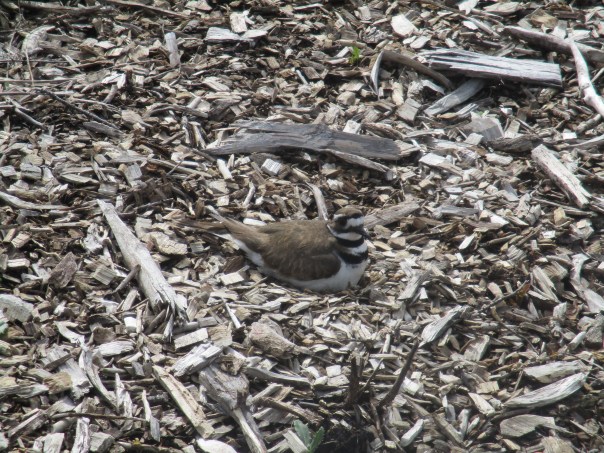
Another part of spring in Michigan that we enjoy is seeing the birds return to the area. Seeing the first Robin and Red Winged Black Bird are sings that Spring is here. We have fun watching the Killdeer protect their nest by doing the broken wing act to make the dogs chase them in the opposite direction. We also try to identify birds we are not familiar with.

This year we have two birds that have become rather annoying. One is a duck who is visiting our pond regularly. Since we use our pond for swimming and fishing as well as irrigation we really don’t want ducks in the pond. There are many other ponds in our area that go unused where this duck could stay and no one would care. Even though we tell Trooper and Scout to chase it away whenever we see him, he just keeps coming back. The second is a robin who likes to sit in the maple tree outside our bedroom window and sing. There is no nest being built there, and there are plenty of other trees in the area, but this robin insists on sitting in this particular tree, every morning in fact. It starts singing before the sun comes up – sometimes as early as 3:30 a.m. While we are usually up around the time the sun comes up, and it may be true that the early bird catches the worm, we find this birds wake up calls to be a little too extreme. I do suppose this is one well-fed robin.