Category Archives: The Farm

Welcome

IMG_3674 (2)

Welcome Friends!

I have to start with a huge THANK YOU to everyone reading this. When I first started writing this blog, about two and a half years ago, I never imagined it would be what it has become. I figured I might have a few people who would read it regularly – friends and family that know and love me. For quite a while that was the case. Occasionally I would look at my stats and see that no one had viewed my blog for several days and I wondered if it was worth writing, then a friend or family member would mention how much they enjoyed reading it. That was all I needed to inspire me to keep writing.

Today I am amazed as I look at my blog stats and see that people from all over the world, 67 countries at last count, have visited my little piece of the internet. Since visiting my blog is often much like a visit to our home or our farm it occurred to me that many visitors probably have no idea where in the world we are at, so if you are curious I will give you some direction. I will start by saying that we are in Michigan which is a state in the USA.

pexels-photo-269646.jpeg

If you are not familiar with Michigan you can find it easily on the map above. Michigan is the state that is shaped like a mitten, well at least part of Michigan is. Our state is unique in that it is made up of two peninsula’s. The lower peninsula is shaped like a mitten and the upper peninsula, you can see on the above map, is the piece of land to the North that extends Westward or to the left (its upper border is outlined in red). Interestingly, while lower Michigan is bordered by the U.S. States of Indiana and Ohio to the South and Upper Michigan is bordered by the U.S. State of Wisconsin to the West, Michigan’s two peninsulas do not share a common border. They are separated by the Straits of Mackinac, which are a series of narrow water ways that connect Lake Huron and Lake Michigan. To travel from one peninsula to the other, by car, you must cross the Mackinac Bridge, which is nearly 5 miles long and said to be the forth longest suspension bridge in the world.  http://www.mackinac.com/about/mackinac-bridge Because Michigan is surrounded by the Great Lakes and adjoining waterways there are also many islands that are part of our state.

To give you a better idea of where we are in Michigan I would hold up my right hand with the palm facing you and my fingers held tightly together (like a mitten) and point to an area near the bottom of my thumb. Michiganders are known for using their hand as a map. Our little piece of the earth is 7.6 acres of farm land in a rural area North East of  Detroit and South West of Port Huron. Some of it is wooded and some of it is open field. We put in a pond as a source of fresh water in 2012, but have yet to build a house on the property.

Like much of the U.S. this winter has been brutally cold here in Michigan, but I thought today I would invite you to take a walk with me. Don’t worry we won’t have to put on an extra 10 lbs. of gear to survive the freezing temperatures and trudge through the snow, because this part of the post I actually started writing last summer.

During the warm seasons, spring after the snow melts, summer, and fall until the snow gets too deep, I like to walk our back field. We keep a path cut around the outside of the field and two paths that cut across the middle. We allow the rest of the field to grow wild during the summer and we mow it each fall. It’s interesting that each year different plants seem to dominate the field. This field, which many people would view as a field full of weeds, we see as a field full of wild flowers. Not only does it provide habitat and food for countless bunnies, birds, rodents, toads and insects, the deer graze it regularly, and it is home to many plants that our bees love to forage.

I usually start my walks on the East side of the property, heading North and off to our left you will notice a large fenced in area. This is our main garden, where we grow much of our own produce in the summer. We also have 5 apple trees growing within this area and we moved our entire blueberry patch in here as well. It didn’t take us long to learn that fencing is the best way to protect our vegetation from deer.

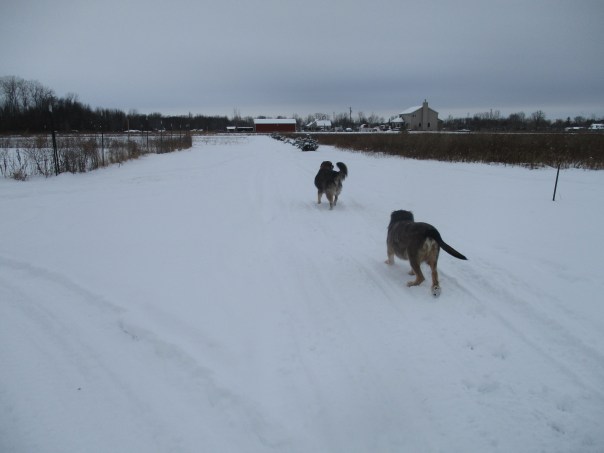
As we walk toward the field I will look for deer grazing. This will be our best chance to see deer because Scout and Trooper will undoubtedly be with us and will frighten off any deer. The boys have been taught that they can only chase the deer as far as our property line and it has become a game for Trooper. I suspect if the deer ever decided to stay and play he would have a ball with them…but they don’t.

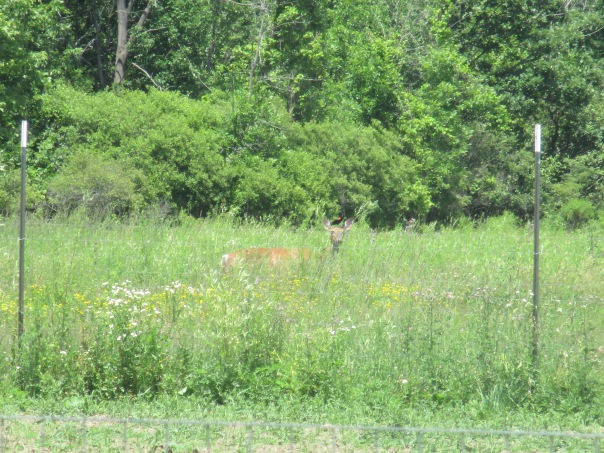
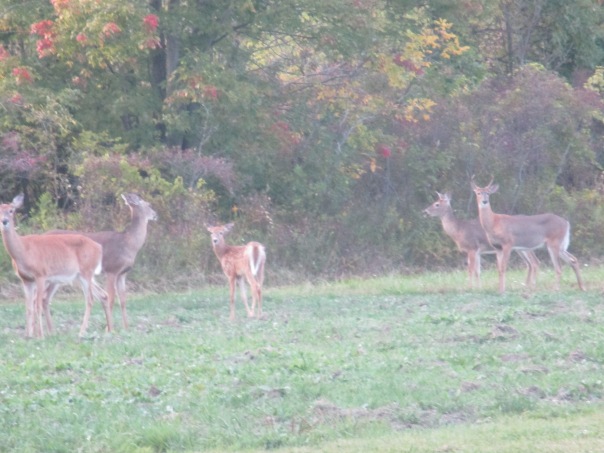
We may see one or two, we may see a mother with her baby(s) or we may see 20 or more deer grazing in the field. On a rare occasion we might witness a scene that feels like something out of a Disney movie. Like this red winged black bird that rides on the back or head of this deer.
IMG_2980

One day when Trooper was walking with me he scared the deer off. The blackbird that had been sitting on the back of the deer began diving at Troopers back, obvious angry at him. The bird never touched Trooper and because the bird was diving at his back he was oblivious to it and bird eventually flew off.
IMG_3283

While the deer are beautiful to watch, are seemingly harmless and our guests get very excited to see them, we have come to see them as a nuisance.  We have invested much money, time and energy to protect our crops against deer. It seems that deer will eat or at least taste anything … except garlic.

When we first bought the farm and we asked a neighbor how he kept the deer from eating his garden he said “plant enough for you and plant enough for the deer.” While his advice sounded good in theory, we quickly learned that it doesn’t work. The deer apparently did not understand the concept; they would walk through the pumpkin patch and rather than eat just one or two whole pumpkins they would take a few bites out of many pumpkins. Thus we concluded that the best way to protect our plants, including young trees, is adequate fencing.

IMG_2935

Beyond the main garden the rest of our property is open fieled. The bright yellow flowers that are blanketing the field at this time are Bird’s Foot Trefoil. The first year we had the farm I notice one small patch of this plant growing in the field. It’s brilliant flowers caught my attention so I did some research to find what it was. Each year I have noticed more and more Trefoil. I suspect that as we cut the field in the fall we are scattering it’s seeds throughout the field. Trefoil is a legume that is used for animal forage, cut for hay, or planted to prevent soil erosion.  https://plants.usda.gov/factsheet/pdf/fs_loco6.pdf One thing we have discovered, that is not mentioned in this USDA fact sheet, is that honey bees like it. This in itself is enough for me to appreciate this plant.

The small white flowers tinged with pink are White Clover. https://plants.usda.gov/factsheet/pdf/fs_trre3.pdf  This is another plant that we highly value as the honey bees feed heavily on the blossoms. While we did not plant the clover in the back field, we have planted a mix of clover and grass seed in areas that we have landscaped. Clover is a nice addition to lawn areas as it can be mowed and it will grow back, and even blossom, repeatedly throughout the summer. It is also nice to walk on barefoot, and we have noticed that it seems to crowd out other unwanted plants like thistle.

IMG_2945

Young Spruce trees line the East and North sides of our property. We began planting these in our second year here. We purchase the 12″ to 15″ seedlings and keep them in a nursery area for one or more seasons to give them time to grow and develop roots and branches, then we transplant them around the farm. Most of these were planted in 2012.

IMG_2941

Canadian Thistle grows sporadically throughout the field and other places on the farm. We mostly consider this plant a menace despite the pretty purple flowers that also have a lovely fragrance, their only saving grace is in the fact that the honey bees like them.

IMG_2943

This white flower with feathery leaves is Yarrow  https://draxe.com/yarrow/ . I have noticed Yarrow growing in various areas on the farm over the past few years but this past year was the first time I noticed it in the back field. According to the above article yarrow is both a culinary and medicinal plant. I not sure why I have not harvested any yet.

IMG_2937In the photo above the Timothy Hay is somewhat camouflaged amongst the other greenery, but if you look toward the top of the photo just left of center you can see Timothy’s long thin seed heads that are a lighter green. Small patches of Timothy are scattered throughout  the field and each year I notice a little more. As we walk past the Timothy I will likely pull on one of the seed heads and as I do the seed head along with the top portion of the stem will slide out of the lower part of the stem. I will put the stem in my mouth and you will no doubt think the I am a hick. I will then pull a second one and offer it to you explaining that Timothy is the best weed for chewing. The end of the inner stem is soft and juicy and even a bit sweet. I lightly chew the end for a while before discarding it later along the way.

IMG_2954

Along the West side of the field is a line of trees that runs the full length of the property and separates our property from the neighbors next to us. The tree line is composed of mature trees, mostly Oak, Maple, Ash, and Hickory, along with various bushes and shrubs and vines that makeup the undergrowth. Unfortunately, the Ash trees in Michigan have fallen prey to, and are being killed off by the Emerald Ash Borer, thus we have cut down nearly all of the dead Ash trees to use for firewood.  As we cut trees down we are also planting new trees. In the above photo you can see the large dead Ash tree to the right and the young Maple that we planted a couple years back in the center foreground. You may also spot some Timothy growing there. Yep, it’s okay to pull one to chew. I knew you would find them as irresistible as I do. 😉
IMG_2972

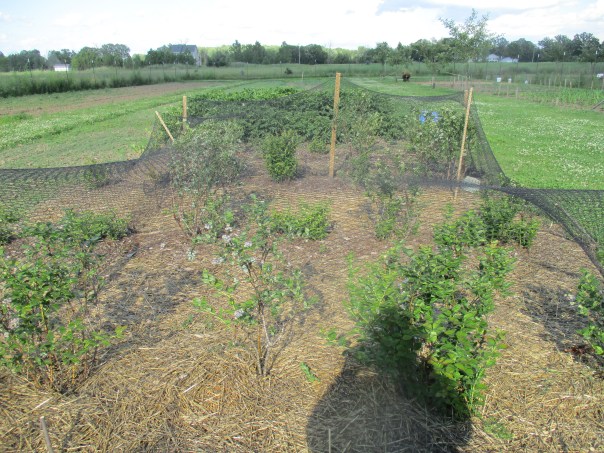
As we circle back around we are now at the West end of the main garden. This is where we moved our Blue Berry Patch to. Having been in a different location for several years we weren’t sure how well the bushes would adapt to this new environment. They have seemed to do well and while we no longer worry about the deer eating them since they are in the fenced area, we still have to protect the fruit from birds, thus the netting over them.

Well, my friend, thank you for spending this time with me. I hope you enjoyed our walk in the field. If you aren’t ready to leave feel free to hang around and enjoy some more of our farm. You can do so by clicking on the following links.

https://donteatitsoap.com/2017/06/28/pond-pictures-relax-and-enjoy/

https://donteatitsoap.com/2017/08/12/gone-fishing/

https://donteatitsoap.com/2017/05/25/five-hives/

https://donteatitsoap.com/2017/09/05/our-harvest-picnic/

https://donteatitsoap.com/2017/05/22/this-season-on-chicken-tv/

https://donteatitsoap.com/2017/05/31/a-beautiful-monday/

and if you would like to return you can always do so by following my blog. Please feel free to leave your questions and comments below as two sided conversations are much more fun.


Our Christmas Tree

For the second year in a row we decided to cut our own Christmas tree. Last year, and again this year, we cut spruce trees from the farm. When we purchased the farm in 2011 there were many deciduous trees growing on the property but there were absolutely no evergreens. The following spring we placed an order with our local conservation district spring tree sale and amongst the things we ordered were 50 spruce trees, 25 Blue Spruce and 25 Norway Spruce. When the 12-15 inch seedlings arrived we had no idea where we were going to plant them, so we made a nursery area for them within our fenced garden area where they were well tended through the summer. It was a hot and dry summer, and the garden required much watering. It was the summer before we had the pond or the windmill so we carted many barrels of water in the back of the truck, from our house to the farm, in order to keep our garden alive. Having these seedlings in the garden area, where it was convenient to water them, proved to be a blessing and allowed them to flourish. By the fall of that year we were ready to plant them in their permanent places. We decided to line the North and East sides of the back field with some of them, as they would eventually provide privacy and wind breaks.

Over the last five years these trees have received much TLC, they have been fenced during the winters to protect them from the deer, they have been weeded and mulched, and during the droughts of summer we have driven the truck around the outskirts of the field delivering water to each of these trees in attempts to keep them alive. Not all of the trees have survived, but most have with some doing better than others.

We have continued to order Norway Spruce and Blue Spruce seedlings each spring and place them in a temporary nursery area until we decided where we want to plant them. Some of them have replaced spruce trees that we lost, we use some to replace dead Ash and Elm trees that we cut down, and we will also replace the trees that we cut for Christmas trees.

IMG_3491
Spruce Trees Line The East Side Of Our Field

It was about 10 days before Christmas, and we had gotten our first decent snow fall, when we went out to cut our tree. My husband and I walked the path along the East and North of the property and examined each tree before we decided which one to cut.

IMG_3492

Scout and Trooper were happy to be with us.

IMG_3495

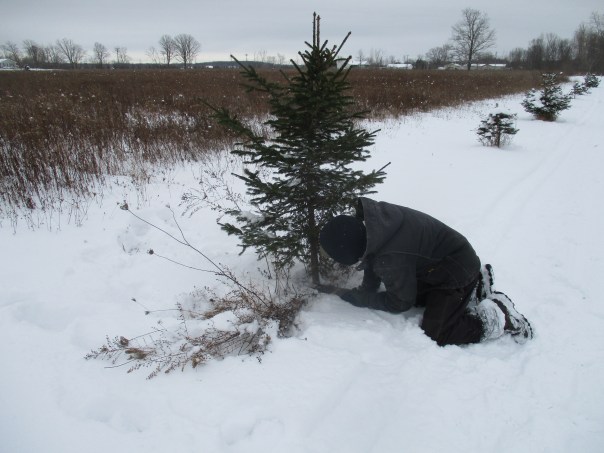
We selected this Norway Spruce. We didn’t measure it but I’m sure it was close to 5 feet tall. It took my husband less than a minute to saw through the trunk.

IMG_3505

As we walked back from the field we spotted this hen who had made her way through the snow out to the field. We were really surprised to see her there because chickens do not like to walk in snow. My husband picked her up and we gave her a lift back to the coop.

IMG_3514

We opted not to trim the longer, upper branches to achieve the “prefect” Christmas Tree shape, but left the tree in it’s natural God-given shape. The short needles and less than crowded branches made adding lights and hanging ornaments easy. And we have been enjoying the simplicity and beauty of our homegrown Christmas tree.

IMG_3611

On Christmas Day we added one final ornament after opening the gift from Tina and Ken. We hung the new “Ciani Family” ornament next to the “God Bless the Farmer” ornament they gifted to us last year. I think I am seeing a theme here to complement our new tradition. 🙂

Rescue Rooster

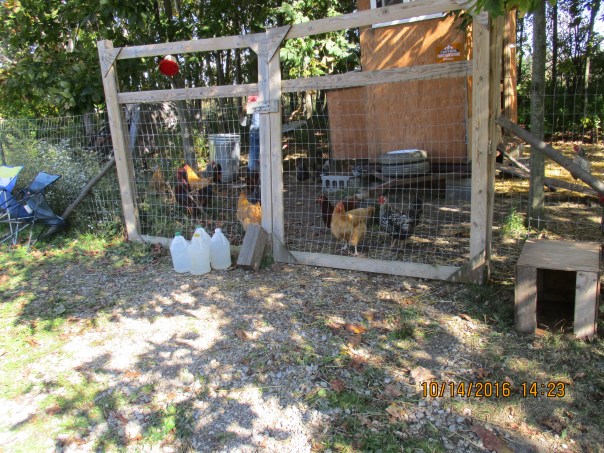
We’ve been raising chickens on our farm since 2013. Having a free range flock of egg layers was one of our priorities when we bought the farm and everyone that knows us knows how much we love our chickens. You can read some of my previous posts about chickens here https://donteatitsoap.com/category/chickens/ .

Ever since we put our first flock of chickens in the coop our lives have revolved around chickens. Every morning without fail, we (nowadays my husband) open up the coop as the sun is coming up, and provide fresh food and water for the flock. On days that he or we are not working at the farm it is necessary to make at least one, but usually two, midday runs to the farm to check on the chickens. Our presence helps to deter predators. Every evening, after doing a beak count,  the chickens are closed in the coop for the night. If any chickens come up missing a search ensues, sometimes resulting in finding that a hen has gotten into one of the fenced in gardens and can’t find her way out, or one has decided to roost in a tree for the night. Other times we have found that, sadly, a hen has fallen prey to a hawk or a fox, and some times they just disappear with out a trace.

Our vigilance has been rewarded with being able to maintain a flock of happy, free range, egg layers, who provide us and others with delicious, healthy, farm fresh eggs. The insect control and entertainment they provide are supplementary benefits.

One thing that we have learned over the years is that while it may be a good idea to keep a rooster to protect and service the flock, having more than one rooster causes disharmony and stresses the hens. Thus we have agreed to only keep one rooster.

IMG_2346
Meet Cocky

Earlier this year I was talking to my dad on the phone and he told me that he had picked up a statue of a rooster that someone was getting rid of. Destined for a dumpster, it was tattered and warn, but since it was not broken dad figured he could clean it up, give it a new coat of paint and bring it back to life-like. He thought this rooster would be a nice addition to our farm. I didn’t tell my husband about the gift dad was planning to give us, because I think surprise gifts are always better.

One day in August when dad stopped by to pick up some eggs and honey I carried the bag to his car and as he put the bag in the back, he took out the life-size rooster statue and handed it to me.  He had done a nice job at repainting it and not only was it as big as a real rooster, it was at least as heavy as a full grown bird.

IMG_3429
Our Rescue Rooster “Jim”


I held the statue tucked into one arm and supported by my other hand, much like I would hold one of our chickens, as dad and I stood by his car talking. I noticed my husband driving up and was happy that dad would be able to present the gift to him as well. As my husband drove closer I could see that he was shaking his head adamantly “No”. I was trying to figure out what he was upset about as he got out of the van and from across the street announced, in no uncertain terms, “it’s not staying!” I couldn’t understand his reaction and as he walked toward us I quickly explained, “dad found this rooster statue and restored it for us.” I thought that he was being rude and going to hurt my dad’s feelings.  About the same time I got the word “statue” out of my mouth my husband had walked close enough that he could get a good look at it. “Oh, it’s not real!” he exclaimed laughing in relief. Dad and I joined in the laughter as my husband explained that from a distance he thought it was a real rooster especially because of the way I was holding it.

Our rescue rooster now resides high atop the oak entertainment center in our living room. (We have kept our agreement of only one rooster at the farm.) A few nights ago my husband and I were laughing about the rooster’s arrival and my husband decided that since we hadn’t given the rooster a name yet and it will always be reminder of the unintended prank my father played on him, the roosters name would be “Jim” (my dad’s name).


Getting Ready For Winter

Fall is a transitional period and much of our time recently has been spent getting ready for winter. Today I’m going to share just quick overview of some of the things we have been up to.

IMG_3400

The driveway needed more gravel so my husband had 30 tons of 21 AA, also known as road gravel, delivered. 30 tons or 60,000 pounds doesn’t really look like a lot. It certainly didn’t cover our whole driveway but we were able to fix the bad spots.

IMG_3397

IMG_3401

This job meant I got some tractor time as we worked together to get the stone spread.

IMG_3404

I LOVE Tractor Time!

Another thing that my husband put a lot of time into is getting all of the equipment winterized and stored. Over the last few years we have acquired quite a collection of motorized equipment. The tractor, lawn mowers, rototillers, chainsaw, power washer and more, all requiring maintenance in various forms.

IMG_1658

My husband had mentioned several times that he needed to put together a Preventative Maintenance Schedule, he also referred to it as a PMS, and I laughed. When I saw him winterizing the equipment I decided to make him a preventative maintenance schedule. Even though my computer skills are not that good I was able to make him a chart that can be used as both a reference document and working document for all of the equipment. As a reference document we can record the name and #’s of each piece of equipment, as well as fuel requirements, spark plug numbers, and numbers of other parts that need to get replaced on a regular basis. With all of this information in one place he doesn’t have to pull out the manual for each piece of equipment to find this information. As a working document he can record the dates that any maintenance is preformed on the equipment.

Here is a link for the PMS document that I made pms feel free to save it, print it, or change it, if you think it would be useful.


Stocking firewood for the winter is another task that we, but mostly my husband, have been putting a lot of time and effort into. For us this involves cutting down trees, mostly dead ash, then removing the limbs from the tree, cutting it into approximately 18 inch logs that will fit into our fireplace, then splitting and stacking the logs. Since the trees that we are cutting are dead we have found that they don’t need to be seasoned. They are already dry enough to split and burn.

One of the things that has always concerned me is watching my husband cut up logs with a chainsaw. First of all the bending is not good for his back, but mostly my concern is the way the logs tend to slip while they are in contact with the chainsaw. It just seems so dangerous. A while back I was reading an article in Countryside Magazine that talked about a sawbuck for holding the logs while they were being sawed. I had never heard of this before, so I did an internet search to see what I was missing. I came across this site http://www.firewood-for-life.com/sawbuck-plans.html that had complete plans, including a list of materials and detailed instructions, for making a sawbuck. It looked easy enough and quite affordable so I decided we were going to make one. I showed the plans to my husband and he agreed it was a good idea. He had a better idea. A few days later he showed up with a sawbuck. It was a different design from the one above, and it has definitely been used, but it meets his needs. Apparently when visiting a neighbor earlier this year he had noticed this piece of equipment. At my mention of his needing one he decided to inquire about the one he had spotted. When he asked the neighbor if he could rent or buy the sawbuck from him, the neighbor told him he could have it. 🙂 Sometimes all you have to do is ask.

IMG_0394

When I talk about firewood I always like to mention our log splitter. https://www.northerntool.com/shop/tools/product_200640136_200640136 I bought this log splitter several years ago when I wanted to be less dependent on my husband for splitting firewood. My husband had always used a maul to split the wood and had pretty much mastered the art. I, on the other hand, found using a maul a struggle. It took a lot of searching to find a log splitter that was not electric or gas powered and this is the only one that I came across. That’s why I like to tell people about it. Although it’s capabilities are limited to logs with a 6 1/2 inch diameter, it works for most of the logs we are trying to split.

Cutting fire wood is something we will continue to do throughout the fall and probably into the winter. If you burn wood for heat, you can never have too much firewood.

While tomorrow we will take the day off to celebrate our Thanksgiving Holiday with family, I wish all of my readers a Happy Thanksgiving, and if you are reading this but not celebrating the Thanksgiving Holiday I hope that you, too, have blessings to celebrate. 🙂

Our Homemade Halloween Costumes

In the 17 years we have been together my husband and I have never been to a Halloween costume party before.  A few weeks ago we received a flyer in telling us that our community was having a Halloween party with food, games, and prizes for the best costume. I set the flyer aside and didn’t think much about it until a few days later when my husband, who had been weeding the strawberry patch all day, told me that he knew what he was going to dress up as for the party.

When he shared his idea with me I thought that it was very clever and would be a lot of fun. I wasn’t surprised that he came up with this cute idea because when you spend all day on your hands and knees pulling weeds you really do have a lot of time to think. Pulling weeds is a very mindless task. I am glad he didn’t want me to guess what he was planning because even though I was certain it would be farming related and that it wasn’t going to cost much, if anything, I would never have thought of this (unless maybe I had spend all day on my hands and knees pulling weeds).

He told me he was going to be a Boo Keeper – think Bee Keeper + Ghost Buster. “I’ll wear my bee suit and carry a net and have little ghosts flying around me and some in the net,” he said. My wheels started turning and in my mind I already had the little Kleenex ghosts made.

About a week later my husband asked what I was going to dress up like for the party. I was just thinking of putting together a scare crow costume out of some of the clothes I have on hand. “You could be a Boo Keeper too he offered, or how about the Queen Boo.” Okay, I liked the idea of Queen Boo. We created both of our costumes mostly with things we had on hand. So here is what we did.

I started with making little ghosts (boo’s). IMG_3355

We decided to make them bee-like so I first used markers to put some black and yellow stripes on them. When I went to my craft supplies I discovered that I had some Styrofoam balls that were the perfect size for the head. If I did not have the Styrofoam balls I would have just balled up a piece of newspaper. I centered the Styrofoam ball on the Kleenex then gather the Kleenex around the ball and tied it with thread. I think I learned to make these little ghosts when I was in grade school. I left the thread long enough that I could thread it through a needled and attach it to the costume.

I then cut some wings out of tissue paper and glued them on.

IMG_3367

Our little ghost bees became known as boo BEES. Warning: Please be careful how you pronounce that lest you get the wrong idea.

Next I made my Queen Boo wings. My husband had a spool of wire, so I used the wire to form a frame for the wings. After forming the first wing I twisted the wire around itself then made the second wing and again twisted the wire together in the center. I covered the twisted ends of the wire with duck tape so I would not get poked or scratched with the ends of the wire.

I glued one wing to a full size piece of tissue paper. When the glue was dry I glued a second piece of tissue paper to the other side of that wing. When the second side was dry I cut the tissue paper in the shape of the wing leaving about 1/2 inch overhang. I repeated the process with the second wing.


IMG_3369

My crown was made of poster board. I wanted it to have a honey comb pattern. To make the honeycomb pattern I decided I could use a wax foundation that we use in the beehives. The bees use these foundation as a base for building their comb. Since the poster board was too thick I decided to use printer paper the make the honey comb design. I placed the printer paper on the wax foundation then colored over it with a brown crayon.

I then  removed the paper from the foundation and colored over the brown honeycomb with a yellowish crayon to give it a honey-like color. I glued the printer paper onto the poster board strip then waited for the glue to dry before cutting out the crown points. I fitted the crown to my head and used tape to hold it’s circular shape.

My husband suggested using glitter on the crown to give it some glitz, but I don’t do glitter. In my personal opinion glitter is an invasive species. Once glitter is introduced into an environment it will spread like wildfire and it seems you will spend the rest of your life trying to get rid of it.

I wore a black turtle neck and black leggings with an oversized white t-shirt that I picked up at Joann Fabrics for $3.00. My husband wore a pair of Tyvek coveralls that he had on hand, then put his bee suit over top. I attached some of the boo BEES to his suit and net and attached some of them to my t-shirt as well. (It’s the worker boo’s job to protect the queen.)

I put on some white face paint to look more ghost-like and my husband picked up some Bit-O-Honey candies for me to pass out.

IMG_3364

Here we are at the party on Friday evening.

IMG_3365

Our neighbor, Maggie, won first place for her wonderful witch costume. My husband won second place a $25 gift certificate and, to my surprise, I one third place a $25 gift certificate as well.

I love that we were able to put a Halloween spin on something that we do in our daily life and were able to create the costumes at little expense. The only money we actually spent on these costumes was the $3 for my t-shirt and a few $ for the Bit-O-Honey candies.

We enjoyed a fun time with some of our neighbors but had to excuse ourselves as darkness fell and duty called. Once out of public eye the Boo Keeper mysteriously morphed into Chicken Farmer and rushed off to close the chickens in the coop where they would be protected from any dangers that were lurking in the darkness.

Note: This is  not an advertisement but years ago I discovered that I can often find t-shirts on sale for $3.00 or less at Joann Fabric. At that price it was worth stocking up so when the kids were in school I would keep a supply of these shirts in various colors. When the kids would come home from school needing a special color shirt for a school activity or project I usually had what they needed. These shirts are designed to be used for craft projects such as tie dye, painting, iron-on, cross stitch and more but are also suitable for wearing just as a regular t-shirt. I in fact have a few in my wardrobe.

I would love to hear your creative ideas for Halloween costumes. Have you ever added a ghostly or funny twist to something you do everyday? Have you made a clever costume out of things you have on hand? Please share your ideas in the comments section below.

Thanks for reading and Happy Halloween!