Tag Archives: farming

A Year In Growing Garlic (Part VI)Unintended Consequences

Tuesday’s warm temperatures allowed me to get into the garlic field to do some work. If you are growing your own garlic this is a job that you shouldn’t have to worry about, but I decided to write about it so that others can learn from our mistakes.

My task for the day was digging green garlic. The garlic that I was digging were not the cloves that we planted last October for harvest this July. This patch of garlic was coming up seemingly independently. What happened was when we planted last years crop, in the fall of 2015, we planted a short row of small cloves that we thought we would use as a test row to try out the potato digger that we hoped to use to harvest the garlic. That row went largely neglected (unweeded and unfertilized) last year as it was not really figured in as part of the crop that we would sell. When harvest season came the condition of the soil was so dry and hard that using the potato digger was out of the question. That short row of garlic also went unharvested.

When my husband tilled the area to prepare for the next planting those garlic plants were tilled under. It is very apparent that many of the cloves from that unharvested garlic survived the tilling, as they sprouted up along with the garlic that we planted for this years crop.

IMG_2462

More garlic coming up would be a good thing except that they were coming up amongst the garlic that we planted for this season. If left in place they would be too crowded which could reduce the size of the bulbs.

Needing to get rid of them, but not wanting to waste them, I decided to harvest the greens. These are referred to as green garlic. Normally to harvest green garlic I would just snip it at the base of the plant and leave the roots in place, but since I did not want this to grow back up I needed to dig it. The job was somewhat complicated by the fact that the soil was still pretty wet and therefore sticky mud, also many of the plants were growing sideways so the roots were not directly below the greens. I spent several hours Tuesday with my hands and knees in the dirt and filled up a paper shopping bag with green garlic.

When I took home the bag full of green garlic Tuesday evening I wasn’t sure exactly what I was going to do with them. I started by clipping all the roots off that evening. I would decide more in the morning.

IMG_2476

Tuesday morning I decided my next step was to clean the greens. For several reasons I decided I was not ready to send these to market. Mostly because people are not familiar with buying and using green garlic, so before market it I need to learn a little more about it myself. I need to know the best way to store them and how long the will keep. I need to experiment so I can educate others.

I expect that they will keep well for a while in the refrigerator, but they do need to be sealed in a bag to prevent the garlic smell from adulterating other foods. So I put a sealed bag of greens in the veggie drawer in the refrigerator. I’ll add some to my salad this weekend.

I then decided to see how well they would dehydrate. If they maintain their flavor they would be even better than dried chives in my opinion. Using scissors I cut them into small pieces and loaded my dehydrator. I set the temperature at 90 degrees and checked them every few hours. It probably took about six hours to completely dry them. I was quite happy with the flavor that was retained through the drying process. A word of warning for anyone who might attempt this: the dried greens are very light weight and confetti-like; the least amount of movement can make them blow around. Many of the green flakes ended up on the counter and even the floor. So move cautiously around them and DO NOT open the dehydrator when it is still running!

My sister and my aunt who stopped by while I was cleaning the green garlic were each given a bag and we talked about ways to use them. I hope to hear back from them how they used them and how well they liked them. 🙂

IMG_2475

I had enough to fill the dehydrator again on Thursday so I did a second batch. I’m sure my husband will agree that dehydrating garlic should come with this WARNING: Do Not Try This At Home. During the first few hours of the process the smell of garlic is over powering. We opened windows and put in a window fan blowing outward. We also agreed that in the future when we dehydrate garlic it will be done outside.

In conclusion, I highly recommend growing (and eating) green garlic, so watch for future posts about where I will be intentionally growing it. 🙂

A Year In Growing Garlic (Part V)

If you are new to reading my blog you may have missed these earlier posts, so check them out and catch up on our year in growing garlic.

https://donteatitsoap.com/2016/09/30/a-year-in-growing-garlic-part-i/

https://donteatitsoap.com/2016/10/13/a-year-in-growing-garlic-part-ii/

https://donteatitsoap.com/2016/10/18/a-year-in-growing-garlic-part-iii/

https://donteatitsoap.com/2017/01/28/a-year-in-growing-garlic-part-iv/

In my Part IV post that I wrote in January I expressed our great concerns about how well the garlic would grow in the wet conditions that we were having this past winter. The wet conditions continued pretty much throughout the winter, with only short freezing periods, and now into the spring. At this point we have learned that garlic is much more resilient that we believed it to be.

IMG_2407

The garlic is coming up beautifully and we are so thankful. Since it has all grown up through the straw, we will leave the straw in place to help with weed control. If the garlic had not grown through the straw we would be raking the straw away in hopes of revealing the garlic spouts.

As the ground dries and temperatures warm I expect to see vigorous green growth on the garlic. We will keep them weeded and watered as necessary and probably side dress it with nitrogen fertilizer in the spring to encourage the green growth. It is recommended that fertilizer not be given after May because at this point the bulb will be developing.


Old Dog New Chicks

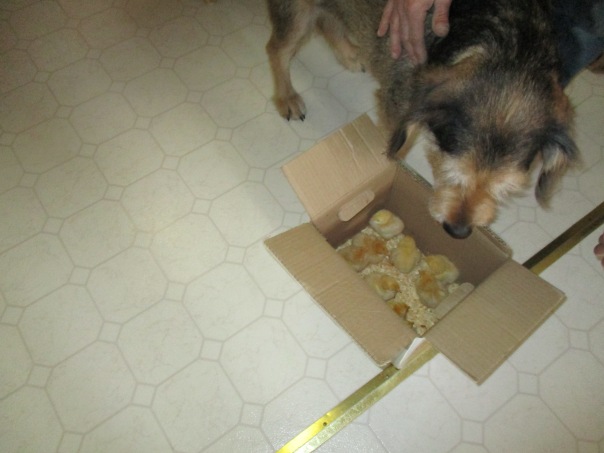
A few days ago, as we prepared to get chicks, my husband brought in the stock tank that we use as a brooder. When Scout saw this he began looking around for the chicks. We had to tell him “not yet, Scout”. We weren’t planning on getting the chicks until the following day. Scout has been down this road before, in fact 4 out of the past five years we have brought home baby chicks and raised them.

The first year I had great concerns about Scout being around the chicks. When we adopted him from the shelter in 2011 we were told he was about 3 years old and part terrier. Nobody knows what kind of terrier but that was not important to us. Over the next several years we found that he definitely had the terrier instinct to hunt and kill small animals and he was quite proficient at it. He could quickly and cleanly dispatch a raccoon, possum, ground hog, cat or baby turkey by just snapping it’s neck. He was about eight years old when we first started raising chickens.

I pretty much left it to my husband to train Scout with the chicks. Dom would hold a chick and let Scout sniff it and nudge it with his nose and he would tell Scout that those were his (Scout’s) babies. “You have to be nice to your babies,” we would say. Scout would become very excited, and want to look into the brooder, whenever he would hear the chicks make a noise, and anytime my husband or I were doing anything with the chicks (feeding, watering, holding or cleaning the brooder) Scout wanted to be involved.

That spring Scout learned that he was not allowed to chase and kill the chickens, unfortunately it was at the expense of one of our hens, but for a dog of his age and breed to learn not to chase chickens, or any other small critter, is a huge success.

IMG_0706
Scout Welcoming Our New Chicks

Nowadays I have no concerns about Scout chasing the chickens. Our free range chickens wander, peck and scratch throughout the farm and we have total confidence that neither Scout nor our other dog, Trooper, will cause them any harm.


One of Scout’s nicknames is “Chicken Daddy”, and he loves it when we tell him he is a good  Chicken Daddy. At age 13 (in people years) Scout has slowed down a lot. He does not pay as much attention to the chicks, but he was still very eager to see/sniff them when we brought them home.

The other thing he really enjoys is helping close up the chicken coop at night. When we go into the coop to count chickens and make sure everyone made it back home, Scout will step inside and sniff a couple of chickens to say “good night to his babies”.

IMG_0715

He really is a good chicken daddy.

I Brake For Bees


I told my husband that I need a t-shirt that says “I brake for bees” but probably more appropriate would be a bumper sticker pasted on the back of our riding lawn tractor.

This may be something only another beekeeper can understand, and even among beekeepers I might be in the minority. It wasn’t something that I thought about before I realized I was doing it, but as I mow the lawn at the farm I often see honey bees foraging on the dandelion or clover blossoms. My natural reaction is to yield them the right of way. Of course having wrote the check to purchase packages of bees, along with reaping the rewards of their labors, I have a great understanding of their value. Now it may or may not be the case that they will move out of the way of the mower just like the chickens and dogs move out of the way of vehicles at the last minute, but I am just not certain.

Few other creatures get this kind of consideration but among them are frogs, toads and snakes.

This past summer, my husband, who is totally on the same page with me as he has been known to get off the mower and move a toad to a safe place before continuing to mow, and I decided to restrict our mowing to the later evening hours after the bees were mostly back to the hive. It may be crazy, but I consider this a small sacrifice to help keep our hives healthy and strong.

img_1650