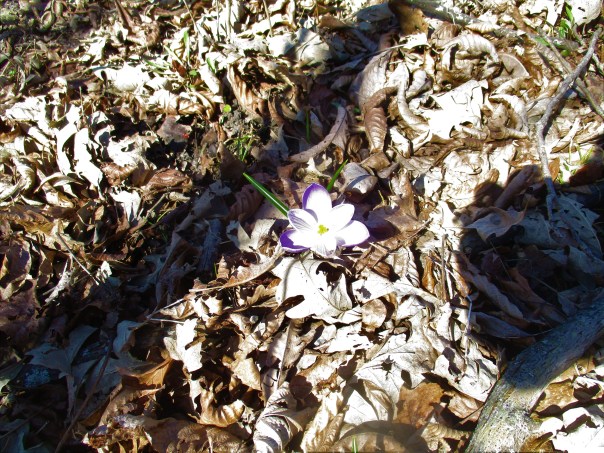
I planted Crocus bulbs in the fall of 2018. Since none came up last year I assumed that the squirrels had dug up the bulbs. What a delight it is to see that our very first flower this year is a crocus. 🙂
I planted Crocus bulbs in the fall of 2018. Since none came up last year I assumed that the squirrels had dug up the bulbs. What a delight it is to see that our very first flower this year is a crocus. 🙂
“Frogs on the Farm” was originally written and published on March 30, 2017, a time when I had very few readers. I have decided to share it again today because for various reasons I haven’t got my usual “Spring is Springing” post ready. Be assured that spring is here: the birds have returned from their winter homes, the trees are beginning to bud, the daffodils, iris’s, lily’s and even the garlic are emerging from underground and the frogs are singing. More on that soon. 🙂
Original Post published March 30, 2017
Last week on one of our sap cooking days, in addition to helping keep the fire going, I took on the secondary chore of raking the leaves out of the pond. As I came up with one rake full of leaves and shook them into the pile just beyond the beach, this frog hopped out of the leaves.
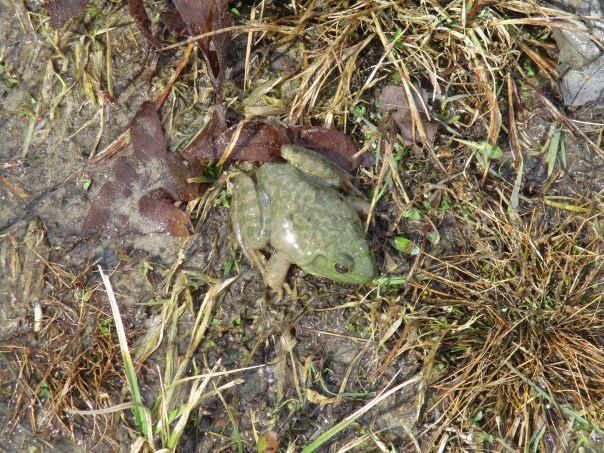
I felt kind of guilty about awakening him or her, because I was yet to see or hear any frogs this spring. It did however spend a good deal of time sunning itself on the beach. It wasn’t until one of the chickens came running up behind it that it took a three foot leap back into the safety of the pond.
It was two days later that we heard the frogs for the first time this year. I remember my mom telling me, that her mom had told her, that after you hear frogs for the first time in the spring you will have three more freezes. Although I’m always excited to hear the frogs in the spring, I haven’t really tested this theory.
Frogs and toads lived on our farm before we put in the pond. I remember the first spring there were tadpoles that had hatched in a puddle of water and my husband was dumping buckets of water in the puddle to keep it from drying up before the tadpoles reached their adolescent stage of life.
Our property does provide the perfect habitat for frogs and toads. The pond offers conditions needed for frogs to lay eggs, for the eggs to hatch into tadpoles and for the tadpoles to live until they grow legs and their lungs develop so they can leave the water. This can take over a year for bull frogs. Even mature frogs, who can live out of water, continue to need a wet area to keep their skin from drying out. Not only does our farm have the pond but we have wooded areas where the ground is covered with dead leaves that keep the ground moist even in the hot and dry summer conditions.
According to the Michigan Department of Natural Resources article that I have linked below of the more than 3400 species of frogs/toads only 13 live in Michigan. I am certain we have at least 4 species that populate our farm.
Frogs and toads are wonderful for pest control. The aforementioned article relates that a single frog will consume thousands of insects per year. Last year we discovered that we were reaping the benefits of this. As we picked our bountiful harvest of strawberries https://donteatitsoap.com/2016/06/30/strawberries-at-last/ last June my husband and I spoke several times about the fact that we did not have any slugs eating the berries. This is a problem the we have had with strawberries we have grown at the house in the past. It wasn’t until my husband told me that he had been surprised by a frog hiding in the strawberry patch, while he was picking berries, that I realized that this frog was probably enjoying a regular diet of slugs and any other pests that threatened to consume our strawberry crop. I am hopeful that a frog will take up residence in the strawberry patch again this year.
Frogs are a good indicator of the health of wetlands, ponds, lakes and such as they do not survive in polluted areas. The Michigan DNR article that I have linked below explains that chemical fertilizers and pesticides are a threat to frog populations; not only can the chemicals kills frogs and toads, but the pesticides also reduce their food supply.
http://www.michigan.gov/dnr/0,4570,7-153-10370_12145_12201-35089–,00.html
The frogs on our farm are also entertaining. In the summer time when we walk around the edge of the pond the frogs jump into the pond one right after the next. It’s kind of funny because there may be 50-100 frogs sitting around the outer edge of the pond. The dogs like to chase the frogs but rarely are they able to catch them. Last year Scout spent hours in the evenings looking for frogs along the edge of the pond, he enjoyed the search immensely even though he never caught any. After dark we are often treated to a campfire symphony, in surround sound I might add, as the several different species of frogs sing from different areas of the farm.
While not everyone has the luxury of being able to put a pond on their property I have included the following link for those who may be interested in creating a frog habitat. I would encourage you to read through the end of the article, as it does explain that the best way to introduce frogs to this habitat is to let them come to it naturally and this may take a year or more. It also explains that not all parts of the U.S. are favorable for creating frog habitats.
Perhaps this post should be sub-titled “The Good, The Bad and The Ugly” because we have seen a bit of each this winter.
Chickens
The chickens mostly fall in good category. Egg production slowed down in late November as usual and we were only getting 2-4 eggs a day, but as the hours of daylight have been getting longer egg production has been gradually increasing. We are now gathering between 7-10 eggs a day. We had more than enough eggs for us, so we didn’t have to buy any this winter. The lack of snow this winter has made the chickens happy because they tend to stay inside when there is snow on the ground.
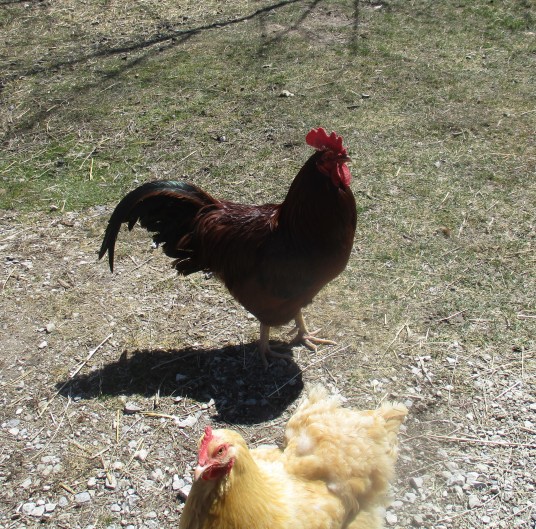
The bad, or at least sad, part is that our rooster died on Thanksgiving. He was one of three birds left from our first batch of chicks we got in 2013. Toward the end of summer we noticed that old age seemed to be catching up to him, so we were not surprised by his death. So far the flock seems to be doing well without him. I was never especially close to Cocky because he seemed to feel that he had to protect his flock from me. I did learn, after being spurred in the leg by him a couple times, not to turn my back on him. We sparred many times over the years, but I did respect him as protector of our flock. While I don’t miss having to look over my should when I’m in or around the chicken yard, I do miss hearing his Cock-a-doodle-do’s.
Bees
Bees fall into the UGLY category. At the end of summer we had eight hives most of which seemed to be thriving. Over fall and winter we have lost all of them. We are baffled as to why the bees are dying. Every hive has had lots of honey in it, the hives have top ventilation to prevent moisture build up and our winter temps haven’t even been that cold so it doesn’t make sense that they are freezing to death. Some even died before temperatures got cold.
It is sad and it is frustrating to have so many losses, but we have decided not to give up yet. We have ordered three more packages of bees to arrive in May so we can try, try again.
Garlic
At this time it seems that the garlic falls into the good category. The new location seems to be good since despite lots of rain and snow melt we have not had any flooding in that area.
The main reason that I am including garlic in this update is because several readers were interested in knowing how the weed guard that we used when planting the garlic worked out. (You can read about it here.) Unfortunately it did not work out as we hoped it would. All was well until after the first big snow storm in early November. We then had a warm up, and as the snow melted, the weed guard became saturated. Then we began seeing rips in it. It seems the wind was getting under the exposed edges and ripping the wet paper. It became so tore up that we ended up removing it completely and mulching the garlic with straw before the ground froze.
If we use this product in the future we now understand it is important to make sure all of the edges are secured – perhaps by burying them in the soil.
Hoop House
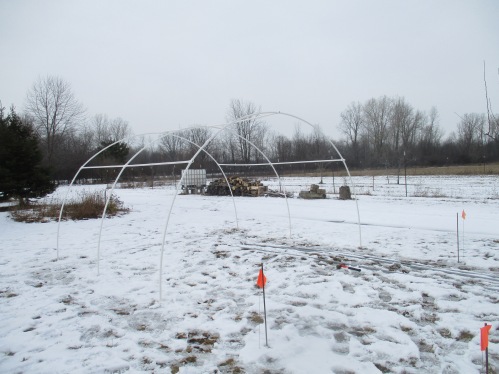
This is another one for the good column. This new addition is currently under construction. It has come a lot farther since this photo was taken last week. Our plan is to have it ready so we can start our garden plants in it this spring. I plan to write a post on it’s design and construction once it is complete and will likely write about it’s uses in the future as well.
The Boys
The boy’s also fall into the good category. Most of our time at the farm this winter has been spent with the boys, more specifically training Ranger. This pup has so much energy that it is important that he get out and use it up. We have found that he requires a minimum of two hours a day outside, but on most day it’s three or more hours of walking, running and hunting.
We have been using a training collar that has three settings – a beep, a vibrate, and a shock. The collar, along with voice commands, is working well with training him to stay on our property, but it is going to take a lot more training and time before he can be trusted not to leave the farm. Beagles have a strong hunting instinct and if they pick up the scent of a rabbit or other small animal (there are many on our farm) it is difficult to call them off.
We are not hunters so we will not be training to hunt rabbits or squirrels.
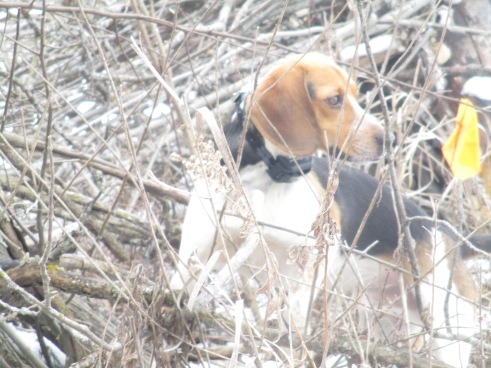
He and Trooper do enjoy hunting for field mice together. This is something that Scout and Trooper would do for hours at a time and we are happy that Ranger has become Trooper’s new hunting buddy.
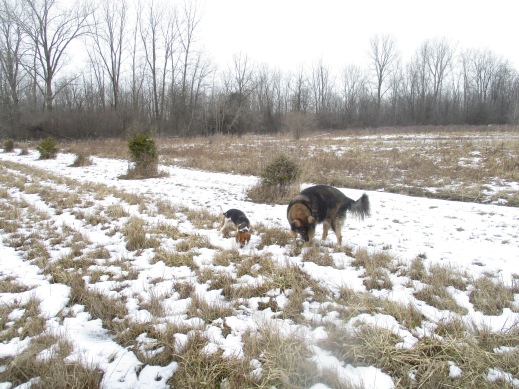
Watching the boys hunt mice can get a bit boring, but it is interesting to observe how they work together.
Trooper who is mostly a watch dog uses both his nose and eyes for hunting.
 Ranger, who is a hunting dog, primarily uses his nose.
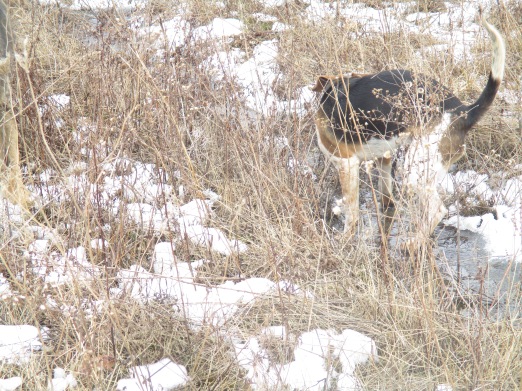
So while Ranger has his nose buried in the dirt trying to sniff out his prey Trooper might capture it as he sees it trying to escape.

After consulting with our vet we did have the boys immunized against diseases that they could catch from mice.
I think it is largely as a result of all this outdoor activity that Ranger has become such a great house dog. While at home is is content to settle into his or our bed for a nap, or he might seek out a little cuddle time from one of us. If he does get bored he will find a rawhide to chew on or bring his ball for a game of catch. He does however let us know when it’s time to get out a expend some of the built up energy.
A couple of weeks ago we decided to put him to the test. We needed to go grocery shopping so thought we would see how well he would behave if we left him out of his crate for a couple hours while we were away. Our strategy was to make sure he was tired out first, so my husband took the boys to the farm for about an hour before we went shopping. Before we left for shopping we also made sure that some of the things that might be tempting to a puppy (shoes, slippers, books) were out of his reach.
We were so happy when we returned home and found the house in the same condition that we left it in. The Boy’s, especially Ranger, were rewarded with lot’s of “good boy’s” and another nice long walk (run, play, hunt) at the farm. We have since left him on three more occasions and have come returned home each time to find that he was a “Good Boy”. 🙂 It may be time to get rid of the crate.
Thanks for reading.
How has your winter been so far?
I have to admit that writing this post has been very challenging for me. As I thought about what our prayer garden is and what it represents my thoughts ran deep, and at times it seems like the answers to what it is, why it exists and how it came to be have turned into questions that that I can not definitively answer. As I struggle to convey the information about our prayer garden I can only pray that God will give me the words I need and that they will perhaps be a blessing to someone who reads them.
Flowers offer more praise to God than man ever shall. ~ Ninian Riley


What Is A Prayer Garden?
When I typed that question into my internet browser this was but one of the definitions that showed up. I selected it because it does seem fitting.
It said: “Used as a quiet place to relax and recharge, a meditation or prayer garden is a place of peace and tranquility. It’s personal space with no right or wrong design elements. A prayer garden can be a small, private corner of a larger garden, or an entire section of your landscaping may be designed around a theme of thoughtful serenity. Planting perennials helps to avoid stress from constant garden maintenance chores, and including beautiful accents — natural or manmade – helps you focus on positivity.”
What Is Our Prayer Garden?
It could be called a flower garden or and herb garden because of the vast array of both flowers and herbs that we grow there. It could be called a rock garden because many rocks were used in it’s construction. It could be called a pollinator garden because bees, butterflies and many other pollinating insects are attracted to the various flowers when in bloom. It could be called a memorial garden since we have planted flowers in memory of my mother, my husband’s mother and my Aunt Shirley. It could also be called a friendship garden since many of the plants have been given to me, some by my children, others by my sisters and some that were added this year were sent by a lady who my husband met this year while working at his landscaping job, and when the plants in the garden need to be thinned I often dig the roots and pass them on the family, friends or neighbors who will give them a new home. Our prayer garden is all of these things combined.
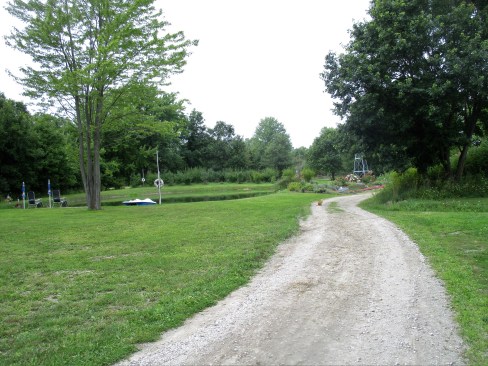
It is the center piece of our farm from which everything else seems to radiate. It is bordered to the west by the pond and the east by the driveway with the barn standing on the other side of the drive. The windmill stands directly to the north of the prayer garden, only a few feet outside the garden edge, and the apiary is just a short distance from there. It is not visible from the road so when in bloom it can be a glorious view as you round the bend in the driveway and are greeted buy the colorful display.

Honestly while it is this “center piece” that we refer to as the prayer garden, it is the entire farm that evokes feelings of peace and serenity and elicits the desire to pray – to commune with God. While it may seem contradictory, we find that even while working on the farm we are often able to recharge.
In Our Beginning
When we first bought our farm, the property had been unused (by humans) for many years. The previous owner had planned to build a house there so he had done some excavating, put in somewhat of a driveway and the well, but it seemed that it had been at least few years since those things had been done. What I’m trying to say is that things were growing wild. We spent a lot of time exploring, discovering and deciding.

We wanted to be good stewards of the piece of earth that God had given to us, so there were many decisions to be made. We wanted to make the land useful, that we may grow our food and raise livestock, while utilizing all of what the land could offer and preserving much of it’s natural beauty. Through exploring the land we discovered that God had given us much more than we had prayed for.
One of our early priorities was having access to water. There was a well on the property but at that time there was no pump to retrieve the water – it was simply a capped well. Since there was no electricity on the property, and that was not a priority, we purchased a hand pump suitable for deep wells and then had the company that drilled the well come out to install the pipes that were needed to hook up the hand pump.
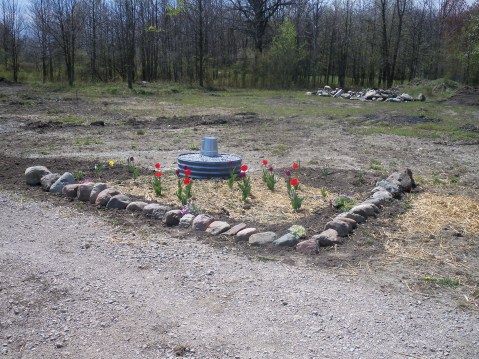
Another thing we needed to do was to protect the well head. It was in an open area and we feared it was at risk of being hit and damaged by some type of vehicle. We purchased a galvanized metal ring and placed it around the outside of the well head then filled the rest of the ring with white stone. It then seemed to be a good area for a flower garden so in the fall we planted tulip bulbs.
The pictures below are what it looked like one spring day in 2012.

The following day when I arrived at the farm the deer had eaten all of the blossoms off of the tulips and all that remained were stems and leaves. I wanted to cry.
In the fall of 2012 we decided to have a pond dug. My husband and I have done the majority of the landscaping and building on the farm. Only twice have we called in professionals to do work which was beyond our abilities. The first was digging the pond. The second was building the barn last June.
 While it was necessary to have excavators do the digging, the design of the pond was ours. We spent hours talking about the layout, measuring, staking, then cording off the area that was to be dug out. They needed to stay a certain distance from the tree line on the west side of the property and a certain distance from the well. They were given explicit instructions and my husband was on-site most of the time the work was being done to assure that our expectations were met.

The above photo was taken in the spring of 2013.
After the pond was dug my husband and I worked together to landscape the area. He brought in top soil with the tractor bucket and we raked it out. We used rocks that we found on the farm to build a retaining wall to prevent soil erosion. I can’t remember exactly what plants we put in at that time but I know they included lavender, salvia and thyme (all deer resistant plants by the way). We then purchased mulch and spread it.
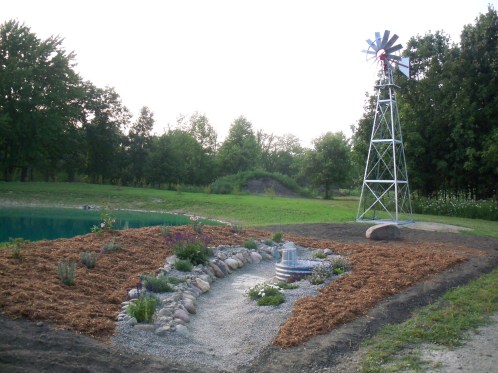
The large rock was one that was unearthed when the pond was being dug. My husband and I found it appealing so we decided to display it in the garden.
We ordered the windmill that spring. It was a bit pricey but would serve dual purposes. The first would be to pump life sustaining oxygen into the pond. The second was for watering plants during dry spells; so along with the windmill we purchased a pump that would pump water out of the pond. You can read about our off grid irrigation process here. After the windmill arrived my husband and I worked together to assemble it. We then invited family over for a windmill raising party.
Over the past few years the garden has continued to evolve. Many new plants have been added and most of what we have planted there has flourished. I sometimes find it necessary to remove plants as well.
The photos below were taken over the past two years.


Why A Prayer Garden?
Now that I have covered the “what is our prayer garden” and told you how it came to be I will address the Why. This is where I was most challenged when putting together this post.
I am not sure when the idea of a prayer garden first came to me or where I even first heard the term. It was likely something that I read about online because that is how we get a lot of information nowadays. I do remember that it was around the time when we were working on landscaping the garden area that I decided that making garden stepping stones was a craft I might enjoy. I experimented with making a couple that I gave away and one that I made that I wanted to place in our garden. 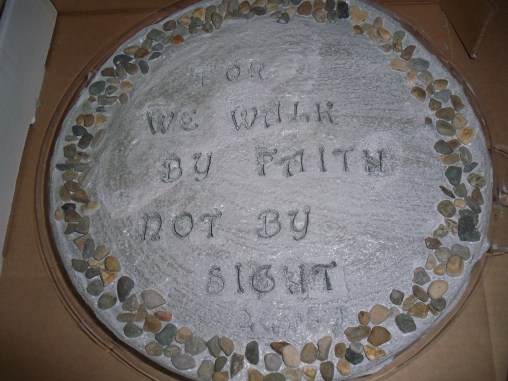
On the stone I made for our garden I imprinted one of my favorite Bible verses. For we walk by faith, not by sight. 2 Cor 5:7. I have found this verse meaningful for many years but even more so after our experience with buying our farm and the blessings we received by waiting on God’s timing. I place the stone in the garden as a continual reminder of how God is always working behind the scenes and if we follow His lead we will be blessed. I think it was around this time that I decided to call this our prayer garden.
I have grown to see the prayer garden as an offering to God – a way to honor and glorify Him, so I was struck when I read the quote at the beginning of this post. These words – Flowers offer more praise to God than man ever shall, were spoken by my Great, Great, Great, Great, Great, Great Grandfather, Ninian Riley, who lived from 1725 – 1814. It was while contemplating this post that I received an email from lady named Kathy Strawn, a third cousin that I have never met, and the family historian. She sent some documents that she had created regarding family history and one of the documents contained the above quote.
Upon reading those words I felt an immediate, yet somewhat eerie, connection to this ancestor who lived so long ago. I wondered where did they come from? Where were they documented? Kathy had referenced the Diary of Nancy (Riley) Clarke Salt as the source and an internet search led me to this site where I was able to read Nancy’s diary. Indeed within the pages Nancy explained that as a hobby her grandfather, Ninian, enjoyed tending to flowers a she attributed that quote to him.
This information led me to some questions: is this just coincidence, finding that my distant ancestor had a love of flowers like I do and that his words that were documented more than 1 1/2 centuries ago would so accurately define my feelings? or is there something more – some type of divine inspiration perhaps? These are questions that will certainly not be answered in this lifetime.
While writing this post it also occurred to me that God would likely be pleased with a garden that was built and maintained in His honor. I draw this assumption from the realization that in Genesis 2:8 “The Lord had planted a garden in the East, in Eden; and it was there that he put the man.” God Himself was a gardener and thought the garden to be a fitting place for His greatest creation – man.
I think I will conclude this post by answering a question that may have been on your mind throughout your time reading this – “Do you pray in the garden?” you ask.
Yes, I do pray in the garden, but not as you might imagine. It is when I am on my hands and knees in the dirt, working the soil or pulling weeds, that I feel God’s presence and am moved to converse with him. I offer prayers of thanksgiving and pray for those in need. I pray for friends and family and if you come to mind I will likely say a prayer for you as well.
I know this post was longer than most of my posts and if you have read to the end I am grateful.
Thank you and God Bless.
I know at least a couple of my readers are waiting for my post dedicated to our prayer garden, but I wanted to give a little background, kind of an introductory post.
When my husband and I got married in 2007 we were living in a manufactured home community (where we still live today). We knew we wanted more, a place of our own where we could grow our own food, raise chickens and bees (and maybe goats) and let our dog(s) run; things we just couldn’t do on our little leased lot. If you live in the US you may remember that in 2007 the economy was on the verge of collapsing – the 2008 “subprime” mortgage crises was just around the corner. This was no time to make our move.
We continued to bide our time in the manufactured home park as the country went into crises. We were blessed that my husband had continuous work during those years so we were able pay down our debt and put some money away. We were also able to do some gardening in raised beds in our small courtyard, and as we outgrew that space my sister and brother-in-law offered up garden space at their place so we were able to grow a lot of our own produce. I also preserved a lot of it.
It was probably sometime in 2009 after housing/property prices had dropped and the market was being flooded with foreclosures that we started talking about what we wanted to buy. We decided that our minimum requirements were between 5 and 10 acres, half wooded, half open field, with a source of water. We wanted it to be in a rural area and we set a price per acre that we were willing to pay. We also began praying about it.
I’m not sure when we really began looking for property, but I’m sure it was well over a year that we searched realtor.com, talked to realtors (who really weren’t much help) and drove around three counties looking at pieces of land (some with houses) for sale. None being exactly what we wanted.
While we continued to pray and search we were becoming antsy. We were also becoming frustrated with not having our own place to let the dogs run. When we first got Scout in 2007 we would take him in the woods behind our house and let him off the leash where he could run around and sniff and chase a squirrel up a tree or go for a swim – all the things that dogs like to do. Then one day my husband and Scout came across a neighbor who was walking his dog in the woods. Although there was no incident this neighbor complained to the park management that Scout was not on a leash, so we received a citation and were told that he must be kept on a leash.
Over the next few years we found some opportunities to allow the dogs to run off-leash. First a friend who had a sawmill on eighty acres nearby allowed us to bring the boys to walk in the woods and swim in his pond. This became a daily routine and went on for well over a year until one day when his neighbors complained that the dogs were scaring the deer away.
It was around this time that we discovered the newly open Columbus Park. I wrote about the park last year in this post. The old homestead turned park offered over 400 hundred acres of fields and woods, a valley with a river running through and wonderful walking paths. In the early days of visiting the park it was a perfect place to take the boys and let them off leash as we were often the only visitors. Over time that began to change. A sign with park rules was posted which stated that dogs were required to be kept on leashes and more often than not there were other visitors at the park. While we continued to visit the park the boys were often restricted to being on leashes.
It was a day in early April 2011, after finishing a walk at Columbus Park, that my husband decided to take a different route home. As he pulled out of the parking lot he made a left hand turn pointing the vehicle in the opposite direction from our house. He then made a righthand turn on the next road we came to. Crawford Road, a gravel backroad that neither of us knew where it would lead. It had been years, perhaps even decades, since I had traveled this road and my husband said he had never been down that road before. We had driven a few miles and as we approached a stop sign and an intersection where Crawford Road ended my husband suddenly said “What was that?” as he stopped the vehicle then backed up. I didn’t know what he spotted until he pointed to a “for sale” sign that was sticking out of the snow bank that despite the warmer spring temperatures was taking it’s time to melt.
My husband pulled into the driveway and hopped out to read the sign. It Said: For Sale By Owner, 7.6 acres, $39,500 and a phone number to call. There was no house on the property so I got out of the vehicle and we decided to have a look around. There were many mature trees on the property but as we walked to the end of the driveway, which extended maybe a couple hundred feet in, we realized that the rest of the property was overgrown with unidentified bushes and shrubs. Though our path had ended we continued to make our way though the thicket, thankfully there was no foliage on the bushes so we could at least see the ground and where we were walking. We continued to walk perhaps a few hundred more feet where the property adjoined to an open field. We assumed this was the property line. As we made our way back to our vehicle my husband called the phone number on the sign. He left a message inquiring about the property and we went home anxiously awaiting a return call.
The call came and we set up a time to meet the owner at the property the following day. At the meeting we learned that we were wrong in our assumption of where the property ended. Instead it included that open field which nearly doubled the size of what we thought was the parcel. It also had a well. The well had been dug within the last few years, it was eighty feet deep and I think it was rated at something like 25 gallons per minute. (WOW!)
This property was everything that we had prayed for. We left that meeting certain that it would be ours. We were so certain in fact that my husband removed the “for sale” sign before we pulled out of the driveway. Within a few days we had negotiated a price and the property owner was arranging to have the paperwork drawn up and scheduling a closing date.
While we waited for that we went shopping for fruit trees. I think we bought nine trees and my husband asked the property owner if he could plant the trees one the property. The owner agreed and my husband drug a small rototiller through the thickets and back to the ridge that divided the front of the property from the back field. It was there he planted our first fruit trees.
Less than four weeks after we first spotted the property, that has since become known as our farm, we signed the paperwork and exchanged a cashiers check for the deed to the property. To this day we are still in awe of how God answered our prayers.
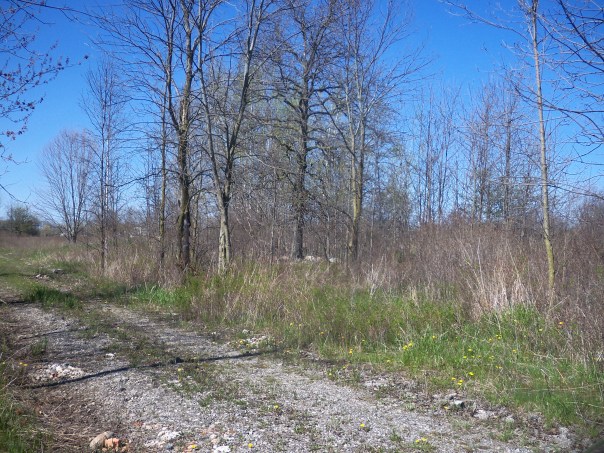
Below are the few photos I have of the farm when we first bought it.


Thanks for visiting. 🙂

