Click here to learn more about my “55 Things” and here to view previous posts in this series.
The nearly full super moon was only intermittently visible through last night’s cloud cover. It is the first of three super moons that we will see this spring. The March full moon is also known as the worm moon, named this by Native Americans, since this is the time of year that worms begin emerging from the ground. Learn more about it here. I attempted to take some photos but since my photography skills’ are lacking they are not nearly as impressive as it seeing it in person.
The following photos are unedited and are posted in sequence as taken. I am not sure what happened in the second photo, but while I would like to think that I captured some stunning other-worldly event, I suspect there is some type of technical explanation.
While the actual full moon will occur tonight (March 9) the thick cloud cover will prevent us from viewing it. I guess I will have to try again in April.
This awareness of the full moon did remind me of a gardening method that we have talked about trying in the past but have not yet done. Since we have not yet started planting, I think this is the year to try planting by the phases of the moon.
This article from explains what types of plants should be planted during each phase of the moon.
First quarter moon cycle (new moon to half full) – Things that are leafy, like lettuce, cabbage and spinach, should be planted.
Second quarter moon cycle (half full to full moon) – Planting time for things that have seeds inside, like tomatoes, beans and peppers.
Third quarter moon cycle (full moon to half full) – Things that grow underground or plants that are perennials, like potatoes, garlic and raspberries, can be planted.
Fourth quarter moon cycle (half full to new moon) – Do not plant. Weed, mow and kill pests instead.
The article also says that while several studies have shown evidence that gardening by the phases of the moon can have positive effects there is no actual proof that it does.
In order to at least start planning for planting I found this handy chart which tells the date of that the moon enters each phase throughout the year. Planting season will begin soon. 🙂 Wish us luck.
Did you get to see the full moon? Have you ever planted by the moon?
Perhaps this post should be sub-titled “The Good, The Bad and The Ugly” because we have seen a bit of each this winter.
Chickens
The chickens mostly fall in good category. Egg production slowed down in late November as usual and we were only getting 2-4 eggs a day, but as the hours of daylight have been getting longer egg production has been gradually increasing. We are now gathering between 7-10 eggs a day. We had more than enough eggs for us, so we didn’t have to buy any this winter. The lack of snow this winter has made the chickens happy because they tend to stay inside when there is snow on the ground.
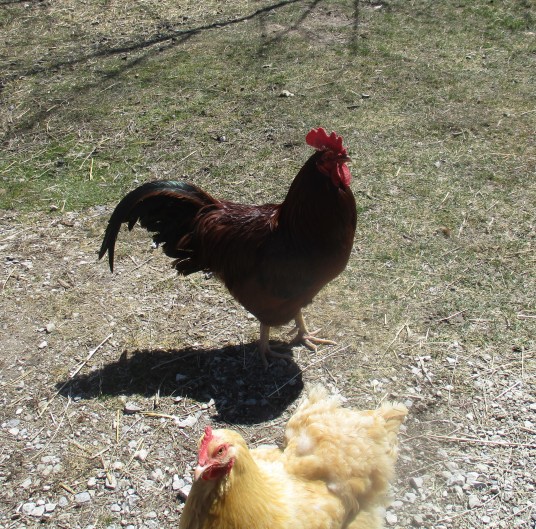
The bad, or at least sad, part is that our rooster died on Thanksgiving. He was one of three birds left from our first batch of chicks we got in 2013. Toward the end of summer we noticed that old age seemed to be catching up to him, so we were not surprised by his death. So far the flock seems to be doing well without him. I was never especially close to Cocky because he seemed to feel that he had to protect his flock from me. I did learn, after being spurred in the leg by him a couple times, not to turn my back on him. We sparred many times over the years, but I did respect him as protector of our flock. While I don’t miss having to look over my should when I’m in or around the chicken yard, I do miss hearing his Cock-a-doodle-do’s.
Cocky and Honey
Bees
Bees fall into the UGLY category. At the end of summer we had eight hives most of which seemed to be thriving. Over fall and winter we have lost all of them. We are baffled as to why the bees are dying. Every hive has had lots of honey in it, the hives have top ventilation to prevent moisture build up and our winter temps haven’t even been that cold so it doesn’t make sense that they are freezing to death. Some even died before temperatures got cold.
It is sad and it is frustrating to have so many losses, but we have decided not to give up yet. We have ordered three more packages of bees to arrive in May so we can try, try again.
Garlic
At this time it seems that the garlic falls into the good category. The new location seems to be good since despite lots of rain and snow melt we have not had any flooding in that area.
The main reason that I am including garlic in this update is because several readers were interested in knowing how the weed guard that we used when planting the garlic worked out. (You can read about it here.) Unfortunately it did not work out as we hoped it would. All was well until after the first big snow storm in early November. We then had a warm up, and as the snow melted, the weed guard became saturated. Then we began seeing rips in it. It seems the wind was getting under the exposed edges and ripping the wet paper. It became so tore up that we ended up removing it completely and mulching the garlic with straw before the ground froze.
If we use this product in the future we now understand it is important to make sure all of the edges are secured – perhaps by burying them in the soil.
Hoop House
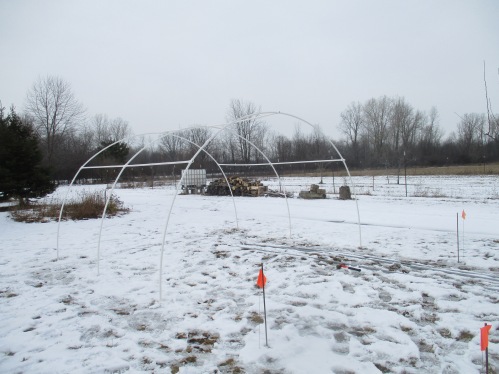
This is another one for the good column. This new addition is currently under construction. It has come a lot farther since this photo was taken last week. Our plan is to have it ready so we can start our garden plants in it this spring. I plan to write a post on it’s design and construction once it is complete and will likely write about it’s uses in the future as well.
The Boys
The boy’s also fall into the good category. Most of our time at the farm this winter has been spent with the boys, more specifically training Ranger. This pup has so much energy that it is important that he get out and use it up. We have found that he requires a minimum of two hours a day outside, but on most day it’s three or more hours of walking, running and hunting.
We have been using a training collar that has three settings – a beep, a vibrate, and a shock. The collar, along with voice commands, is working well with training him to stay on our property, but it is going to take a lot more training and time before he can be trusted not to leave the farm. Beagles have a strong hunting instinct and if they pick up the scent of a rabbit or other small animal (there are many on our farm) it is difficult to call them off.
We are not hunters so we will not be training to hunt rabbits or squirrels.
He and Trooper do enjoy hunting for field mice together. This is something that Scout and Trooper would do for hours at a time and we are happy that Ranger has become Trooper’s new hunting buddy.
Watching the boys hunt mice can get a bit boring, but it is interesting to observe how they work together.
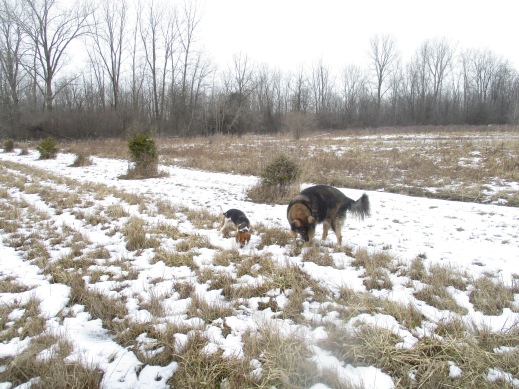
Trooper who is mostly a watch dog uses both his nose and eyes for hunting.
Ranger, who is a hunting dog, primarily uses his nose.
So while Ranger has his nose buried in the dirt trying to sniff out his prey Trooper might capture it as he sees it trying to escape.
Now what do I do with it?
After consulting with our vet we did have the boys immunized against diseases that they could catch from mice.
I think it is largely as a result of all this outdoor activity that Ranger has become such a great house dog. While at home is is content to settle into his or our bed for a nap, or he might seek out a little cuddle time from one of us. If he does get bored he will find a rawhide to chew on or bring his ball for a game of catch. He does however let us know when it’s time to get out a expend some of the built up energy.
A couple of weeks ago we decided to put him to the test. We needed to go grocery shopping so thought we would see how well he would behave if we left him out of his crate for a couple hours while we were away. Our strategy was to make sure he was tired out first, so my husband took the boys to the farm for about an hour before we went shopping. Before we left for shopping we also made sure that some of the things that might be tempting to a puppy (shoes, slippers, books) were out of his reach.
We were so happy when we returned home and found the house in the same condition that we left it in. The Boy’s, especially Ranger, were rewarded with lot’s of “good boy’s” and another nice long walk (run, play, hunt) at the farm. We have since left him on three more occasions and have come returned home each time to find that he was a “Good Boy”. 🙂 It may be time to get rid of the crate.
While Ranger is the name we gave him, it seems The Pup has already acquired a few nick names.
Maybe you already guessed the first one is The Pup or Pup. This one just seemed to come natural. He looks like a puppy and acts like a puppy and I often find myself referring to him as The Pup. Sometimes when talking to him I call him Pup as well.
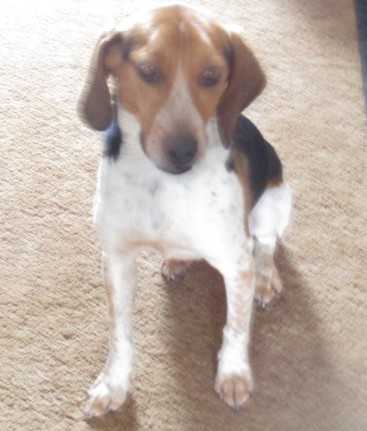
More often when addressing him I find myself calling him Mister. I’ve noticed my husband does this as well. I think I began calling this because when he sits down and looks at me he looks like a little gentleman.
As we know looks can be deceiving, hence another nick name. It was pretty early on when I began calling him Dennis, as in Dennis the Menace. He has that type of personality. Young, cute, innocent, always wanting to be right where we are and finding ways to get into trouble. He can be lovable and annoying at the same time. If Ranger is Dennis I think Trooper is his Mr. Wilson. LOL!
The other nick name he has is Zippy. This is what my husband calls him, which refers to both his energy level and his speed. This one may get a little confusing because my husband had called Trooper Zippy since he was young. As a young dog Trooper had the same type of energy and speed that we now see in Ranger.
So it seems Ranger has become Zippy too or should I say Zippy Two. 🙂
I know at least a couple of my readers are waiting for my post dedicated to our prayer garden, but I wanted to give a little background, kind of an introductory post.
When my husband and I got married in 2007 we were living in a manufactured home community (where we still live today). We knew we wanted more, a place of our own where we could grow our own food, raise chickens and bees (and maybe goats) and let our dog(s) run; things we just couldn’t do on our little leased lot. If you live in the US you may remember that in 2007 the economy was on the verge of collapsing – the 2008 “subprime” mortgage crises was just around the corner. This was no time to make our move.
We continued to bide our time in the manufactured home park as the country went into crises. We were blessed that my husband had continuous work during those years so we were able pay down our debt and put some money away. We were also able to do some gardening in raised beds in our small courtyard, and as we outgrew that space my sister and brother-in-law offered up garden space at their place so we were able to grow a lot of our own produce. I also preserved a lot of it.
It was probably sometime in 2009 after housing/property prices had dropped and the market was being flooded with foreclosures that we started talking about what we wanted to buy. We decided that our minimum requirements were between 5 and 10 acres, half wooded, half open field, with a source of water. We wanted it to be in a rural area and we set a price per acre that we were willing to pay. We also began praying about it.
I’m not sure when we really began looking for property, but I’m sure it was well over a year that we searched realtor.com, talked to realtors (who really weren’t much help) and drove around three counties looking at pieces of land (some with houses) for sale. None being exactly what we wanted.
While we continued to pray and search we were becoming antsy. We were also becoming frustrated with not having our own place to let the dogs run. When we first got Scout in 2007 we would take him in the woods behind our house and let him off the leash where he could run around and sniff and chase a squirrel up a tree or go for a swim – all the things that dogs like to do. Then one day my husband and Scout came across a neighbor who was walking his dog in the woods. Although there was no incident this neighbor complained to the park management that Scout was not on a leash, so we received a citation and were told that he must be kept on a leash.
Over the next few years we found some opportunities to allow the dogs to run off-leash. First a friend who had a sawmill on eighty acres nearby allowed us to bring the boys to walk in the woods and swim in his pond. This became a daily routine and went on for well over a year until one day when his neighbors complained that the dogs were scaring the deer away.
It was around this time that we discovered the newly open Columbus Park. I wrote about the park last year in this post. The old homestead turned park offered over 400 hundred acres of fields and woods, a valley with a river running through and wonderful walking paths. In the early days of visiting the park it was a perfect place to take the boys and let them off leash as we were often the only visitors. Over time that began to change. A sign with park rules was posted which stated that dogs were required to be kept on leashes and more often than not there were other visitors at the park. While we continued to visit the park the boys were often restricted to being on leashes.
It was a day in early April 2011, after finishing a walk at Columbus Park, that my husband decided to take a different route home. As he pulled out of the parking lot he made a left hand turn pointing the vehicle in the opposite direction from our house. He then made a righthand turn on the next road we came to. Crawford Road, a gravel backroad that neither of us knew where it would lead. It had been years, perhaps even decades, since I had traveled this road and my husband said he had never been down that road before. We had driven a few miles and as we approached a stop sign and an intersection where Crawford Road ended my husband suddenly said “What was that?” as he stopped the vehicle then backed up. I didn’t know what he spotted until he pointed to a “for sale” sign that was sticking out of the snow bank that despite the warmer spring temperatures was taking it’s time to melt.
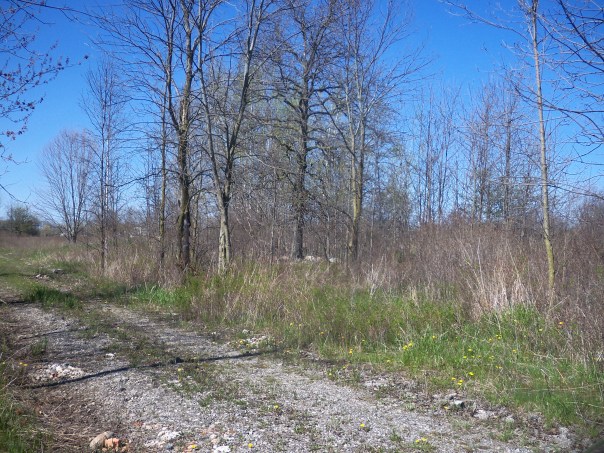
My husband pulled into the driveway and hopped out to read the sign. It Said: For Sale By Owner, 7.6 acres, $39,500 and a phone number to call. There was no house on the property so I got out of the vehicle and we decided to have a look around. There were many mature trees on the property but as we walked to the end of the driveway, which extended maybe a couple hundred feet in, we realized that the rest of the property was overgrown with unidentified bushes and shrubs. Though our path had ended we continued to make our way though the thicket, thankfully there was no foliage on the bushes so we could at least see the ground and where we were walking. We continued to walk perhaps a few hundred more feet where the property adjoined to an open field. We assumed this was the property line. As we made our way back to our vehicle my husband called the phone number on the sign. He left a message inquiring about the property and we went home anxiously awaiting a return call.
The call came and we set up a time to meet the owner at the property the following day. At the meeting we learned that we were wrong in our assumption of where the property ended. Instead it included that open field which nearly doubled the size of what we thought was the parcel. It also had a well. The well had been dug within the last few years, it was eighty feet deep and I think it was rated at something like 25 gallons per minute. (WOW!)
This property was everything that we had prayed for. We left that meeting certain that it would be ours. We were so certain in fact that my husband removed the “for sale” sign before we pulled out of the driveway. Within a few days we had negotiated a price and the property owner was arranging to have the paperwork drawn up and scheduling a closing date.
While we waited for that we went shopping for fruit trees. I think we bought nine trees and my husband asked the property owner if he could plant the trees one the property. The owner agreed and my husband drug a small rototiller through the thickets and back to the ridge that divided the front of the property from the back field. It was there he planted our first fruit trees.
Less than four weeks after we first spotted the property, that has since become known as our farm, we signed the paperwork and exchanged a cashiers check for the deed to the property. To this day we are still in awe of how God answered our prayers.
Below are the few photos I have of the farm when we first bought it.
Growing sweet potatoes this year was really just an experiment and unfortunately one that I did not document. While I regret that I don’t have exact dates, time frames and pictures, I was so impressed with the results that I wanted to share the process.
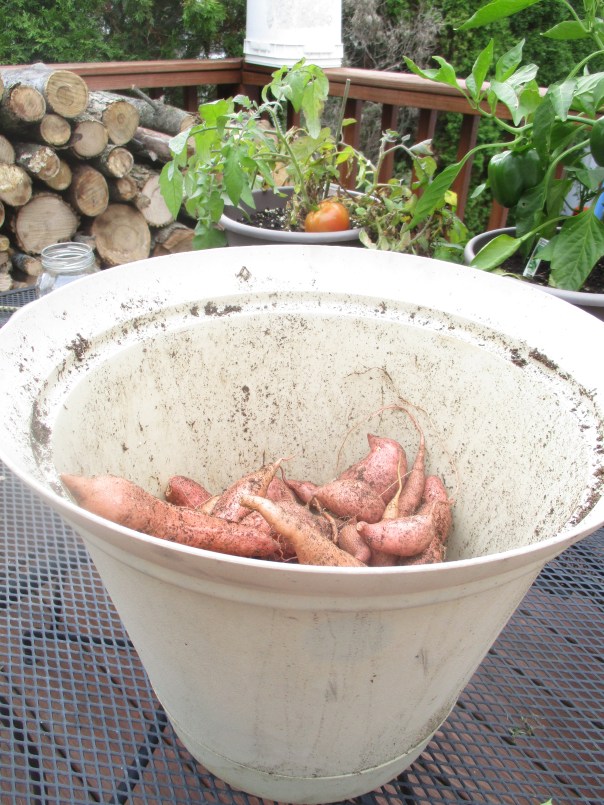
Below is a photo of our sweet potato harvest.
It might not look very impressive until I tell you that all of those sweet potatoes grew in that pot (approximately 3 gallon).
The Process
I think it was late February or early March when I noticed a sweet potato that I had bought at the grocery store was beginning to grow roots. Rather than send it to the compost heap I decided to let it live.
I poked a toothpick into each side of the sweet potato at about the halfway point then put one end of it into a large mouth jar filled with water where it continued to grow more roots. The toothpicks held the top end above the lip of the jar. It was important to keep the jar filled with water and in a couple of weeks it began to sprout leaves.
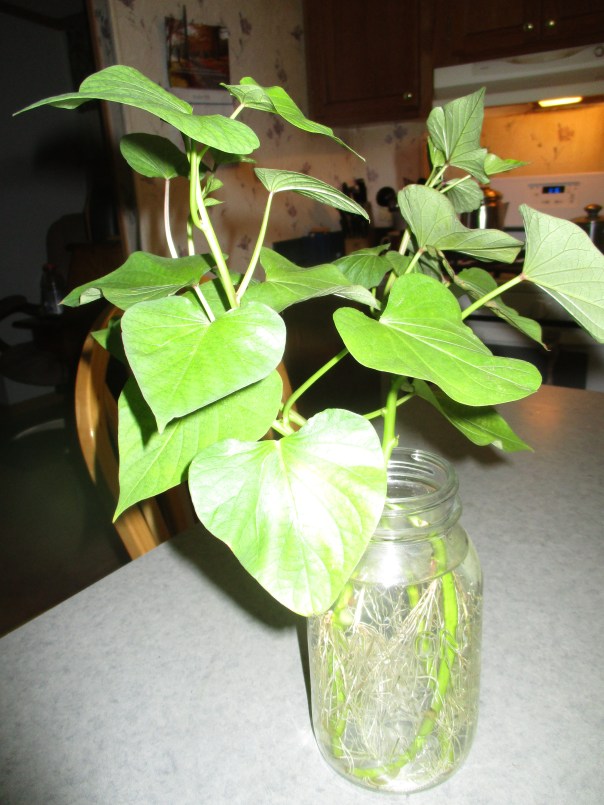
I kept adding water and the leaves grew into vines. Once the vines were over 12 inches long I cut six to eight inches off and put them in a jar of water to root. I think it was early April when I planted 4 of them in the pot filled with potting soil. I also gave some to my cousin so she could grow her own.
I kept the pot near a sunny window and kept them well watered and they continued to grow. I think it was mid to late May, when the weather warmed enough and the threat of frost had passed, that I moved the pot to our deck.
From there it was just a matter of keeping them watered. If we did not have rain the soil dried up quickly and the leaves would begin to droop.
It was the first week in October, when we were having cooler overnight temperatures, when I noticed that even though the soil was moist the leaves were drooping. I decided it was time to harvest them. Harvest was as simple as dumping the whole pot out then breaking up the soil and picking the sweet potatoes out.
Doing It Again
Since this variety grew so well I decided to try to keep it growing. The vine was not dead so I cut some slips from it and have them rooting in a jar right now. Soon I will need to plant them in a pot of soil.
Eating Them
Sweet potatoes are a great source of many of the nutrients that our bodies need to stay healthy. You can learn more about that here. While searching for a link to provide you with those benefits I discovered something I did not know. Sweet potato leaves are edible. They can be prepared and eaten like other leafy greens (think spinach) and are very high in nutrients. This article explains more.
We usually eat sweet potato baked but sometimes cut it up and add it to soups or stews. I am now planning on adding sweet potato leaves to our diet as well.
Do you have a favorite sweet potato recipe you would like to share? How you ever eaten sweet potato leaves?


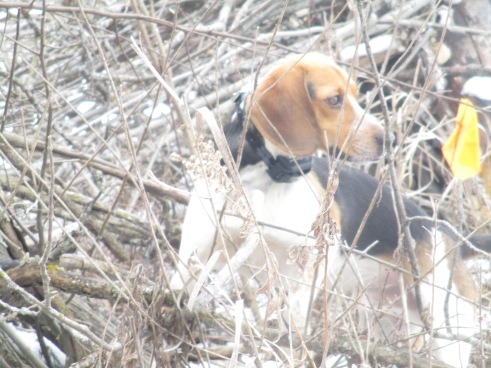
 Ranger, who is a hunting dog, primarily uses his nose.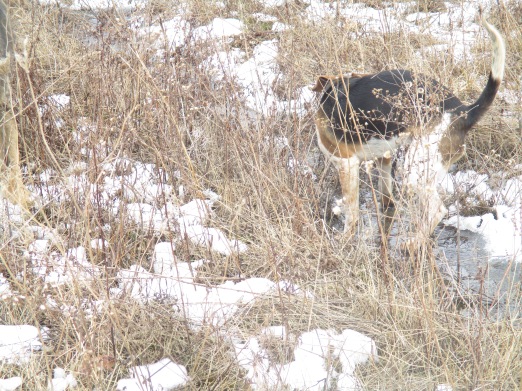





 Don't Eat It! Soap and Skin Care