Tag Archives: Homesteading

Spring Happenings

The last weekend in May is known as the unofficial start of summer and the weather last weekend played right along. Temperatures were around 90 degrees Fahrenheit for several days. Time seems to being going so fast that I am wondering how I missed spring.

I went back and looked at some of my photos from the last few weeks for a reminder.
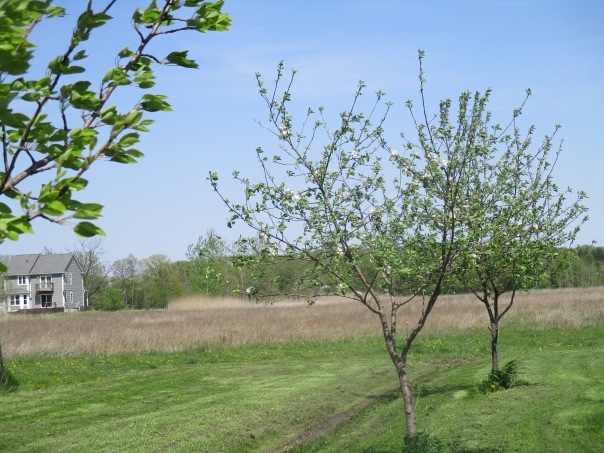
IMG_4094The fruit trees, including apple, pear, and tart cherry all blossomed and are now setting fruit. Berry bushes, including our blue berry, raspberry, currant and grapes are setting fruit as well.
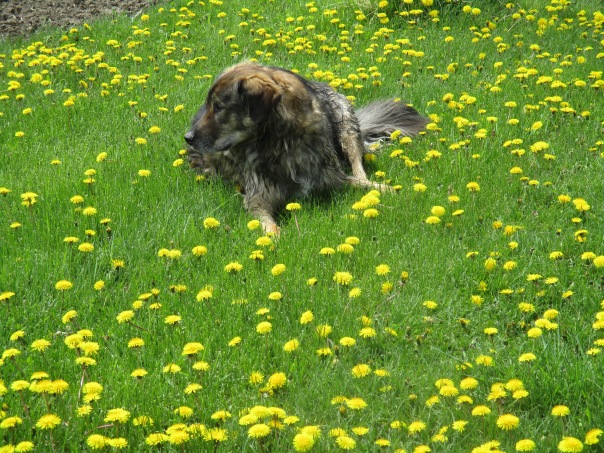
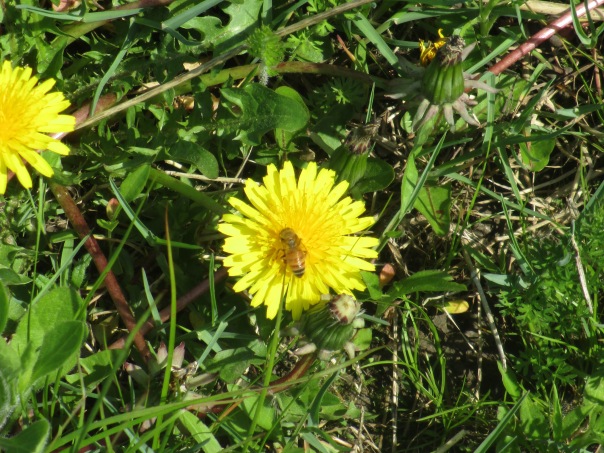
IMG_4091The dandelions blossomed and my husband helped me pick a bunch for soap making before they went to seed. I have enough for two batches of sweet dandelion soap. Trooper didn’t help pick dandelions but he enjoyed being there.

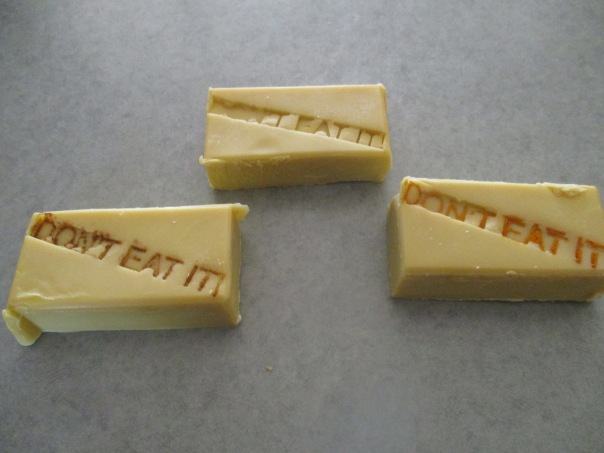
Speaking of Sweet Dandelion soap, I had just made a batch in May when I received the Mother’s Day gift my girls bought for me. It is a soap stamp. So I began playing with it as this batch was curing.IMG_4128It will be tricky to figure out when the soap is the correct degree of hardness for the stamp to work just right and challenging learning to apply the right amount of pressure to the stamp so I don’t squish the soap. I thought about using some type of coloring to add contrast, but it has to be something natural since I do not use artificial coloring in my soap. In the above photo I used cinnamon in one and turmeric in the other. Learning to use this will be a lot of trial and error.
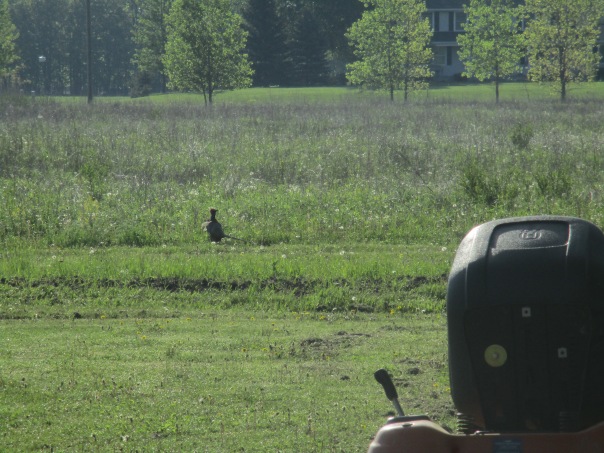
The dandelions have now gone to seed and last week when I was mowing the lawn I was getting bombarded with dandelion seeds. They were flying everywhere and they were stuck to my clothes and in my hair. I told my husband I wouldn’t be surprised if I end up with dandelions growing out of my ears. He thought they would probably grow from my belly button because “you know everyone has a little dirt in their belly button.” LOL!IMG_4106We have been hearing  pheasants a lot on the farm and in the neighboring field and every now and the we get a glimpse of one. We are glad to see them as it had seemed that the pheasant population had all but disappeared over the last thirty or so years.
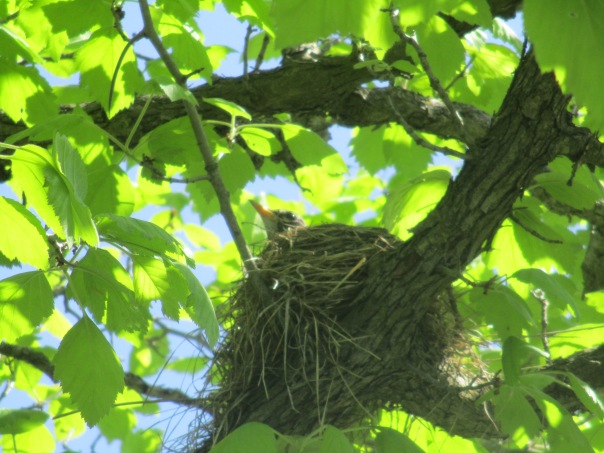
IMG_4102We have spotted many new nests around the farm this spring mostly they have been empty when we looked but one had robin eggs in it and I did spot this momma sitting on hers.
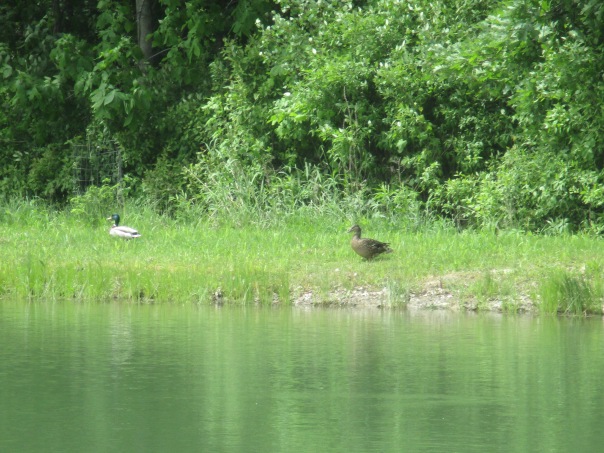
IMG_4127We also have a pair of ducks who have been frequenting the pond this spring. My husband and I agree that we will not be surprised if we find out that they have a nest in the woods next to the pond. I guess we will know if they show up with babies.
IMG_4097This past winter was a bad one for bees in our area. We lost four of our five hives so we bought two more packages and installed them into hives. Since my husband installed them on his own I didn’t get any photos.

The garden has been planted. We have tomatoes, bell peppers, hot peppers, egg plant, potatoes, cabbage, cucumbers, cantaloupe, water melon, lettuce, Swiss chard, celery, basil, parsley, carrots, beets, green beans, corn, winter squash and pumpkins.

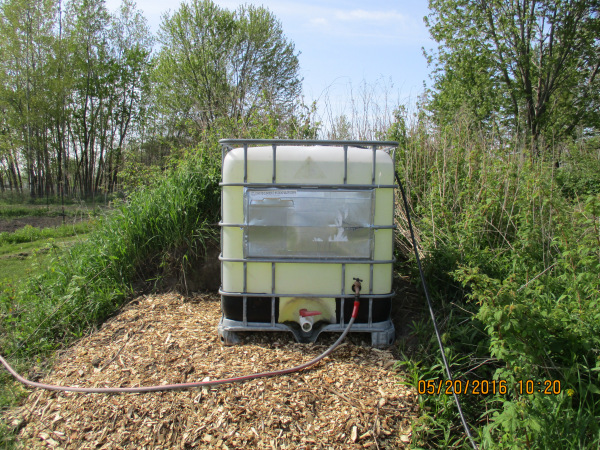
Along with the hot weather came a dry spell – we weren’t really expecting it because the weather forecasters had predicted that we would get rain and storms as the remnants from tropical storm Alberto made it’s way North into our part of the country. Somehow all that rain missed us.
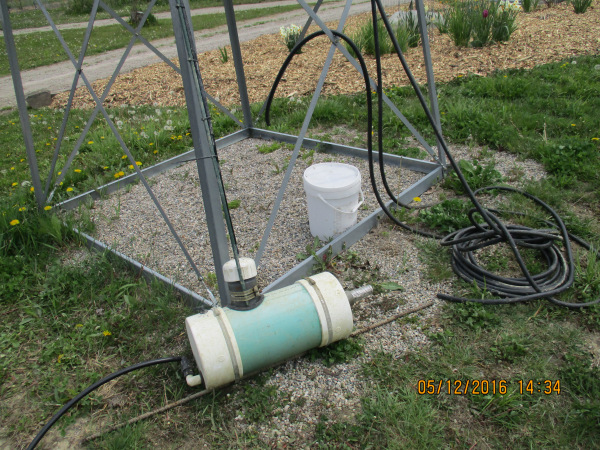
IMG_1233Fortunately my husband had put the pump in the pond and we were able to take advantage of the wind that we had last week to get the tanks filled and keep things watered as we awaited the rain.
IMG_1281

We finally got rain this morning and what a blessing it is. Not only will it give all of our crops the boost that they need right now, and give us a break from watering, it makes pulling weeds much easier. Pulling weeds is one of the thing we have been spending much time doing this past week as weeds were threatening to take over the strawberry patch, the garlic field and the asparagus patch. Pulling weeds out of dry clay soil is next to impossible so that task will go much quicker now.
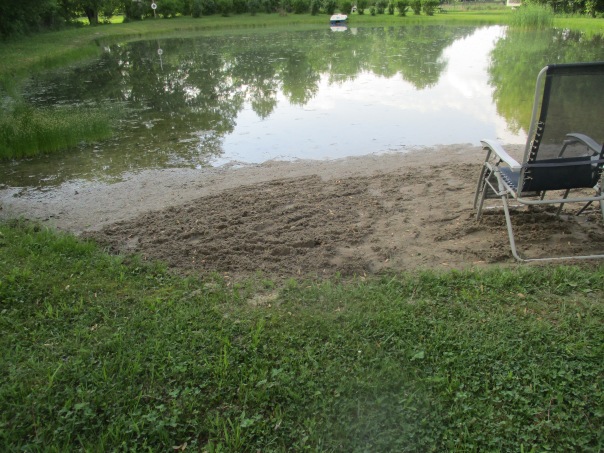
IMG_4124.JPGSince the temperatures were so warm (hot) I did spend some time last Friday raking the beach area. If I have to work on a hot day cleaning the pond is the perfect job. 🙂 After I raked the leaves out of the beach area and used our small rototiller to rough up the sand we set up our beach chairs and umbrella. Woo hoo we are ready for summer!!!

The following day when the sun was high in the sky and temperatures soared, a dip in the pond was a refreshing treat.

Thus far we have picked and eaten and froze lots of asparagus and I picked some rhubarb and put several packages in the freezer as well. When I was freezing the rhubarb I discovered one small package of rhubarb from last year. I decided I needed to use it up. I also found the last of my strawberries from last year – another small package. Since there were only about a cup of each there was not really enough to make this into a pie or crisp, so I decided to make strawberry-rhubarb sauce. I put both the strawberries and the rhubarb in a sauce pan then added a bit of water – maybe a half cup. I wasn’t too worried about having too much because I could cook it off to get the sauce to thicken. I simmered this until the fruit was soft. I then mashed the mixture with a potato masher. I continued cooking it until it was thick and added sugar to taste. I can’t really tell you how much sugar to add because everybody likes a different degree of sweetness and some strawberries are much sweeter than others. I just started with a couple tablespoons and tasted until it was right. While this fruity dessert was good eaten plain, my husband used some as an ice cream topping and I mixed some with some vanilla yogurt as well.

They say that time flies when you’re having fun, and I have always believed that time seems to go faster as I get older, so I think both of these combined explains why it is June already and I feel like I missed Spring. Thanks for sticking with me for this recap.

Just curious – does time seem to be flying by for you as well?

Blueberry Patch Upgrade

If you read my recent post about how we work with nature on the farm you may recall that we have had problems with birds eating our blueberries. Birds have an unfair advantage over us as they can seemingly sit perched on the nearest tree branch or fence post and wait until the berry reaches the perfect degree of ripeness then swoop in and gobble it up. We on the other hand schedule blueberry picking in between all of the other chores that need to be done in a day and it seems if we leave a partially green berry to ripen for one more day the birds get it before we get back.

For the last few years we have used netting over the bushes to keep the birds from eating the fruits of our labor. Our methods have worked to some degree but for various reasons have been less than ideal.

For a couple years we just wrapped each bush with the netting. The problem with this is  that  every time we went to pick berries we had to unwrap each bush then rewrap it after we were finished. As you can imagine this was not very efficient.

IMG_1516

Last year we used a different approach. My husband put wooden stakes around the outside of the blueberry patch and covered the whole patch with netting.

IMG_2957

This was also largely effective, but again less than ideal as in order to pick blueberries we crawled under the net on our hands and knees. With both of these method an occasional bird might get in and steal a few berries, but we were able to harvest most of the berries for our own sustenance and enjoyment.

The netting that we have been using for these projects came in a large roll, maybe 150 feet long by 20 feet wide, (it’s hard to tell because it is stretchy) and was something that my husband found sitting along the roadside at a neighbors house waiting for the trash men to carry it away. He picked it up and brought it home thinking we would probably find some use for it. We have used it over and over for project like this.

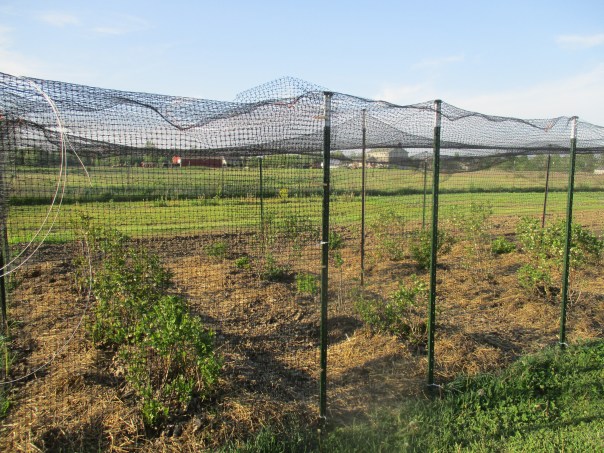
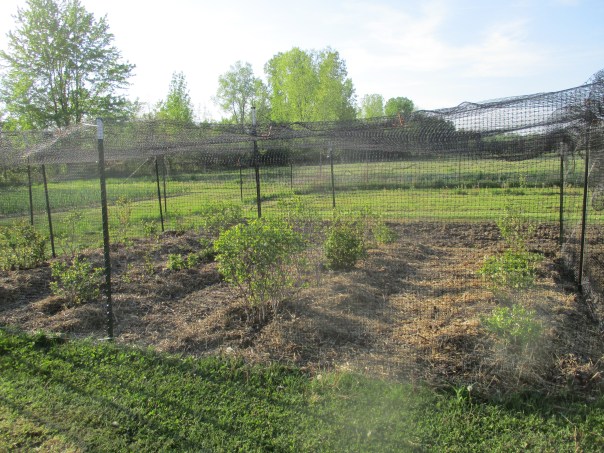
This year we decided it was time to give the blueberry patch an upgrade. We needed a screened, fenced or netted structure to keep birds out but allow us in to pick berries (standing up).

We first thought that we would need to use chicken wire as fencing to get the grid small enough to keep the birds out, but when my husband went to the  farm store he discovered a plastic fence that he thought would work well. This fence had a small grid, was light weight, and more affordable than chicken wire.  He also bought 12 – 7 1/2 foot t-posts. He set the t-posts around the perimeter of the patch with each side having two corner posts and one post midway along the side. On one side he set an additional two posts about three feet apart where we wanted our entrance to be.

The plastic fence was light weight and easy for my husband to manage by himself. He started at the t-post to the left of our entrance he attached the fence to the t-post using zip ties. (They are so very handy.) He then rolled the fence to the left and attached it to the corner post again using zip ties. He continued rolling the fence and attaching it to each t-post until he arrived back at the starting point. The plastic fence fit snuggly and looked very nice. When he was back at the final t-post he cut the fence leaving just a small amount to over lap. Instead of using zip ties to secure it at this point he clipped the fence to itself using clothes pins (also handy to have around). We can now enter the blueberry patch (standing up 🙂 🙂 ) by unclipping the clothes pins and opening up just a three foot section of fence.

IMG_4103

To keep birds from flying in through the top we used the same netting we have been using all along. Before draping the netting over the top my husband placed one taller t-post in the middle of the blueberry patch to keep the net from sagging too much. He also wrapped the tops of the t-posts with duck tape, or maybe it was gorilla tape, I’m not sure, but it was to keep the metal t-post from snagging and ripping the netting.

IMG_4104

Once he had the netting draped over the t-posts and fencing, with at least a few inches of overlap on each side, he tied the netting to the fencing with string. He placed ties  wherever he noticed there might be a gap.

While I won’t be surprised to see a determined bird finds it’s way in now and then, at least we should be able to efficiently and comfortably harvest most of the crop. We will keep this fence up year round and hope that it will last for many years – at least until the blueberry bushes out grow it. 🙂


Chickens Come Home To Roost

The idiom “chickens come home to roost”  may be difficult to understand. It is used to relate the fact that actions will always have a consequence and normally applied in a negative way. https://idioms.thefreedictionary.com/chickens+come+home+to+roost Making a connection between chickens roosting and consequences to your actions can be quite a stretch. In order to make this connection there is one thing that you need to realize – chickens always come home to roost.

I admit this was one of my fears when we first started raising chickens – how are we going to get all on those chickens in the coop every night? Well it really doesn’t take much training for the chickens to learn that the coop is their nighttime home.  If chicks are raised by a hen then the hens does all of the training. When we raise chicks this is what we do – we introduce the chicks to the coop at the farm once they have feathered out, usually around four to six weeks. We set up a small pen near the coop where the chicks can spend their days.   You can read about that here. At night we can then gather them up to put them in the coop. The young chicks huddle together at night usually in one of the nest boxes. We continue this routine for about 5-7 days or until the chicks learn to get into the coop on their own. After that when darkness falls the chicks will naturally go to the coop each night. It will become their safe space.

Eventually they will outgrow the nest box, and the need to huddle together at night, and will spend their nights sleeping perched on a roost within the coop. Our coop has roosts at various heights and the chickens tend to seek out the higher roosts. It is a chicken’s instinct to roost high up at night.

We have been raising chickens on the farm for five years and it has been our experience that with few exceptions the chickens always come home to roost. Exceptions – every rule seems to have them so let me share the exceptions that we have found for this rule.

Why The Chickens Don’t Come Home To Roost:

Each night we do a head (beak) count to assure that all of the chickens have returned and are safely inside the coop. If any are missing we do a search. Occasionally we have discovered that a hen has fallen prey to a wild predator and we have found either a headless body or a pile of feathers.

On other occasions we have found that one or more hen(s) have gotten into one of our fenced garden areas because someone, either intentionally or (oops) unintentionally, left the gate open. If given enough time they will usually find their way back to the gate and out of the garden, but when darkness is closing in their instinct is to head in the direction of their coop (the gate is in the opposite direction) and they keep running into the fence trying to get home. (You may have heard that chickens are stupid.)

One other thing that we have experienced, that is really only a partial exception, is when the a hen decides that rather go into the coop she would rather roost in one of the trees outside the coop for the night. The reason that this is only a partial exception is that we have never had a hen try to roost in a tree elsewhere on the farm. They first return to the coop area, then fly up onto what ever tree branch they can get to. Possibly because the branches are higher than the roosts inside the coop, they think this is a good option. It is not! Some nighttime predators can climb trees and we have lost a couple of hens when we have allowed them to roost in a tree at night.

There is one other scenario that, although we have not experienced it, I think is worth mentioning. It is a broody hen. A hen may lay several (or even a whole bunch of) eggs in a secluded area and when she thinks the time is right will begin to brood (sit on the eggs). She will not leave the nest at night to return to the coop. I have read stories of hens disappearing and then showing up three weeks later with a bunch of chicks. What a surprise that would be.

Now if you were thinking about raising free range chickens but worried about having to play chicken rodeo every night, do not fear – chickens come home to roost.

Thanks for reading. 🙂


Asparagus For Dinner

Dinner is probably the most common time to eat asparagus and it always goes well as a side dish – lightly steamed, roasted, sautéed, grilled, topped with butter, olive oil, sea salt, hollandaise sauce or cheese – even pickled or raw and tossed in a salad – I’m not sure you can go wrong with fresh asparagus. Last week I shared a recipe for using asparagus at breakfast and today I am going to share with you another way I cooked our freshly picked asparagus this week.

Asparagus – Split Pea Soup

If you already have favorite recipe for split pea soup by all means use it – just cut up a big bunch of asparagus and add it to the pot as the soup cooks. If you don’t have a recipe for pea soup here is how I made it. Disclaimer: I usually don’t use exact measures when cooking – I am a pinch of this, shake of that, taste as you go along type of cook.

1 bag of dried split peas

a good size bunch of asparagus

5 or more carrots

1 onion

1 pound of beef smoked sausage

several cloves of fresh minced garlic or two about teaspoons of garlic powder.

about 1/4 teaspoon of black pepper

add salt later if needed – the smoked sausage will add some salt and you don’t want to get to much

I always soak the peas in water over night. The next morning I drain the peas and put them in the crockpot. Add enough water to just cover the peas. I then cut up the asparagus, carrots, onion, and sausage and put them in the crockpot. I add the garlic and black pepper and put the lid on. I start it out on high for at least an hour to build up the heat. Then I turn it to low and let it cook. After a few more hours I check to see if the peas have become mushy. (At this point you can also taste it to see if it needs more salt or pepper and add them as needed.) If the peas are still hard I put the lid on tightly and turn it back up to high for another hour or so. Once peas have become mushy I leave the lid partially covering the pot so any excess water can cook off and the soup will thicken. If at any point the soup is too think just add some more water. When the soup is the desired consistency dish yourself up a bowl and enjoy!!! 🙂

I almost forgot – the first time I made this I put it all in a cast iron Dutch oven and cooked over an open fire at the farm. It does make a nice campfire dinner.

Raising Chicks – Stage Three

The chicks, at four weeks old, were quickly out growing their stage two brooder so we began transitioning them to the chicken yard.

IMG_3932

The gradual transition serves several purposes. It allows the older birds to get used to the young ones; it allows the chicks to become familiar with their new environment; and they have the warmth provided by the heat lamp in the stage two brooder while the nights are still cold.

IMG_3920

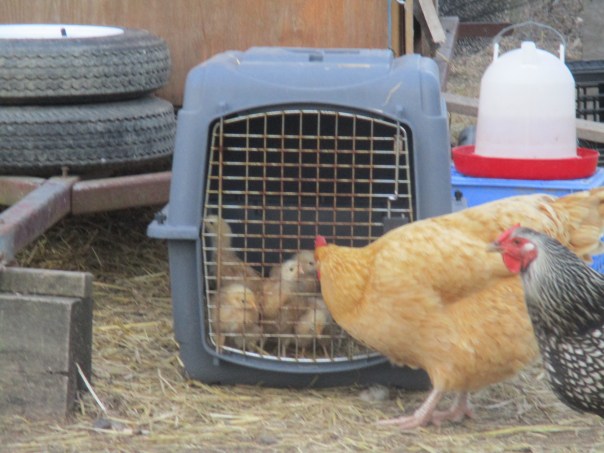
We set up a temporary enclosure within the chicken yard, near the coop. We use 4 t-posts and about 30 feet of 2 foot tall chicken wire. We also place netting over the top to deter overhead predators.

IMG_3919

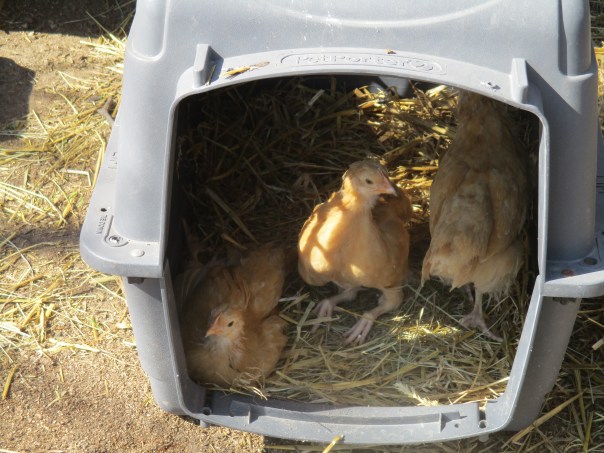
The spot offers both shade and sufficient sunshine, at least this time of year before the trees get their leaves. The wooden box provides shelter if they need it and the crate is used to transport the chicks to and fro.

Each day for about a week the chicks were taken out to this play yard to spend their day pecking and scratching and doing what chickens do, and each night they return to their stage two brooder.

After a few days we began letting them out of their enclosure when we were in the area. They love this freedom and it is so funny to watch them run at full (chick) speed with wings flapping or crane their neck and jump to catch a bug in mid air.

IMG_4047

Last week, when the chicks were about 5 weeks old and nicely feathered out, they began spending their nights in the coop.  They have yet to find their way into the coop at night. Instead they find their way to the crate then we put them in the coop. We will begin training them to go in on their own soon.

IMG_4050

We have left the outside enclosure up  for now and make sure the chicks are inside when we are not around. When we are there we allow them to free range, but they have yet to venture far outside the chicken yard.

IMG_4052

Once the buds on the hickory trees become leaves we will take down the enclosure because the leaves in the densely treed area will provide a canopy to help hide the chicks from the view of over head predators.

We really are enjoying raising this batch of Buff Orpington and Black Austrolorp chicks. They are very friendly and I would recommend these breeds for anyone considering raising chickens.

Thnaks for visiting. 🙂