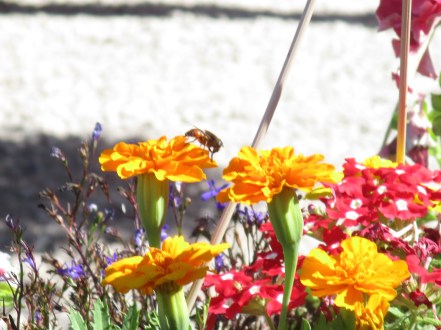
In the origin Part II of this series, which was written in 2016, I wrote about planting 4 Basswood trees with the intention that they would grow and the blossoms would provide food for the bees. Despite our best efforts the trees did not do well and to date only two of the trees are struggling to survive.
I first thought I would just skip Part II and repost Part III in the series. Instead I decided to share my thoughts on a subject has been identified as contributing to the decline in bees/pollinators.
You have probably heard that insecticides, more specifically neonicotinoids, are thought to be partly to blame for the decline in bee/pollinator populations. It would the stand to reason that if our goal is to help save the bees then we should try to avoid use of these chemicals.
Repel Bugs Instead Of Poison Them
Here are a couple of ways to do that. The first is companion planting – that means to plant different types of plants together that support each other’s health and well being. This companion planting guide provides a chart that includes what plants will repel specific insect away from other plants which are susceptible.
The second is this homemade garden bug spray. Like companion planting this spray acts to repel insects rather than kill them. In the past we have tried various recipes for bug sprays – some work some don’t. Last year when I saw this recipe on 5 Acres and A Dream , a homesteading blog that I follow, I decided to try it. Two things that inspired me to try this recipe were first that it was easy to make with simple ingredients – mint, garlic, cayenne and a few drops of biosafe dish soap (see link for complete recipe). The second was Leigh’s (author of 5 Acres and A Dream) testimony that it worked for her. I am not sure of all the bugs that it is effective against but in our experience it worked well against aphids and some other, unidentified, bugs. Leigh says it saved her cabbage and basil plants from whatever was eating them.
Know What You Are Buying
The other thing regarding insecticides that I wanted to bring to your attention, for those who might be purchasing plants from a greenhouse or garden center, is that the plants may have already been treated with neonicotinoids. Since it is not required that treated plants be labeled as such, it is best to ask if they have. While I generally promote shopping local and supporting small businesses, it is probably worth mentioning that two large retailers in the USA, Home Depot and Lowe’s, had planned to stop selling treated plants by 2018-2019. According to this article Home Depot seems to have largely followed through with their plan. (I have not yet been able to find evidence that Lowe’s has done so.)
Of course there is always the option of starting your own plants from seed rather than buying plants and that is what we plan to do more of this year.
Have you ever done companion planting? Do you have any tried and true methods for repelling insects?
Thanks for reading and be on the look out for Part III of this series (Planting For Bees).
This post was originally published in 2016 and again in 2018 but since I have many new followers since it was last posted I thought it was worth repeating. Thanks for reading.
Recently someone sent me an email which contained this picture. Her comment was, “I thought this was interesting”. Since she thought it was interesting I thought other readers might think so as well.
This is the time of year when people start itching to get outside and beautify their yards, so it’s the perfect time to write about it. While I think the photo (above) is good, I’d like to offer some other thoughts, ideas and links for reference.
It you have access to pretty much any media source you have probably heard in recent years about the honey bees being in danger. There have been countless stories of mysterious bee die-offs and colony collapse disorder. When we tell people that we are bee keepers, we often get comments about the bees disappearing and people seem to have varying degrees of knowledge on the topic. Disturbing as it is, I won’t go into my thoughts on the many causes of this, but instead focus on what individuals can do to, as the above photo says, “Help Save The Bees”. I have found this website to be a good resource https://savebees.org/ if you want to know more about the topic.
I think it is important to note that it is not only the honey bees that are in danger. The honey bee is the one we most often think of and are probably most concerned with because we humans have become managers of the honey bee. We put them in homes (hives), where we want them, and feed or medicate them when we feel it is necessary. We then utilize their services for pollenating our crops and we rob them of their products (honey, wax, pollen, propolis) for our consumption. Other bee types, each with their own attributes, are disappearing as well. Even though we don’t get honey or other products from them these other bees, wasps, and hornets they still play important roles in nature, doing things like pollinating plants and helping control insect populations by feeding on insects and caterpillars.
I do think that rather than sit on our hands and wait years for the government to come up with a plan and then spend millions of dollars on it, that most of us have the power to do some little things that can make a difference.
In addition to the message in the above picture, I’ll offer the following suggestions:
#1. Do Nothing – I’m not trying to confuse you when I say that the first action that should be considered, and is quite appropriate in many situations, is to do nothing. What I mean is let nature take its course. We often see bees, hornets and wasps as dangerous and feel the need to exterminate them from our space, so when we find a nest we are quick to seek ways to get rid of it. Sometimes, they do indeed, build nests in buildings, or equipment, or other places where they just can’t stay, so it is necessary to get rid of them. Other times it may be possible to allow them to stay.
Last year, for example, we discovered a bald faced hornets nest in the tree in front of our house. The nest was about 12 feet up and hung over the street. It was also near my parking place in the driveway. My first thought was that it was dangerous for whoever cut the grass, it was also potentially dangerous for people riding bikes or walking under that tree, I wondered if they would become disturbed by my entering and exiting my vehicle, and heaven forbid some kids should decide to play ball in the street and hit that nest. My husband and I talked about it and decided that if these hornets became aggressive we would then remove the nest. These hornets visited our deck daily but I only saw one or two at a time. They would fly around but never attempted to sting. I did observe them eating other insects. They never seemed disturbed by the grass being cut or our being in the area of their nest. We were able to peacefully coexist and I feel good about our decision to let them stay. If at all possible give bees, wasps and hornets their (or a piece of your) space.
#2 Do Nothing – Another way to do nothing, or let nature take its course, is to let wild flowers grow and blossom, thus providing food for the bees. Unfortunately we have come to think of many of the blossoms that the bees feed on as unsightly weeds. In our area bees forage on the dandelions and clover in our lawns and in addition they forage on things like golden rod, asters, thistle blossoms and many other (weeds) that grow in fields and along ditches. So instead of cutting , pulling or using herbicides to eradicate these weeds, we can decide to “do nothing”. Enjoy seeing the dandelions blossom in your yard or the thistle and golden rod take over a field or the side of the ditch and know they are a beautiful source of food for the bees.
I also want to share my thoughts about planting for the bees but have decided to do that in a separate post, so stay tuned.
Perhaps this post should be sub-titled “The Good, The Bad and The Ugly” because we have seen a bit of each this winter.
Chickens
The chickens mostly fall in good category. Egg production slowed down in late November as usual and we were only getting 2-4 eggs a day, but as the hours of daylight have been getting longer egg production has been gradually increasing. We are now gathering between 7-10 eggs a day. We had more than enough eggs for us, so we didn’t have to buy any this winter. The lack of snow this winter has made the chickens happy because they tend to stay inside when there is snow on the ground.
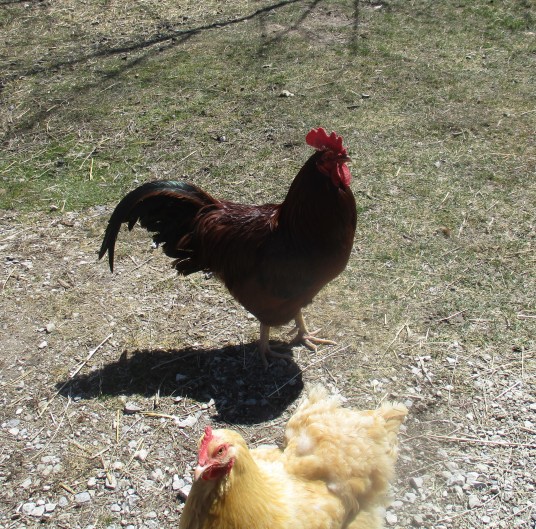
The bad, or at least sad, part is that our rooster died on Thanksgiving. He was one of three birds left from our first batch of chicks we got in 2013. Toward the end of summer we noticed that old age seemed to be catching up to him, so we were not surprised by his death. So far the flock seems to be doing well without him. I was never especially close to Cocky because he seemed to feel that he had to protect his flock from me. I did learn, after being spurred in the leg by him a couple times, not to turn my back on him. We sparred many times over the years, but I did respect him as protector of our flock. While I don’t miss having to look over my should when I’m in or around the chicken yard, I do miss hearing his Cock-a-doodle-do’s.
Cocky and Honey
Bees
Bees fall into the UGLY category. At the end of summer we had eight hives most of which seemed to be thriving. Over fall and winter we have lost all of them. We are baffled as to why the bees are dying. Every hive has had lots of honey in it, the hives have top ventilation to prevent moisture build up and our winter temps haven’t even been that cold so it doesn’t make sense that they are freezing to death. Some even died before temperatures got cold.
It is sad and it is frustrating to have so many losses, but we have decided not to give up yet. We have ordered three more packages of bees to arrive in May so we can try, try again.
Garlic
At this time it seems that the garlic falls into the good category. The new location seems to be good since despite lots of rain and snow melt we have not had any flooding in that area.
The main reason that I am including garlic in this update is because several readers were interested in knowing how the weed guard that we used when planting the garlic worked out. (You can read about it here.) Unfortunately it did not work out as we hoped it would. All was well until after the first big snow storm in early November. We then had a warm up, and as the snow melted, the weed guard became saturated. Then we began seeing rips in it. It seems the wind was getting under the exposed edges and ripping the wet paper. It became so tore up that we ended up removing it completely and mulching the garlic with straw before the ground froze.
If we use this product in the future we now understand it is important to make sure all of the edges are secured – perhaps by burying them in the soil.
Hoop House
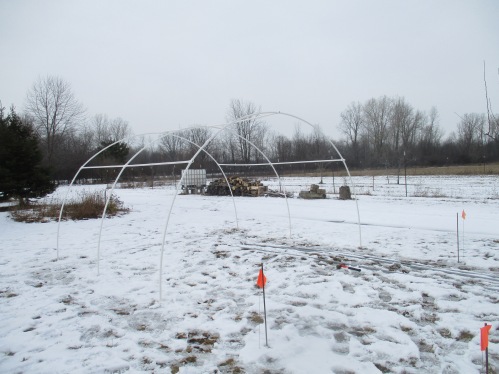
This is another one for the good column. This new addition is currently under construction. It has come a lot farther since this photo was taken last week. Our plan is to have it ready so we can start our garden plants in it this spring. I plan to write a post on it’s design and construction once it is complete and will likely write about it’s uses in the future as well.
The Boys
The boy’s also fall into the good category. Most of our time at the farm this winter has been spent with the boys, more specifically training Ranger. This pup has so much energy that it is important that he get out and use it up. We have found that he requires a minimum of two hours a day outside, but on most day it’s three or more hours of walking, running and hunting.
We have been using a training collar that has three settings – a beep, a vibrate, and a shock. The collar, along with voice commands, is working well with training him to stay on our property, but it is going to take a lot more training and time before he can be trusted not to leave the farm. Beagles have a strong hunting instinct and if they pick up the scent of a rabbit or other small animal (there are many on our farm) it is difficult to call them off.
We are not hunters so we will not be training to hunt rabbits or squirrels.
He and Trooper do enjoy hunting for field mice together. This is something that Scout and Trooper would do for hours at a time and we are happy that Ranger has become Trooper’s new hunting buddy.
Watching the boys hunt mice can get a bit boring, but it is interesting to observe how they work together.
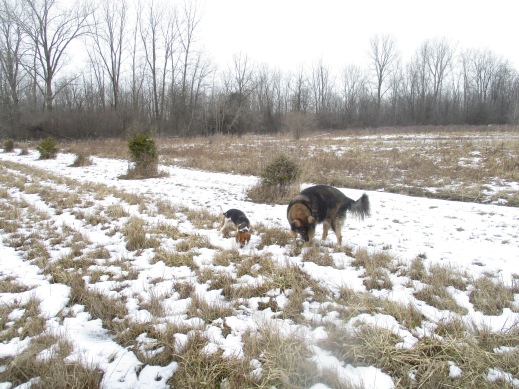
Trooper who is mostly a watch dog uses both his nose and eyes for hunting.
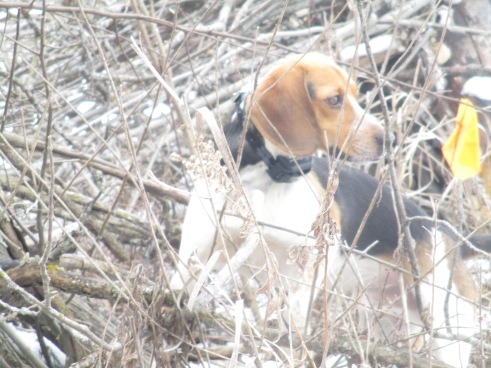
Ranger, who is a hunting dog, primarily uses his nose.
So while Ranger has his nose buried in the dirt trying to sniff out his prey Trooper might capture it as he sees it trying to escape.
Now what do I do with it?
After consulting with our vet we did have the boys immunized against diseases that they could catch from mice.
I think it is largely as a result of all this outdoor activity that Ranger has become such a great house dog. While at home is is content to settle into his or our bed for a nap, or he might seek out a little cuddle time from one of us. If he does get bored he will find a rawhide to chew on or bring his ball for a game of catch. He does however let us know when it’s time to get out a expend some of the built up energy.
A couple of weeks ago we decided to put him to the test. We needed to go grocery shopping so thought we would see how well he would behave if we left him out of his crate for a couple hours while we were away. Our strategy was to make sure he was tired out first, so my husband took the boys to the farm for about an hour before we went shopping. Before we left for shopping we also made sure that some of the things that might be tempting to a puppy (shoes, slippers, books) were out of his reach.
We were so happy when we returned home and found the house in the same condition that we left it in. The Boy’s, especially Ranger, were rewarded with lot’s of “good boy’s” and another nice long walk (run, play, hunt) at the farm. We have since left him on three more occasions and have come returned home each time to find that he was a “Good Boy”. 🙂 It may be time to get rid of the crate.
It’s hard to believe that autumn is here. I just wanted to hold on to summer – perhaps indefinitely. Since it is humanly impossible to stop time, the best I can do is hold onto and treasure the memories that Summer 2019 gifted me. I have decided to place some of these precious memories in this post where, like keepsakes in a trinket box, they will be safely stored and I can return to them whenever I like. I will also share them with you.
At The Farm
In early August I used my hours at the farm for picking blueberries, watering plants, and mostly weeding the prayer garden (this is the time of year that weeds really start to take over if they are not kept in check).
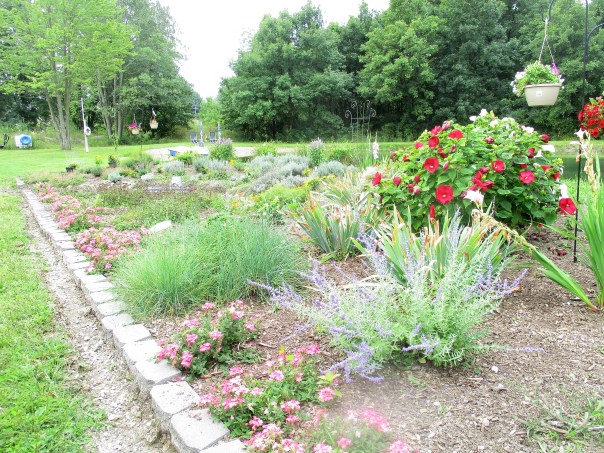
I had mentioned in one of my earlier posts that the prayer garden was in full bloom. My husband said he wanted to correct that statement but didn’t. He is right of course – by design the prayer garden is in continuous bloom, from early spring, when the daffodils appear, until late fall, or at least until we get the first frost of the season there is always something blossoming.
By mid August my chore list had changed. We had some decent rain so we didn’t have to do much watering. We began picking tomatoes and peppers and I began cleaning our 2019 garlic crop.
For the past four weeks or so the focus has been on harvesting our garden and either cooking and eating or preserving the harvest. While most of the tomatoes have been frozen so far, I did manage to get 15 quarts of tomato sauce canned. We have been enjoying fresh red skin potatoes (boiled or made into potato salad), Swiss chard (sautéed with garlic, cooked into an omelet or added to a cream cheese stuffed chicken breast), baked butter nut squash, tomatoes (fresh on the side, on a sandwich, or cooked into homemade pasta sauce) and stuffed green peppers. I also cut up three small cabbages and started the process of turning them into sauerkraut. This is the time of year that all of the work pays off.
The Bees
Busy, busy, busy.
We have eight healthy hives right now and our son-in-laws hive is thriving as well.
We have harvested honey three times this summer from three different hives. Each harvest yielded approximately 30 lbs. of honey. After we harvest the honey and wax from the frames my husband sets the frames back out for the bees to finish cleaning them up. The picture above shows the bees completing this task.
A few weeks ago one of the hives swarmed. My husband captured the swarm and put it in an empty hive. He then placed a feeder with honey in it on top. The next day the bees had left that hive. We are not sure why they weren’t happy there but they did fill up on the honey before leaving.
The Chickens
The eight Jersey Giants that were cute little chicks this spring are now full grown hens. They began laying in eggs in August and will hopefully keep us in fresh eggs through the winter months.
Soap Making
Normally I don’t make a lot of soap during the summer months but I found I was out of a few varieties. I decided to have some fun with it.
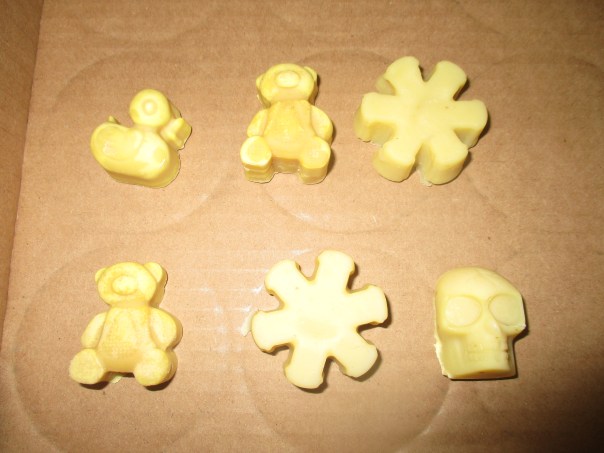
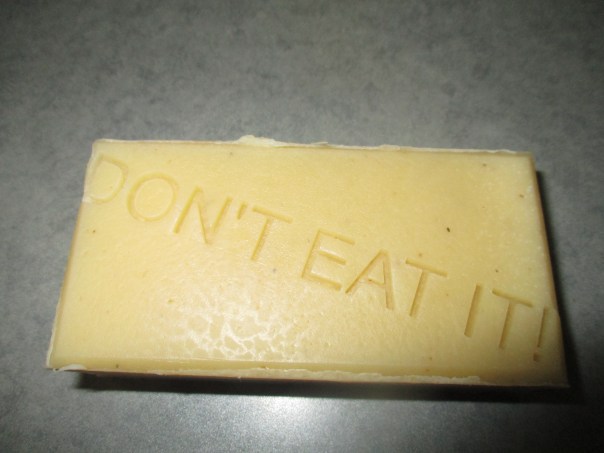
My sister had given me some silicone mini molds so I made a few small bars using them. I can see making holiday themed sample soaps or using teddy bears or duckies as favors for a baby shower. They would however need to be clearly labeled “Don’t Eat It!” as I would want someone thinking they were white chocolate.
I have also been practicing using my soap stamp and getting better at it. It’s really a matter of stamping the soap when it is still just a little soft.
Family and Fun
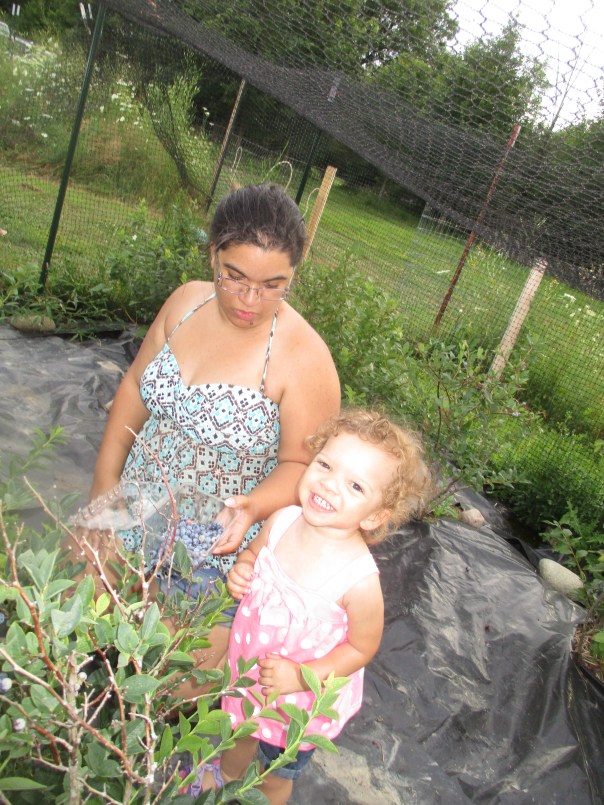
In early August we planned a family picnic at the farm. Not all of the girls could make it but Tina and Ken brought our grandkids and Kara also came out. After we ate, our three year old grandson, Jackson, went fishing with his dad and grandpa and caught his first fish. I didn’t get any pictures of this because Tina and Kara and I had taken (granddaughter) Addy to pick blueberries.
Not only did Addy enjoy picking the berries she enjoyed eating them as well. The cutest part was that each time Addy, who is learning to talk, picked a berry she would say appo (apple). The first time she said it we thought it was so cute we laughed before telling her “berry”. So after that each time she picked a berry she would say “appo” and laugh then when we told her berry she would say “ber-ry”. Her laugh was so contagious that we were all laughing each time she said “appo”.
In August my husband and I went plant shopping. Normally I don’t like shopping. The exceptions are going to a greenhouse or nursey and shopping for yarn or other craft supplies. Each spring we usually go to a local green house and pick up a least a few plants for the year but it’s quite easy for me to get carried away and buy way more plants than I need.
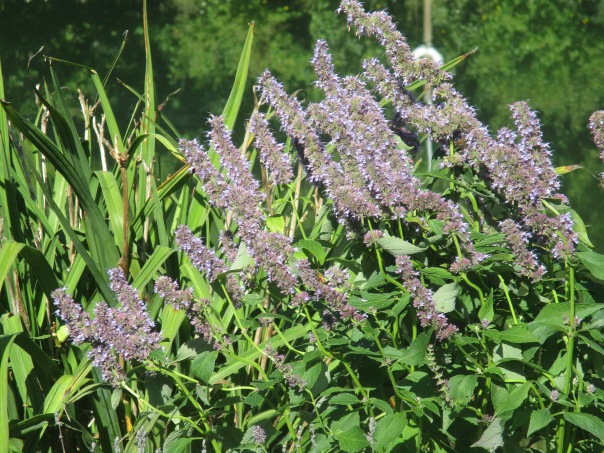
You may remember from this post that my husband was working at a greenhouse this spring and was able to bring home many plants that would have otherwise ended up in the dumpster. With all the free flowers we had there was no need to go plant shopping…until August. While working the landscaping job that he started in July my husband had to make a trip to a nursery where they purchased anise hyssop plants that would be planted at one of the jobsites. “They had pretty purple flowers and the bees were all over them,” he said as he told me about the plants. I knew this herb had some medicinal properties and if the bees like it then we should definitely plants some.
I did a little homework and found that anise hyssop is generally a plant the deer avoid because of it’s strong fragrance. This sounded like the perfect addition to our prayer garden.
We purchased two large plants that were in full bloom and two smaller (less expensive) plants that should continue to grow each year until they are about a foot wide. I understand that these plants also drop seeds each year that will readily sprout into new plants. These plants are still blooming more than a month after we planted them and I saw bees foraging in them yesterday. 🙂
As we were walking through the green house I noticed a table full of flowers that I was not familiar with. They had bright orange and yellow flowers. They were marked $5 each. After asking an employee if the deer would eat them and being assured that it was not likely, I picked out two yellow and one orange. (There I go getting carried away.) The plant is called lantana. It wasn’t until we got them home that we realized that they are an annual so will not be coming back next year. 😦
We took a Sunday off in August to visit the Armada Fair and watch the tractor pulls.
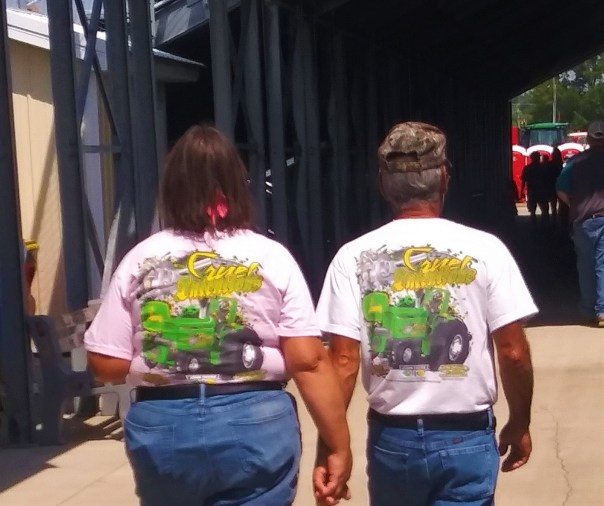
My husband and I wore our matching tractor pull t-shirts so my daughter snapped a photo of us. We were joined by daughters Kara and Lindell and Lindell’s boyfriend Brysen. We arrived early enough to walk through the animal barns and view the exhibits before the tractor pulls began. I’m not sure which is cuter baby goats or baby cows. I love seeing them both.
We also filled up on lots of expensive fair food. I wonder which was higher the calorie count or the price.
For those of you who, like Brysen, have never seen a tractor pull, let me sum it up. Basically tractor pulling is a competition to see who’s tractor can pull a weighted sled the farthest. If you would like a little more information see this article.
This tractor, named Cruel Intentions, is owned by the Capozzo family. They also own and operate the excavating company that dug our pond. This is the tractor we were rooting for that day and they did take first place in their class.
After the tractors were finished they brought in a couple of semi’s that did an exhibition pull.
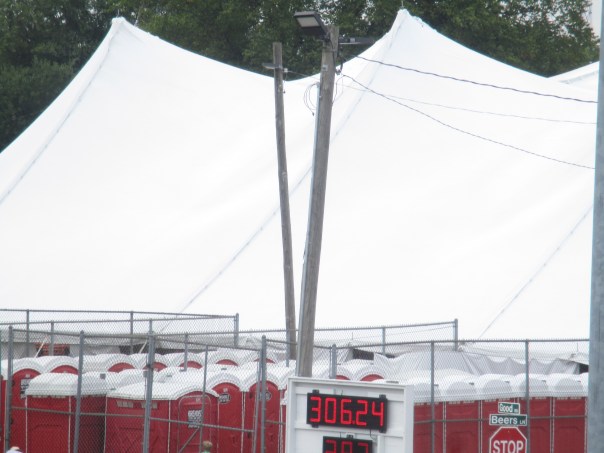
In the photo below I was trying to get a shot of the score board that electronically records each tractor’s speed and the distance they pull but my aim was a little high.
After viewing this photo I did spot something I hadn’t noticed before. The street signs to the right of the score board mark the intersection that leads to the adult beverage tent. If you can’t make out the signs they say “Good RD” and ” Beers LN”. That made me chuckle.
The beverage tent was the other place we visited at the fair and while I mostly stuck with non alcoholic beverages that day I did end up drinking a glass of hard cider when Lindell ended up with an extra one.
Lindell, Me, Kara
Even though autumn has arrived, and the temperatures have been slowly cooling, we are forecast to have at least one more of summer-like day today and I will happily take all that we can get.
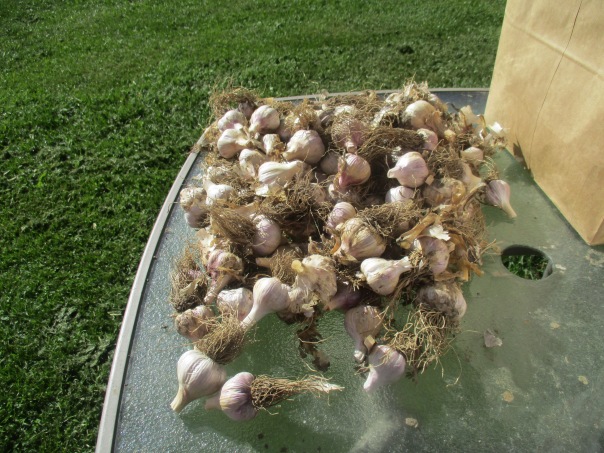
My plan this morning was to clean garlic. There were about 150 bulbs that I wanted to get done. I figured it would take me about an hour to complete this task so I also took some time to enjoy the day. Would you like to join me?
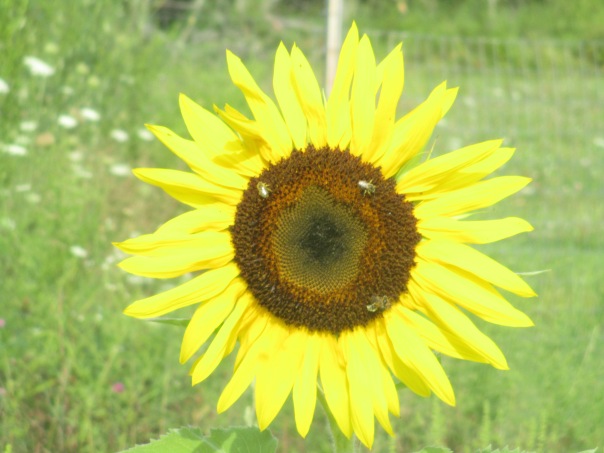
As I walked past the garden I was greeted by this sunflower. I wonder, is it possible to look at a sunflower and not smile? As you can tell I was not the only one happy to see this flower. The honey bees were all over it.
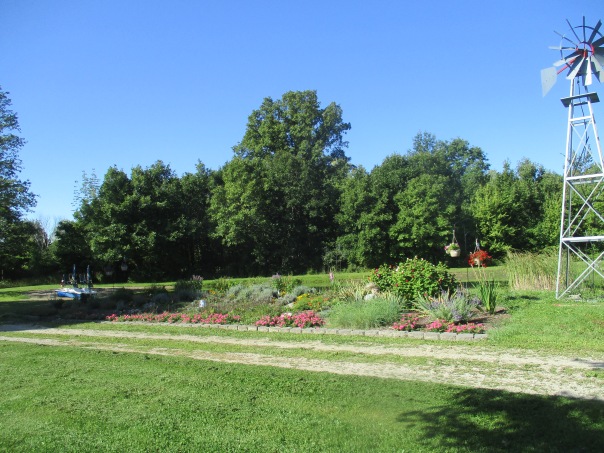
This was the view from were I was working. Nothing but blue sky and sunshine this morning.
While walking through the prayer garden I discovered that the honey bees were also foraging the anise hyssop. This is a recent addition to the prayer garden and was largely added for the benefit of the bees. I only see one bee in this picture, but I assure you there were more that the camera did not capture.
My husband discovered that bees like this plant while working at his landscaping job. They had to go to a greenhouse to purchase some anise hyssop plants for a job they were doing, and he said the bees were all over the plants. A couple weeks later he took me to that greenhouse to purchase some for our farm.
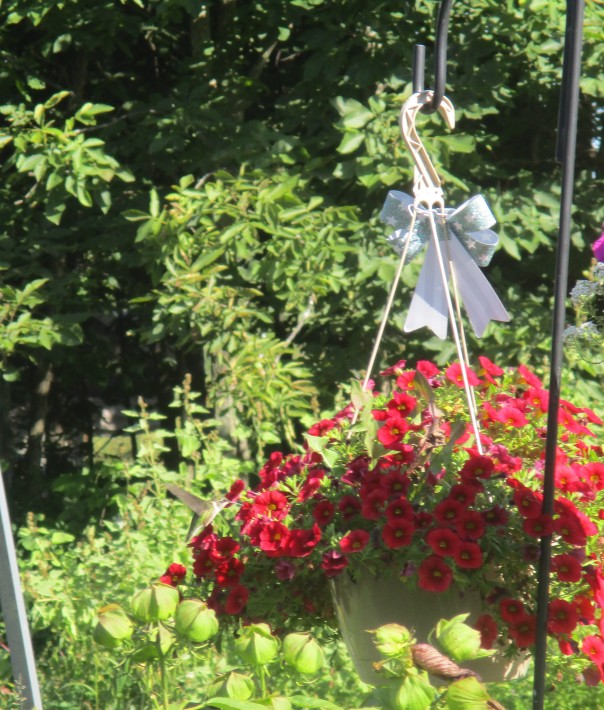
Another visitor to the prayer garden this morning was this Hummingbird, searching for nectar in the hanging plants.
It is a bit camouflaged by the green plants in the background. Do you see it just left of center?
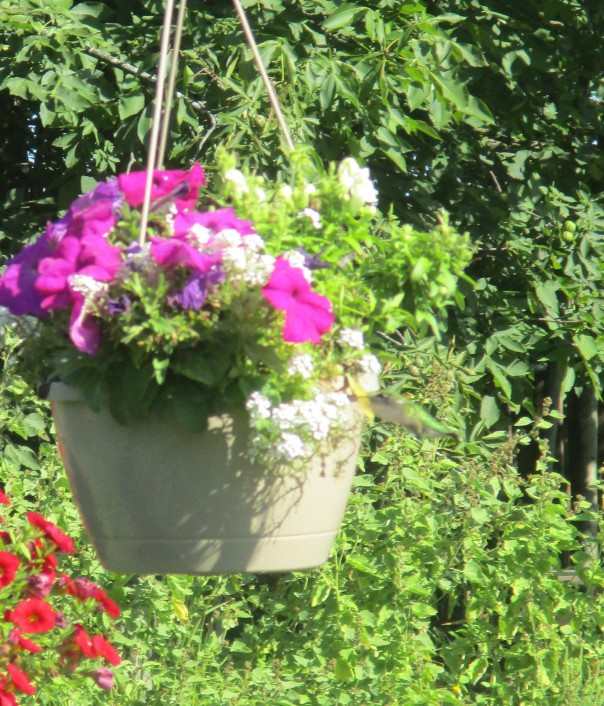
It is now to the right of this basket.
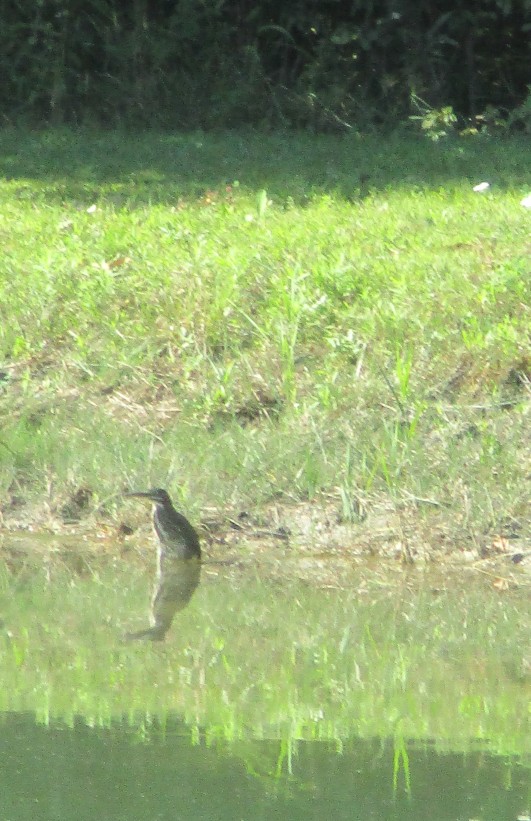
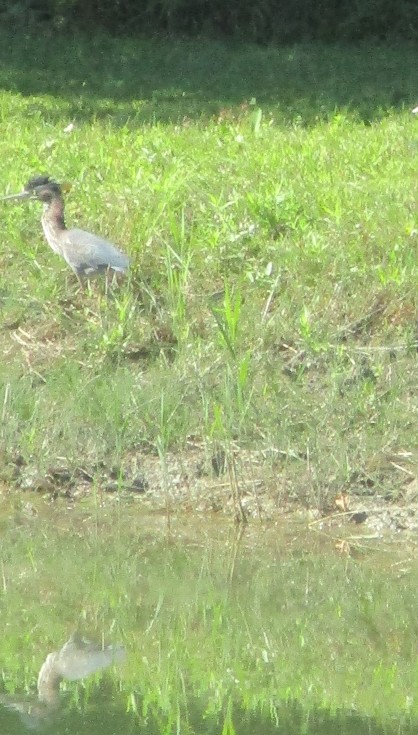
In recent weeks we have seen the return of an annual visitor. For at least the past 5 years we have seen this bird (or one like it) in and around our pond in the late summer. I am assuming it is the same bird and although we usually see just one at a time on rare occasions we will see two.
Since it was not a bird I was familiar with and was unable to positively identify it through our bird books or internet searches, in 2016 I turned to my blog readers for help through this post. While the answer did not come through the post comments, I learned that our bird was a Green Herron.
He or she is a quiet bird and blends well into the grasses that surround the pond.
Can you believe this is the same bird? It’s appearance certainly changes as it makes a quick getaway.
Before noon I return to the house with that batch of garlic cleaned.
September 6, 2019
Though there was rain in the forecast I was hopeful it would hold off and I could finish up cleaning the last batch (about 100 bulbs) of garlic.
The sky was gray and the sun was hidden. Before getting started I took in some of the surroundings.
Maple leaves are indicating that Fall is not far off.
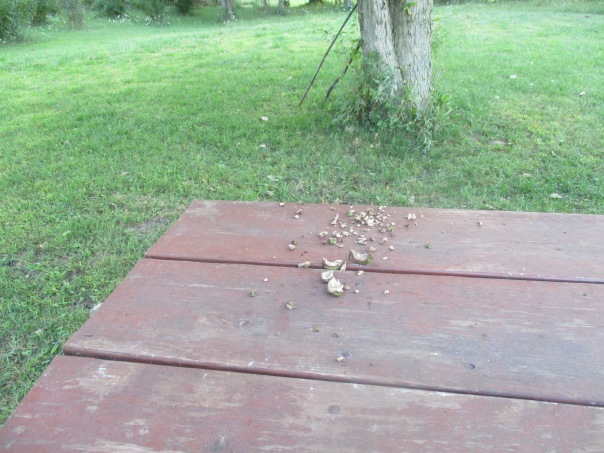
Squirrels have been collecting nuts.
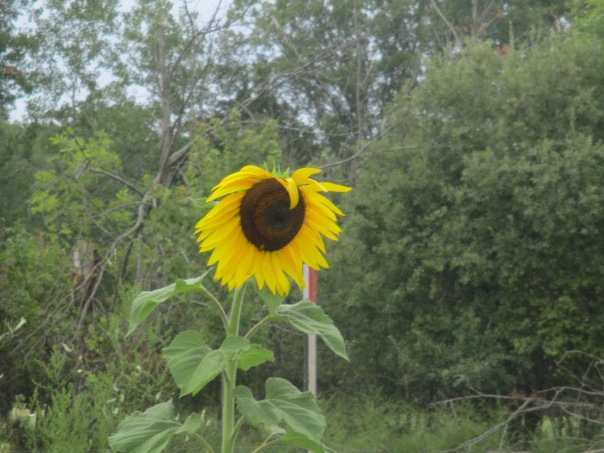
This sunflower with a fancy hairdo.
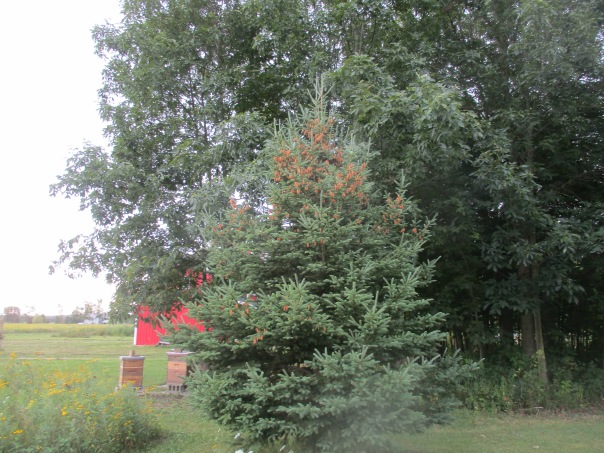
The Norway Spruce that is loaded with pinecones.
With the threat of rain it was not a good morning for cleaning garlic so my plan B was to work in the prayer garden.
As I brought out my garden tools the rain began.
Perhaps plan C, canning tomatoes, is a better job for today.
Thanks for joining me. Are you seeing signs of Fall in your area?
 In the origin Part II of this series, which was written in 2016, I wrote about planting 4 Basswood trees with the intention that they would grow and the blossoms would provide food for the bees. Despite our best efforts the trees did not do well and to date only two of the trees are struggling to survive.
 Ranger, who is a hunting dog, primarily uses his nose.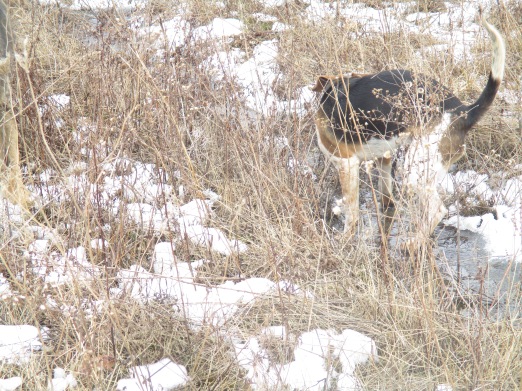









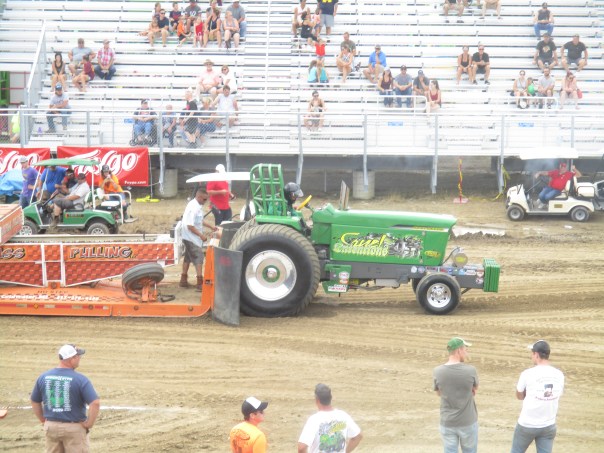 This tractor, named Cruel Intentions, is owned by the Capozzo family. They also own and operate the excavating company that dug our pond. This is the tractor we were rooting for that day and they did take first place in their class.